Markets, Planning, or Something in Between?
Everyone plans. The question is whose plan.
Start Here: Everyone Plans
A family sits down in January and plans the year: rent, a used car, saving for a child’s tuition. A small contractor plans which jobs to bid on and how many workers to hire. Walmart plans which products go to which of its stores, down to the day. Planning is everywhere in a market economy. People who make plans also change them when prices move, when a better offer appears, or when they learn something new.
Now picture a different kind of plan. In 1928 the Soviet Union adopted its First Five-Year Plan, which called for rapid industrialization and a drastic cut in private business. A central board called Gosplan turned the goals of the Communist Party into specific targets for the whole country: how much steel, how many tractors, how much grain. It is the same word, “plan,” but a very different thing. One is a plan you choose for yourself and can change. The other is one plan for everyone, set by the state.
Friedrich Hayek, who later won the Nobel Prize in economics, put the point this way in 1945:
Real economies don’t sort neatly into two boxes. Most mix markets and government in different ways, so it helps to ask three separate questions about any economy:
The answers don’t line up on one left-right line. A country can have state-owned giants and market prices, or open markets and little political freedom. This reading follows three steps. Measure It sets out the words and places real countries on the three questions. Explain It asks why systems perform so differently, starting with what a planner would need to know. Weigh It turns to the values behind the choice of a mix. Earlier readings on trade, on who should decide, and on profits and losses introduced the ideas used here; this one puts them to work on whole economies.
Measure It: What Are We Comparing?
1 The words
People argue past each other when they use the same words for different things. These are the terms this reading uses:
- Market economy. Most firms are privately owned, and prices set in markets guide what gets produced. Government sets rules, enforces contracts, taxes, and provides some services.
- Central planning. The state owns most firms and farms, and a central authority sets what to produce, how, and for whom. Prices are set by the planners, not by buyers and sellers.
- Market socialism. Firms are owned by workers or the public, but they buy and sell in markets.
- Social democracy. A market economy with high taxes and a large welfare state that pays for health care, pensions, and other benefits.
- State capitalism. The state acts as an owner and investor inside a market economy. In the words of Britannica, the state “functions in a manner akin to a business enterprise,” with decisions “driven by its political goals.” State-owned firms control more than 70 percent of the world’s oil and gas reserves. The term came back into wide use after the 2008 financial crisis.
China shows how these can combine. Economist Yong Wang, in a study published by the U.S. International Trade Commission, describes state-owned firms that hold monopolies in “upstream” industries such as energy, telecommunications, and banking, while “downstream” industries that sell to consumers are open to private competition.
2 Measuring economic freedom
Two widely used indexes try to measure how much an economy relies on markets. The Fraser Institute’s Economic Freedom of the World report scores countries on the size of government, the rule of law and property rights, sound money, freedom to trade with other countries, and regulation. The Heritage Foundation’s Index of Economic Freedom measures similar things. Both come from market-oriented research institutes, which is worth knowing when you read them.
In the 2025 Fraser report, with data for 2023, the top ten were Hong Kong, Singapore, New Zealand, Switzerland, the United States, Ireland, Australia and Taiwan (tied), Denmark, and the Netherlands. Venezuela was among the bottom ten. In Heritage’s 2025 index, Singapore ranked first.
Read the indexes with care. A survey of the research by Jakob de Haan, Susanna Lundström, and Jan-Egbert Sturm found that how an index weights its parts can change the results, and that a link between economic freedom and growth does not by itself show which causes which. Rich countries may find it easier to afford secure property rights and stable money. The indexes are a useful first look, not a final verdict.
3 The map
The table places seven economies on the three questions. Notice how often the answers split.
| Economy | Who owns the big firms? | What directs resources? | Political freedom (Freedom House, 2026) |
|---|---|---|---|
| Soviet Union, 1980s | The state owned nearly all firms and farms. | Gosplan set national plans and output targets; the state set prices. | One-party state; no free elections or free press. |
| China today | State firms dominate upstream industries such as energy, telecommunications, and banking; private firms compete downstream. | Mostly market prices, with the state steering key industries. | Not Free (9 of 100). |
| Singapore | Temasek, owned by the Minister for Finance, holds a portfolio of S$518 billion; 75.7 percent of residents live in public housing flats. | Market prices and open trade; 1st in Heritage 2025 and 2nd in Fraser 2025. | Partly Free (48 of 100). |
| United Arab Emirates | Large state investment funds; Abu Dhabi’s largest manages about $1.13 trillion. | Market prices; 23rd in Heritage 2025. Nearly 90 percent of residents are foreign workers. | Not Free (18 of 100). |
| Denmark | Mostly private firms. | Market prices; top ten in Fraser 2025. Taxes equal 45.2 percent of GDP, the highest in the OECD. | Free (97 of 100). |
| United States | Mostly private firms. | Market prices; 5th in Fraser 2025. | Free (81 of 100). |
| Venezuela | Large state role, including the state oil company. | Among the bottom ten in Fraser 2025. Real output fell about 75 percent from 2013 to 2021. | Not Free (13 of 100). |
Singapore ranks near the top of both economic freedom indexes while the state owns big firms and most of the housing. Denmark taxes more than almost any rich country and still ranks among the ten most economically free. China and the United Arab Emirates run on market prices with little political freedom. Ownership, prices, and political freedom are three different questions.
Explain It: Why Do Systems Perform So Differently?
4 Calculation and discovery
In 1920 the Austrian economist Ludwig von Mises asked a question that critics of markets had not answered: how would planners know whether a project was worth doing? His answer was blunt: “Where there is no free market, there is no pricing mechanism; without a pricing mechanism, there is no economic calculation.”
Here is the problem in plain terms. Suppose planners must choose between two ways to build a bridge. One uses more steel and fewer workers; the other uses more concrete and more workers. Which is cheaper? In a market economy, prices for steel, concrete, and labor answer that question, because each price reflects how much people value those resources in every other use. If the state owns all the steel mills and cement plants and there is no market for them, there are no such prices. The planner can count tons and hours but cannot compare their costs.
Hayek added a second point in 1945. The knowledge an economy runs on is not in any one place. It is spread across millions of people as “knowledge of the particular circumstances of time and place”: which machine is about to break, which customer wants what, which warehouse has room. No central board can collect it all, and much of it can’t be written down. Prices pull that scattered knowledge together. When a shortage drives up the price of tin, people economize on tin without knowing why.
Hayek’s third point, in a 1968 lecture, goes further. He called competition “a procedure for discovering facts which, if the procedure did not exist, would remain unknown or at least would not be used.” The point is not that planners lack a fast enough computer. Much of the information a planner would need does not exist yet. Nobody knows the best way to make a product, or whether people want it, until someone tries and buyers respond. Decision researchers Sarah Lichtenstein and Paul Slovic reach a similar conclusion about consumers: “in many situations we do not really know what we prefer; we must construct our preferences as the situation arises.” You may not know you want a new kind of phone, food, or job until it is in front of you. A plan can’t be built around preferences people haven’t formed yet.
Defenders of socialism did answer. In 1936 the Polish economist Oskar Lange proposed market socialism: the state would own firms, but planners would set prices by “trial and error,” raising a price when there was a shortage and lowering it when there was a surplus, while managers followed simple rules. Critics, including Hayek, replied that Lange’s planners would still need the information only markets create, and that managers of state firms who don’t own anything have little reason to take risks, try new products, or cut losses.
5 Incentives and the soft budget
Information is half of the story; incentives are the other half. The Hungarian economist János Kornai coined the term “soft budget constraint” to describe what he saw in planned economies: a state firm that loses money gets bailed out, given more credit, or allowed to raise its prices. Kornai, Eric Maskin, and Gérard Roland explain that when managers expect to be rescued, losses stop disciplining them. In a market economy, a firm that keeps losing money eventually closes, and its workers, buildings, and machines move to uses people value more. The reading on profits and losses called losses the signal to stop. A soft budget turns that signal off.
Soft budgets are not only a problem of planned economies. They appear wherever governments rescue failing firms, banks, or local governments. What made central planning different was that nearly every firm in the economy worked this way.
6 Natural experiments
The strongest evidence comes from places where history divided one people into two systems, and from large countries that changed course.
- Germany. After World War II, Germany split into a market economy in the West and a planned economy in the East, with the same language and culture. By early 1989, according to economists at the German Institute for Economic Research, East Germany trailed West Germany by “some 50 percent” in both productivity and real living standards, a gap that had widened for three decades.
- Korea. Before 1945, Korea was one country under Japanese rule, and the area that became North Korea was somewhat richer. After the division, the North adopted central planning and the South built a market economy. By 2022, output per person in the South was more than 25 times that of the North.
- China. Under Mao Zedong’s central planning, China stayed poor. After reforms began in 1978, farmers were allowed to sell surplus crops, private firms were allowed to grow, and foreign trade opened. Nicholas Lardy of the Peterson Institute concludes that China’s growth came “primarily because of the freeing of the private sector and the shrinking of the state.” The World Bank estimates that close to 800 million fewer people in China lived on less than $1.90 a day over 40 years, nearly three-quarters of the world’s reduction in extreme poverty over that period.
- India. For four decades after independence, India relied on import substitution, large state firms, and a “License Raj” in which firms needed government permission to enter an industry, expand, or import machinery. After a balance-of-payments crisis in 1991, the government abolished industrial licensing for all but 18 industries, cut the average tariff from 72.5 percent in 1991–92 to 24.6 percent by 1996–97, and opened the door to foreign investment. Output per person rose from about $2,060 in 1991 to about $7,770 in 2022, nearly fourfold. The World Bank estimates that extreme poverty fell from 27.1 percent of Indians in 2011 to 2.6 percent in 2023, though it notes that better survey methods explain part of the latest drop.
Economists debate the timing in India. Dani Rodrik and Arvind Subramanian find that growth sped up around 1980, more than a decade before the big reforms, after the government became friendlier to existing businesses. Arvind Panagariya replies that liberalization was already under way in the 1980s, that growth in that decade was “fragile and unsustainable,” and that the deeper reforms of the 1990s made faster growth last. Both sides agree that India grew faster after it moved away from the tight controls of earlier decades; they disagree about which moves mattered most.
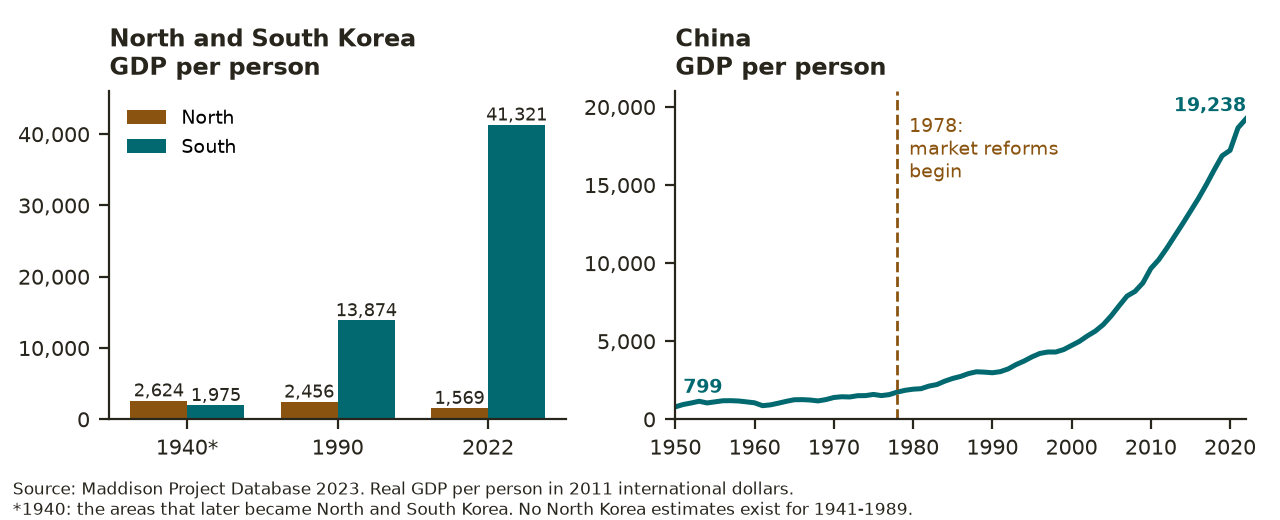
No natural experiment is perfect. The two sides of each divide differed in more than their economic systems, including their allies and the aid they received. But the pattern is the same in every case, and the size of the gaps is hard to explain any other way.
The record also includes famines. In the Soviet Union in 1932 and 1933, between about 5 and 10.8 million people died after forced collectivization of farms and heavy grain requisitions. Economists Andrei Markevich, Natalya Naumenko, and Nancy Qian find that the higher death rate in Ukraine was “due to state policy.” In China, during the Great Leap Forward of 1958 to 1962, an estimated 36 million people died. In both cases, the state kept taking grain from the countryside as people starved, and people had no way to vote, protest, or leave.
Collapse can happen without a full central plan. Venezuela relied on a large state role in its economy and ranks near the bottom of the economic freedom indexes. Its real output fell about 75 percent from 2013 to 2021, which the International Monetary Fund called “the single largest economic collapse for a non-conflict country in almost half a century.”
WATCH The Soviet Union: An Experiment in Marxism and Stages of Central Planning and Marxism in the Soviet Union (Marginal Revolution University, about 3 and 6 minutes)
WATCH The Reality of Socialism: Poland (Fraser Institute, a market-oriented think tank, 6 minutes. Poles who lived through central planning describe shortages, lines, and the shift to markets after 1989)
7 The in-between cases
Most of today’s debate is not about Soviet-style planning. It is about the mixes in between.
The Nordic countries. Denmark and Sweden are often called socialist, but they are market economies with large welfare states. Denmark’s taxes equal 45.2 percent of GDP, the highest in the OECD, yet it ranks among the ten most economically free countries. Sweden grew rich before its welfare state became large: output per person rose about fivefold from 1870 to 1950. Economist Andreas Bergh concludes that Sweden became rich because of well-functioning market institutions and that its income equality came before the expansion of the welfare state. In 1970, Sweden was the fourth richest country in the OECD. By the late 1990s it had fallen to the bottom third, a decline economist Assar Lindbeck links to the “pronounced centralisation” of its economic system in the late 1960s and early 1970s. Reforms in the 1980s and 1990s were followed by a revival. Both sides have a point here: a large welfare state can coexist with prosperity, and these are not planned economies.
Singapore and the United Arab Emirates. Both are open, low-tax markets in which the state is a large owner and investor. In Singapore, government-linked companies produced about 12.9 percent of GDP in 1998, according to the Singapore Department of Statistics. A study by International Monetary Fund economists Carlos Ramírez and Ling Hui Tan found that these companies were rewarded by investors with a valuation premium of more than 20 percent over comparable private firms. The United Arab Emirates, a federation of seven emirates, invests its oil wealth through huge state funds. These cases raise a real question: is it private ownership that matters most, or competition, open trade, and hard budgets that make even state firms answer to profit and loss?
Market socialism in practice. Yugoslavia tried worker-managed firms that sold in markets. Economist Saul Estrin finds that the system seemed to work until the late 1970s, then slid into stagnation, debt, inefficiency, and inflation. Worker-owned firms can thrive inside a market economy, though. Mondragon, a federation of cooperatives in Spain’s Basque Country, had more than 70,000 workers and €11.2 billion in sales in 2024. The difference is that Mondragon’s cooperatives compete in markets and face losses, while Yugoslavia’s firms could count on soft budgets.
China. China grew after it let markets in, yet the state still owns banks and key industries and directs credit toward its priorities. Did China grow because of the state, or despite it? Lardy’s evidence points to the private sector as the main engine. Justin Yifu Lin of Peking University, a former World Bank chief economist, argues instead that a “facilitating state,” one that builds infrastructure and uses industrial policy to help promising industries compete, was essential. Barry Naughton of the University of California, San Diego, finds that China grew rapidly for nearly three decades after 1978 before it adopted large-scale industrial policy around 2006. The debate continues.
Weigh It: What Kind of Mix?
Every real economy is a mix of markets and government. The choices are about how much, and which parts. Evidence can tell us a lot about what each mix produces. It can’t settle which values should count most.
“My plan” or “our plan”? Some modern socialists, such as the sociologist Erik Olin Wright, argue for democratic planning: decisions made by voters, workers, and communities, not by distant bureaucrats. A plan chosen by vote, they say, is our plan, not one imposed from above. The reply has two parts. A majority’s plan is still not my plan; the people who lose the vote must live by it. And a vote does not create the knowledge Hayek and Mises described. Voters, like planners, can’t know the prices and preferences that markets discover. Supporters of markets point out that a market lets many plans exist at once: you can follow yours while your neighbor follows hers.
Fair Challenges
Decide what you think of each challenge first, then open the response.
“Planning failed because of bad leaders, not the system.”
“With big data and AI, we could plan an economy now.”
“Walmart and Amazon plan huge operations, so a whole economy could be planned.”
“Democratic planning would be our plan, not a bureaucrat’s.”
“The Nordic countries show socialism works.”
Economists also disagree among themselves. Four live debates:
- How much does state ownership hurt? Singapore’s government-linked companies earn investor premiums, while state firms in planned economies did poorly. Competition and hard budgets may matter as much as who owns the firm.
- Did China grow because of the state or despite it? Lardy and Naughton credit the private sector and markets for China’s rise. Lin credits a state that built infrastructure and steered industry. Yong Wang’s model shows how state monopolies upstream can coexist with fast growth downstream.
- Does economic freedom cause growth, or does growth bring freedom? The link is strong, but de Haan and his coauthors caution that the direction of cause is hard to pin down.
- Do markets make people more or less moral? The reading on the moral case for markets reviews this evidence. Armin Falk and Nora Szech found that people trading in a lab market were more willing to let a lab mouse die for money than people deciding alone. Friedrich Breyer and Joachim Weimann reply that the experiment’s design can’t show that markets themselves erode morals.
Notice what evidence can settle and what it can’t. The record of central planning is strongly negative: slower growth, shortages, and in the worst cases famine. How much state ownership, taxation, and welfare spending a market economy can carry, and what each costs, are questions evidence can answer, though economists still argue about the answers. How much of economic life should be decided together, how much security is worth some loss of freedom or growth, and how equal outcomes should be are questions of values.
What Economics Adds
LISTEN Who Won the Socialist Calculation Debate? on EconTalk, February 17, 2025, with transcript. Economist Peter Boettke explains Mises’s and Hayek’s arguments to host Russ Roberts and asks whether computers and AI could overcome the limits of planning.
LISTEN When Bricks Were Rubles on Planet Money, NPR, April 1, 2022, with transcript. After the Soviet Union collapsed, rubles lost value and firms paid each other in bricks and IOUs, revealing how a few oil, gas, and mining industries had propped up the rest of the planned economy.
READ THE ORIGINAL The Use of Knowledge in Society and Economic Calculation in the Socialist Commonwealth (Friedrich Hayek’s 1945 essay, free at the Library of Economics and Liberty, and Ludwig von Mises’s 1920 essay)
The Normative Question
Every economy plans. The question is how much of that planning should be done by individuals, families, and firms making their own choices, and how much by governments acting for everyone. How large should the state’s role be as an owner, a taxpayer, and a provider of security? Economics can show what each mix has produced and what it costs. Choosing among them depends on how you weigh freedom against security, individual choice against collective decision, and growth against equality.
Key Terms in Plain Words
- Market economy
- An economy where most firms are private and market prices guide production.
- Central planning
- A system where the state owns most firms and a central authority decides what to produce.
- Market socialism
- Worker or public ownership of firms that buy and sell in markets.
- Social democracy
- A market economy with high taxes and a large welfare state.
- State capitalism
- The state as a major owner and investor inside a market economy, pursuing political goals.
- State-owned enterprise
- A firm owned and controlled by the government.
- Economic calculation
- Comparing the costs and benefits of different uses of resources, which requires prices.
- Knowledge problem
- Hayek’s point that the knowledge an economy needs is scattered across millions of people.
- Discovery procedure
- Hayek’s description of competition as a way to find out facts no one knew.
- Soft budget constraint
- Kornai’s term for firms that expect to be rescued when they lose money.
- Natural experiment
- A real-world split that lets us compare similar groups under different rules.
- Economic freedom index
- A score of how much an economy relies on markets, property rights, and open trade.
Sources
- Quotations, figures, examples, and videos in this sheet come from the sources below, current as of November 13, 2026.
- Start Here
- Encyclopaedia Britannica, “Gosplan.” britannica.com
- Friedrich A. Hayek, “The Use of Knowledge in Society,” American Economic Review 35, no. 4 (1945): 519–530, Library of Economics and Liberty econlib.org
- Measure It
- Encyclopaedia Britannica, “State Capitalism.” britannica.com
- Cambridge Elements, State and Capitalism in China (on the revival of the term after 2008) cambridge.org
- Yong Wang, “A Model of China’s State Capitalism,” U.S. International Trade Commission usitc.gov
- Fraser Institute, Economic Freedom of the World: 2025 Annual Report (market-oriented; copy hosted by the Cato Institute) cato.org
- Institute of Economic Affairs, “Economic Freedom of the World 2025” (summary of rankings) iea.org.uk
- Heritage Foundation, 2025 Index of Economic Freedom, Executive Summary (market-oriented) static.heritage.org
- Crédit Libanais Economic Research, “UAE Ranks 23rd Globally in 2025 Index of Economic Freedom.” economics.creditlibanais.com
- Jakob de Haan, Susanna Lundström, and Jan-Egbert Sturm, “Market-Oriented Institutions and Policies and Economic Growth: A Critical Survey,” Journal of Economic Surveys 20, no. 2 (2006): 157–191 onlinelibrary.wiley.com
- Freedom House, Freedom in the World 2026, country scores freedomhouse.org
- Temasek, “Our Portfolio” (net portfolio value as of March 31, 2026) temasek.com.sg
- Housing & Development Board (Singapore), Key Statistics FY2025 hdb.gov.sg
- Congressional Research Service, “The United Arab Emirates (UAE): Issues for U.S. Policy,” RS21852 congress.gov
- U.S. Department of State, 2026 Investment Climate Statements: United Arab Emirates state.gov
- OECD, Revenue Statistics 2025: Denmark oecd.org
- Can Political Freedom Last Without Economic Freedom?
- Friedrich A. Hayek, The Road to Serfdom: Text and Documents, The Definitive Edition, edited by Bruce Caldwell (University of Chicago Press, 2007; first published 1944) press.uchicago.edu
- Milton Friedman, Capitalism and Freedom (University of Chicago Press, 1962; 60th anniversary edition 2020) press.uchicago.edu
- Robert A. Lawson and J. R. Clark, “Examining the Hayek–Friedman Hypothesis on Economic and Political Freedom,” Journal of Economic Behavior & Organization 74, no. 3 (2010): 230–239 econpapers.repec.org
- Gabriel F. Benzecry, Nicholas A. Reinarts, and Daniel J. Smith, “You Have Nothing to Lose but Your Chains?” Public Choice 202 (2025): 529–556 doi.org
- Francesco Giavazzi and Guido Tabellini, “Economic and Political Liberalizations,” Journal of Monetary Economics 52, no. 7 (2005): 1297–1330 ideas.repec.org
- Robert Szarka, “The Effect of Economic Freedom on Civil Liberties in the Short Run: Physical Integrity Rights, 2000–2011,” Journal of Private Enterprise 31, no. 3 (2016): 21–35 journal.apee.org
- Freedom House, “Hong Kong: Freedom in the World 2026.” freedomhouse.org
- Meg Tuszynski, “Democracy Needs More Than Elections,” Economic Freedom, Explained, November 4, 2026 (argument; author at SMU’s Bridwell Institute for Economic Freedom, market-oriented) efexplained.substack.com
- Explain It: Calculation, Discovery, And Incentives
- Ludwig von Mises, “Economic Calculation in the Socialist Commonwealth” (1920), Mises Institute mises.org
- Friedrich A. Hayek, “Competition as a Discovery Procedure,” translated by Marcellus S. Snow, Quarterly Journal of Austrian Economics 5, no. 3 (2002): 9–23 sjsu.edu
- Sarah Lichtenstein and Paul Slovic, eds., “The Construction of Preference: An Overview,” in The Construction of Preference (Cambridge University Press, 2006) cambridge.org
- Oskar Lange, “On the Economic Theory of Socialism: Part One,” Review of Economic Studies 4, no. 1 (1936): 53–71 competitionandappropriation.econ.ucla.edu
- János Kornai, Eric Maskin, and Gérard Roland, “Understanding the Soft Budget Constraint,” Journal of Economic Literature 41, no. 4 (2003): 1095–1136 aeaweb.org
- Explain It: Natural Experiments
- Christoph F. Büchtemann and Jürgen Schupp, “Repercussions of Reunification: Patterns and Trends in the Socio-Economic Transformation of East Germany,” DIW Discussion Paper, 1992 econstor.eu
- Maddison Project Database 2023 (Jutta Bolt and Jan Luiten van Zanden, Journal of Economic Surveys, 2024); Korea estimates from Cha and others, Historical Statistics of Korea (Springer, 2020) rug.nl
- Nicholas R. Lardy, Markets over Mao: The Rise of Private Business in China (Peterson Institute for International Economics, 2014) piie.com
- Nicholas R. Lardy, Markets over Mao, introduction (preview) piie.com
- World Bank, “Lifting 800 Million People Out of Poverty: New Report Looks at Lessons from China’s Experience,” April 1, 2022 worldbank.org
- Philippe Aghion, Robin Burgess, Stephen J. Redding, and Fabrizio Zilibotti, “The Unequal Effects of Liberalization: Evidence from Dismantling the License Raj in India,” American Economic Review 98, no. 4 (2008) lse.ac.uk
- Montek S. Ahluwalia, “Economic Reforms in India Since 1991: Has Gradualism Worked?” Journal of Economic Perspectives 16, no. 3 (2002): 67–88 aeaweb.org
- T. N. Srinivasan, “Indian Economic Reforms: A Brief Stocktaking,” Stanford Center for International Development Working Paper 190, October 2003 kingcenter.stanford.edu
- World Bank, Poverty & Equity Brief: India, October 2026 documents1.worldbank.org
- Dani Rodrik and Arvind Subramanian, “From ‘Hindu Growth’ to Productivity Surge: The Mystery of the Indian Growth Transition,” IMF Staff Papers 52, no. 2 (2005): 193–228 imf.org
- Arvind Panagariya, “India in the 1980s and 1990s: A Triumph of Reforms,” IMF Working Paper 04/43, March 2004 imf.org
- Justin Yifu Lin, “Industrial Policy and China’s Economic Development: From the Perspective of New Structural Economics,” Fudan Journal of the Humanities and Social Sciences 10 (2017): 419–429 (argument) link.springer.com
- Barry Naughton, The Rise of China’s Industrial Policy, 1978 to 2020 (UNAM, 2021), UC Institute on Global Conflict and Cooperation ucigcc.org
- Andrei Markevich, Natalya Naumenko, and Nancy Qian, “The Causes of Ukrainian Famine Mortality, 1932–33,” NBER Working Paper 29089, 2021 nber.org
- Our World in Data, “Famines” (World Peace Foundation estimates, including China 1958–1962) ourworldindata.org
- International Monetary Fund, “Regional Spillovers from the Venezuelan Crisis,” IMF Departmental Paper 2022/019 elibrary.imf.org
- Marginal Revolution University, “The Soviet Union: An Experiment in Marxism.” youtube.com
- Marginal Revolution University, “Stages of Central Planning and Marxism in the Soviet Union.” youtube.com
- Fraser Institute, “The Reality of Socialism: Poland | Mini-Documentary,” March 18, 2024 (advocacy) youtube.com
- Explain It: The In-Between Cases
- Andreas Bergh, “What Are the Policy Lessons from Sweden? On the Rise, Fall and Revival of a Capitalist Welfare State,” New Political Economy 19, no. 5 (2014): 662–694 lusem.lu.se
- Assar Lindbeck, “Swedish Economic Growth in an International Perspective,” Swedish Economic Policy Review 7 (2000): 7–37, Government Offices of Sweden regeringen.se
- SOAS University of London, Development Leadership Dialogue, “Reclaiming the Truth from Free-Market Fairy Tales: A Case Study of Singapore,” March 2025 (argument; cites the Singapore Department of Statistics estimate for 1998) soas.ac.uk
- Carlos D. Ramírez and Ling Hui Tan, “Singapore, Inc. Versus the Private Sector: Are Government-Linked Companies Different?” IMF Staff Papers 51, no. 3 (2004) elibrary.imf.org
- Saul Estrin, “Yugoslavia: The Case of Self-Managing Market Socialism,” Journal of Economic Perspectives 5, no. 4 (1991): 187–194 aeaweb.org
- Mondragon Corporation, Informe Anual 2024 (Annual Report 2024) mondragon-corporation.com
- Weigh It And Fair Challenges (Arguments)
- Erik Olin Wright, How to Be an Anticapitalist in the Twenty-First Century (Verso, 2019) versobooks.com
- G. A. Cohen, Why Not Socialism? (Princeton University Press, 2009) muse.jhu.edu
- W. Paul Cockshott and Allin Cottrell, Towards a New Socialism (Spokesman, 1993), authors’ online edition users.wfu.edu
- Leigh Phillips and Michal Rozworski, The People’s Republic of Walmart (Verso, 2019) versobooks.com
- Capitalisn’t, “The Workplace Is a Dictatorship? ft. Elizabeth Anderson,” September 24, 2026 (argument) capitalisnt.com
- Armin Falk and Nora Szech, “Morals and Markets,” Science 340 (2013): 707–711 science.org
- Friedrich Breyer and Joachim Weimann, “Of Morals, Markets and Mice: Be Careful Drawing Policy Conclusions from Experimental Findings!” CESifo Working Paper 4745, 2014 ifo.de
- Podcasts And Original Readings
- EconTalk, “Who Won the Socialist Calculation Debate? (with Peter Boettke),” February 17, 2025 (with transcript) econtalk.org
- Planet Money, NPR, “When Bricks Were Rubles,” April 1, 2022 (with transcript) npr.org