Will Technology Take Our Jobs?
What two centuries of machines, and the first years of AI, tell us about work
Start Here: Every Generation Asks This
In 1811, skilled textile workers in the English Midlands began breaking into workshops at night and smashing the new knitting frames and power looms that were taking their trade. They signed their threats “Ned Ludd,” and history remembers them as the Luddites. Parliament made frame-breaking a crime punishable by death. The machines stayed.
The machines stayed, and on the big question the Luddites were wrong. Over the 1800s, power looms took over 98 percent of the labor needed to weave a yard of cloth, yet the number of factory weaving jobs grew. Cheaper cloth meant people bought far more of it, and textile employment kept growing for more than a century. On their own trades, though, the hand workers had reason to fear. Britain’s hand-loom weavers, about 240,000 in 1820, earned two or three times a laborer’s wage in their “golden age.” As power looms spread, their wages collapsed in the 1820s, and by 1850 only about 43,000 remained. Both things were true: the industry grew, and the people whose skills the machine replaced were left worse off.
The question did not go away. In 1821 the economist David Ricardo, who had argued that machinery helped every class, changed his mind in print: “the substitution of machinery for human labour, is often very injurious to the interests of the class of labourers.” In 1930 John Maynard Keynes gave the fear a name, “technological unemployment,” which he defined as “unemployment due to our discovery of means of economising the use of labour outrunning the pace at which we can find new uses for labour.” He called it “only a temporary phase of maladjustment.” In 1964, with factories automating, Congress created a National Commission on Technology, Automation, and Economic Progress. Its 1966 report concluded that “technology eliminates jobs, not work.”
An older worry was about the work itself, not the number of jobs. Adam Smith opened The Wealth of Nations (1776) by praising the division of labor, but near its end he warned that a worker whose whole life is spent “performing a few simple operations” “generally becomes as stupid and ignorant as it is possible for a human creature to become.” Karl Marx quoted the passage in Capital (1867). Smith’s remedy was not to slow the division of labor but to educate: he proposed “in every parish or district a little school,” paid for partly by the public. The same question applies to AI. Does it take over the dullest tasks and leave people more of the work that uses judgment, or does it leave workers less to think about?
This reading follows three steps. Measure It asks what it means for a job to be “at risk” and how exposed today’s jobs are to AI. Explain It shows why two centuries of labor-saving machines have not used up the work, when the transition still hurts, and what AI has done to jobs so far. Weigh It lays out what people propose to do about it and how good the evidence is for each idea. The reading on profits and losses called this process creative destruction. This one asks who gets the creative part, who gets the destruction, and for how long.
WATCH Creative Destruction: Technology and Trade (Marginal Revolution University)
Measure It: What Counts as “At Risk”?
1 Jobs are bundles of tasks
A job is not one thing. A bank teller counts cash, takes deposits, answers questions, spots fraud, and sells accounts. Machines usually take over some of those tasks, not the whole job. MIT economist David Autor points out that automated teller machines (ATMs) quadrupled from about 100,000 to 400,000 between 1995 and 2010. Yet bank teller jobs rose modestly, from about 500,000 in 1980 to about 550,000 in 2010, though they shrank as a share of all jobs.
How? ATMs made each branch cheaper to run. The number of tellers per branch fell by more than a third between 1988 and 2004, but the number of urban branches rose by more than 40 percent, helped by rules that let banks open more branches. Economist James Bessen adds that the job itself changed: cash handling mattered less, and dealing with customers mattered more. The story didn’t end there. As customers moved to online and mobile banking, branches closed. Tellers held about 339,000 jobs in 2025, and the Bureau of Labor Statistics projects a 13 percent decline by 2035. A machine can raise demand for the people who work beside it for a while, and a later technology can lower it. The tasks decide.
2 Two ways to count the risk
In 2013, Oxford researchers Carl Benedikt Frey and Michael Osborne estimated that about 47 percent of U.S. jobs were in occupations at high risk of computerization within a decade or two. The number became famous. In 2016, a study for the Organisation for Economic Co-operation and Development (OECD) by Melanie Arntz, Terry Gregory, and Ulrich Zierahn redid the exercise using the tasks individual workers report doing, not the average for their occupation. They found that 9 percent of U.S. jobs were at high risk.
Why the gap? Frey and Osborne rated whole occupations. Arntz and her coauthors found that many workers in “high-risk” occupations spend much of their day on tasks that are hard to automate, such as working with people face to face or in groups. Neither study counted the new jobs technology creates, and the jobs the first study flagged did not disappear on schedule. The lesson for reading any headline about jobs “at risk”: ask whether it counts jobs or tasks, and whether it counts what gets created.
3 How exposed are jobs to AI?
Researchers measure exposure by asking, task by task, whether an AI tool could do the task much faster. Tyna Eloundou, Sam Manning, Pamela Mishkin, and Daniel Rock, researchers at OpenAI and the University of Pennsylvania, estimated in an early version of their study that about 80 percent of U.S. workers could have at least 10 percent of their tasks affected by large language models, and about 19 percent could have at least half affected. Economists at the International Monetary Fund (IMF) estimate that almost 40 percent of jobs worldwide, and about 60 percent in advanced economies, are exposed to AI. About half of the exposed jobs in advanced economies, they estimate, could be hurt, while the rest could gain from AI as a helper.
Exposure is not the same as job loss. A task that AI can speed up may make a worker more valuable, as with the teller who now spends more time with customers, or less valuable, if the employer needs fewer workers to get the same output. Exposure measures don’t forecast how fast firms will adopt AI or which way a job will go. They tell you where to look.
Explain It: Why Hasn’t Work Run Out?
Start with the verdict of history. In every earlier wave of technology, from the power loom to the tractor to the computer, machines destroyed particular jobs and the economy created more work overall. Output per hour in the United States is about five times what it was in 1948, and a larger share of adults has a job today than then. The serious debates are about three narrower questions: how long the transition takes, who bears its costs, and whether AI will break the pattern.
4 Three forces: displacement, productivity, and new tasks
Economists Daron Acemoglu of MIT and Pascual Restrepo of Yale describe what a labor-saving technology does as three forces pulling in different directions:
- Displacement. Machines take over tasks that people used to do. On its own, this lowers the demand for labor.
- Productivity. The same output now costs less, so prices fall and people buy more, of that good and of everything else with the money they save. That raises demand for workers in the tasks machines can’t do and in other industries.
- New tasks. Technology creates work that didn’t exist before, from programming to repairing wind turbines. Acemoglu and Restrepo call this reinstatement, because it gives labor new tasks to do.
Autor argues that commentators “tend to overstate the extent of machine substitution for human labor and ignore the strong complementarities” that raise pay and demand for labor. Farming shows how big the shift can be. In 1900, 41 percent of U.S. workers were in agriculture. By 2000, the share was 2 percent, mostly because of machinery, and in 2022 direct on-farm jobs were about 1.2 percent of U.S. employment, according to the U.S. Department of Agriculture. The country did not end up with 39 percent of its workers unemployed. They and their children moved into factories, offices, schools, and hospitals.
Whether jobs grow inside the industry that automates depends on demand. Bessen traced U.S. cotton textiles, steel, and autos over two centuries. In each, jobs grew alongside rapid automation for decades, because falling prices drew in many new buyers: demand was elastic, as the reading on elasticity explains. Later, once most people had about as much cloth or steel as they wanted, demand became inelastic, and further automation cut jobs. U.S. textile employment grew for more than 100 years before the 1940s and then fell. The same test applies to AI. Where lower costs bring in many more customers, jobs can grow. Where demand is already met, they shrink.
Many of today’s jobs are ones no one could have named a few generations ago. Autor, Caroline Chin, Anna Salomons, and Bryan Seegmiller traced job titles in the Census back to 1940. They found that roughly 60 percent of employment in 2018 was in job titles that did not exist in 1940, from “cybersecurity analyst” to “solar photovoltaic electrician” to “drama therapist.”
The graph shows the long-run result for the economy as a whole. Since 1948, output per hour of work has risen about fivefold. Over the same years, the share of adults with a job rose.
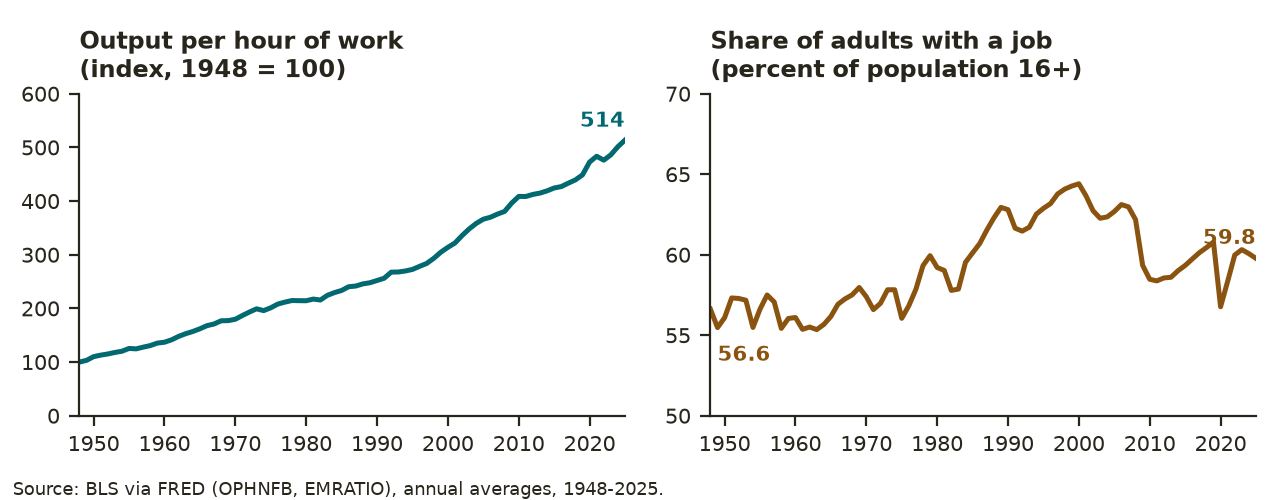
Technology was not the only thing moving. Much of the rise in the share working came from women entering the labor force, and much of the decline since 2000 comes from an aging population, as the reading on labor force participation explains. What the graph does show is that five times as much output per hour did not leave most adults without work.
5 When the transition hurts
“In the long run” can be a long time, and the people who lose are not always the people who gain. Four bodies of evidence make the point:
- The first industrial revolution. Economic historian Robert Allen found that in Britain in the first half of the 1800s, real wages stagnated while output per worker grew, and the profit share of national income rose. Only after mid-century did wages begin to grow with productivity. He named the gap “Engels’ pause,” after Friedrich Engels, who wrote about factory workers of the 1840s.
- Robots in the United States and Germany. Acemoglu and Restrepo found that from 1990 to 2007, each additional industrial robot per thousand workers in a U.S. local labor market lowered the share of people employed by 0.2 percentage points and wages by 0.42 percent. In Germany, Wolfgang Dauth and coauthors found that robots cut manufacturing jobs, but the losses were fully offset by new jobs in services. Robots there did not push many existing workers out; the adjustment came mostly through fewer young people being hired into factories. The reading on manufacturing takes up robots and factory jobs in more detail.
- Wages, not just jobs. Acemoglu and Restrepo estimate that 50 to 70 percent of the change in the U.S. wage structure from 1980 to 2016 came from falling relative wages for groups of workers specialized in routine tasks in industries that automated quickly. Other economists put more weight on trade, unions, or market power, but the pattern is clear: automation can leave total employment healthy while some groups fall behind.
- The cost of losing a job. Louis Jacobson, Robert LaLonde, and Daniel Sullivan found that long-tenured workers laid off from struggling firms were still earning about 25 percent less than before, five years later. Steven Davis and Till von Wachter found that men laid off in mass layoffs lose, over 20 years, the equivalent of 1.4 years of their old earnings, and 2.8 years if the layoff comes when unemployment is high.
This is the cost Ricardo saw. A technology can make the country richer and still leave a 50-year-old with skills the market no longer values.
6 What AI has done so far
In the tasks. The best evidence comes from experiments and rollouts inside firms. Erik Brynjolfsson of Stanford, Danielle Li, and Lindsey Raymond studied 5,179 customer-support agents given an AI assistant. Issues resolved per hour rose 14 percent on average and 34 percent for novice and less-skilled workers, with little gain for the most experienced. In an experiment with 453 college-educated professionals, Shakked Noy and Whitney Zhang found that ChatGPT cut the time spent on writing tasks by 40 percent and raised quality by 18 percent, with the weakest writers gaining most. In both studies, AI narrowed the gap between less and more experienced workers.
In the job market as a whole. Nearly four years after ChatGPT’s release, broad measures show little change. The Budget Lab at Yale, updating its tracker in October 2026, finds that the mix of occupations “is not yet changing in ways that clearly align with the introduction of AI,” and that measures of AI use “show no connection to changes in employment or unemployment.” A Federal Reserve note found no drop in job postings at firms and industries that adopted AI more. In Denmark, where survey data on chatbot use can be linked to tax records, Anders Humlum and Emilie Vestergaard estimate effects on earnings and hours close to zero, ruling out effects larger than 2 percent two years after ChatGPT’s launch. Work was being reorganized, but pay and hours didn’t move.
At the entry level. The warning sign is young workers. Using payroll records from ADP, the largest U.S. payroll company, Brynjolfsson, Bharat Chandar, and Ruyu Chen find that by June 2026, employment of workers ages 22 to 25 in the most AI-exposed occupations was about 19 percent below where it would have been had it kept pace with peers in less-exposed jobs. The gap comes mostly through less hiring, not more layoffs, and it is concentrated where AI automates tasks rather than assisting workers. Experienced workers in the same occupations show no comparable gap. The authors are careful: these are “descriptive patterns, not causal estimates,” and they do not view any single study “as definitive.” The reading on labor markets covers a St. Louis Fed study that reaches a similar conclusion for young workers.
Federal Reserve Governor Lisa Cook summed up the evidence in September 2026: “there is limited evidence that AI is yielding significant changes to the structure of the labor market,” though AI “might be decreasing labor demand” in software coding and simultaneous translation, and many recent college graduates are having a harder time finding a first job. She warned of a possible “supply-side” mismatch between workers’ skills and available jobs, where the Fed “would have limited tools,” because cutting interest rates can’t retrain anyone.
How much AI will add to growth is an open question. Acemoglu estimates that AI will raise total factor productivity, the output the economy gets from its labor and capital combined, by no more than 0.66 percent over ten years. OECD economists estimate AI could add 0.25 to 0.6 percentage points to productivity growth every year. The reading on unemployment looks at whether AI could cause mass unemployment.
Weigh It: What Should We Do About It?
7 The menu, and how good the evidence is
Proposals fall into a few groups. They are not equally well tested.
Make it easier to switch jobs. The more easily workers can move to new tasks, places, and occupations, the shorter the painful part of the transition. A 2015 report by the Treasury Department, the Council of Economic Advisers, and the Labor Department found that state licensing rules make it harder for workers to change occupations and to move between states. It recommended letting states recognize each other’s licenses. Janna Johnson and Morris Kleiner found that people in occupations with state-specific licensing exams are 36 percent less likely to move between states. This approach costs taxpayers little and leans on markets to create the new work. It does less for the worker who loses a job late in a career.
Retraining. Evidence here depends on the program. Randomized trials of sectoral training programs, which screen applicants, train them for specific jobs that local employers need, and help them find work, show earnings gains of 12 to 34 percent that persist for years, according to a review by Lawrence Katz, Jonathan Roth, Richard Hendra, and Kelsey Schaberg. By contrast, a national evaluation of the federal Trade Adjustment Assistance (TAA) program, which serves workers who lose jobs to imports, found that participants earned less than similar workers while in training and had at best caught up four years after losing their jobs. Its trainees, the evaluators wrote, “did not appear to reap clear economic returns.” Training works best when it is tied to real jobs.
Wage insurance. Some displaced workers can find a new job only at lower pay. Wage insurance pays part of the difference for a while. Under TAA, workers 50 and older could receive up to half the gap between their old and new wages for up to two years. Benjamin Hyman, Brian Kovak, and Adam Leive compared workers just above and below the age cutoff and found that eligibility raised short-run employment and long-run total earnings, mostly because workers spent less time out of work. It rewards going back to work rather than waiting for a job like the old one.
Cash with no strings. Some argue that if AI shrinks the need for labor, everyone should get a basic income. The largest U.S. experiment so far, run by the research group OpenResearch, gave 1,000 low-income adults $1,000 a month for three years and compared them with 2,000 who got $50 a month. Recipients were 2 percentage points less likely to work and worked 1.3 fewer hours a week, and their earnings, not counting the transfers, were about $1,500 a year lower. Supporters see more freedom to choose; critics see an expensive program that reduces work. Either way, one experiment can’t say what a permanent national program would do.
Change how automation is taxed. Acemoglu, Andrea Manera, and Restrepo argue that the tax code tilts firms toward machines. They estimate that labor is taxed at an effective rate of 25.5 to 33.5 percent, while software and equipment were taxed at about 10 percent in the 2010s and 5 percent after the 2017 tax law. They favor evening out the treatment. João Guerreiro, Sergio Rebelo, and Pedro Teles find that a tax on robots makes sense only while today’s routine workers, who can’t easily switch occupations, are still working, and should fall to zero once they retire. They also find that taxing robots carries a substantial efficiency cost, and that a better-designed income tax can reduce inequality at a lower cost.
Steer the technology. Acemoglu argues for “pro-worker AI,” such as tools that make teachers or nurses more capable rather than replacing them, and for policies, such as evening out the tax treatment of labor and machines, that tilt development in that direction. Critics doubt that officials can predict which technologies will turn out to help workers. The new jobs of the past, from web designer to wind-turbine technician, were not planned.
Here is the menu in one place.
| Option | Who it helps most | Strength of evidence | Main trade-off |
|---|---|---|---|
| Easier job switching | Workers who can move to new jobs or states | Good for the costs of licensing; indirect for automation | Does little for older workers late in a career |
| Sectoral training | Lower-wage workers who can train for local jobs | Strong: several randomized trials | Costly to run well; small programs so far |
| Broad retraining (TAA-style) | Workers displaced by trade | Moderate study; no clear earnings gain | Money and time spent without clear results |
| Wage insurance | Older displaced workers who take lower-paying jobs | Good: careful comparison around an age cutoff | Taxpayer cost; tested mainly on workers 50 and older |
| Unconditional cash | Anyone with low income | One large randomized trial | Very costly at national scale; somewhat less work |
| Tax machines more, or labor less | Workers whose tasks are being automated | Models, not experiments | Slower productivity growth and higher prices |
| Steer AI toward helping workers | Workers in jobs AI could assist | An argument, not yet tested | Officials may pick the wrong technologies |
Fair Challenges
Decide what you think of each challenge first, then open the response.
“This time really is different. AI does thinking work, so soon there will be nothing left for people to do.”
“Technology always creates more jobs than it destroys, so there is nothing to worry about.”
“We should slow down or ban technologies that destroy jobs.”
“A famous study found that 47 percent of jobs will be automated.”
“Young workers’ job troubles are all because of AI.” / “AI has nothing to do with it.”
Economists also disagree among themselves. Three live debates:
- How much will AI raise productivity? Acemoglu’s estimate is modest; OECD and others project several times more. The answer matters for wages, for budgets, and for how many new tasks AI creates.
- Does the tax code push firms to automate too much? Acemoglu, Manera, and Restrepo say yes. Guerreiro, Rebelo, and Teles find a case for a temporary robot tax but note its cost, and many economists warn that taxing investment slows the growth that raises wages.
- Should government steer which technologies get built? Acemoglu and Brynjolfsson both want AI to complement workers. Acemoglu leans toward policy to tilt it that way. Brynjolfsson stresses better measures of what AI can and can’t do. Economists such as Tyler Cowen expect new work to emerge without much steering, as it has before.
Notice what evidence can settle and what it can’t. How many tasks AI can do, how fast firms adopt it, what happens to employment and pay, and which programs help displaced workers are questions evidence can answer, even if the answers take years. How much risk to accept for faster growth, how much the winners from a new technology owe the workers who lose, and whether that help should come from government, employers, families, or charity are questions of values.
What Economics Adds
LISTEN Will AI Take My Job? Ask an Economist! on The Indicator from Planet Money, NPR, November 4, 2026, nine minutes, with transcript. Daron Acemoglu and Erik Brynjolfsson answer listeners’ questions about where AI job losses are showing up, what “pro-worker AI” would look like, and what students should do.
LISTEN David Autor on the Future of Work and Polanyi’s Paradox on EconTalk, October 6, 2014, with transcript. Autor explains to host Russ Roberts why tasks that rely on knowledge we can’t write down have been hard to automate, and why he expects the gains from machines to reach people. Listen with today’s AI in mind.
READ THE ORIGINAL On Machinery and Economic Possibilities for our Grandchildren (David Ricardo’s 1821 chapter, free at the Library of Economics and Liberty, and John Maynard Keynes’s 1930 essay)
The Normative Question
When a new technology makes the country richer but costs some workers their livelihoods, what, if anything, do the winners owe the losers? Should help come through markets that create new work, through employers, families, and charities, or through government programs paid for by taxes? And should we ever slow a technology to protect existing jobs? Economics can show what each choice costs, who gains, and who pays. Choosing among them depends on how you weigh growth against security, and freedom to innovate against protection from its risks.
Key Terms in Plain Words
- Automation
- Using machines or software to do tasks people used to do.
- Task
- One piece of a job; most jobs are bundles of many tasks.
- Exposure
- How many of a job’s tasks a technology could do or speed up. It is not a forecast of job loss.
- Technological unemployment
- Keynes’s term for job losses that come faster than new uses for labor appear.
- Displacement effect
- Machines taking over tasks, which lowers the demand for labor in those tasks.
- Productivity effect
- Lower costs and prices that raise demand for goods, and for workers elsewhere.
- Reinstatement
- New tasks created by technology that give people new work to do.
- Complement
- A technology that makes a worker more productive instead of replacing the worker.
- Creative destruction
- New products and methods replacing old ones, creating some jobs and ending others.
- Polanyi’s paradox
- “We know more than we can tell”: skills we can’t explain are hard to program.
- Wage insurance
- Payments that make up part of the pay cut when a laid-off worker takes a lower-paying job.
- Sectoral training
- Job training built around specific jobs that local employers need to fill.
Sources
- Quotations, figures, examples, and videos in this sheet come from the sources below, current as of November 11, 2026.
- Start Here
- The National Archives (UK), “The Proclamation of Ned Ludd.” nationalarchives.gov.uk
- UK Parliament, Hansard, House of Commons debate, “Frame Breaking and Nottingham Peace Bills,” February 14, 1812 api.parliament.uk
- James Bessen, “Toil and Technology,” Finance & Development, International Monetary Fund, March 2015 (power looms, and ATMs and bank tellers) imf.org
- Robert C. Allen, “The Hand-Loom Weaver and the Power Loom: A Schumpeterian Perspective,” NYU Abu Dhabi Working Paper 0004, May 2017 nyuad.nyu.edu
- David Ricardo, On the Principles of Political Economy and Taxation, 3rd ed. (1821), Chapter 31, “On Machinery,” Library of Economics and Liberty econlib.org
- John Maynard Keynes, “Economic Possibilities for our Grandchildren” (1930) econ.yale.edu
- Adam Smith, An Inquiry into the Nature and Causes of the Wealth of Nations, Book V, Chapter I, Part III, Article II (education of the common people), 1776, Library of Economics and Liberty econlib.org
- Karl Marx, Capital, Volume I (1867), Chapter 14, Section 5, “The Capitalistic Character of Manufacture,” Marxists Internet Archive marxists.org
- David H. Autor, “Why Are There Still So Many Jobs? The History and Future of Workplace Automation,” Journal of Economic Perspectives 29, no. 3 (2015): 3–30 (quotes the 1966 commission report) economics.mit.edu
- Marginal Revolution University, “Creative Destruction: Technology and Trade.” youtube.com
- Measure It
- U.S. Bureau of Labor Statistics, Occupational Outlook Handbook, “Tellers.” bls.gov
- Carl Benedikt Frey and Michael A. Osborne, “The Future of Employment: How Susceptible Are Jobs to Computerisation?” Oxford Martin School, 2013 oxfordmartin.ox.ac.uk
- Melanie Arntz, Terry Gregory, and Ulrich Zierahn, “The Risk of Automation for Jobs in OECD Countries: A Comparative Analysis,” OECD Social, Employment and Migration Working Paper 189, 2016 oecd.org
- Tyna Eloundou, Sam Manning, Pamela Mishkin, and Daniel Rock, “GPTs are GPTs: An Early Look at the Labor Market Impact Potential of Large Language Models,” working paper, August 2023 arxiv.org
- Tyna Eloundou, Sam Manning, Pamela Mishkin, and Daniel Rock, “GPTs Are GPTs: Labor Market Impact Potential of LLMs,” Science 384 (2024): 1306–1308 science.org
- Mauro Cazzaniga and others, “Gen-AI: Artificial Intelligence and the Future of Work,” IMF Staff Discussion Note 2024/001, January 2024 elibrary.imf.org
- Explain It
- Daron Acemoglu and Pascual Restrepo, “Automation and New Tasks: How Technology Displaces and Reinstates Labor,” Journal of Economic Perspectives 33, no. 2 (2019): 3–30 aeaweb.org
- U.S. Department of Agriculture, Economic Research Service, “Agriculture and Its Related Industries Provide 10.4 Percent of U.S. Employment.” ers.usda.gov
- David Autor, Caroline Chin, Anna M. Salomons, and Bryan Seegmiller, “New Frontiers: The Origins and Content of New Work, 1940–2018,” NBER Working Paper 30389 nber.org
- U.S. Bureau of Labor Statistics, “Nonfarm Business Sector: Real Output Per Hour of All Persons” (OPHNFB), via FRED fred.stlouisfed.org
- U.S. Bureau of Labor Statistics, “Employment-Population Ratio” (EMRATIO), via FRED fred.stlouisfed.org
- U.S. Bureau of Labor Statistics, “Employment-Population Ratio, 25–54 Yrs.” (LNS12300060), via FRED, October 2026 fred.stlouisfed.org
- U.S. Bureau of Labor Statistics, “Nonfarm Business Sector: Labor Share for All Workers” (PRS85006173), via FRED fred.stlouisfed.org
- James Bessen, “Automation and Jobs: When Technology Boosts Employment,” Economic Policy 34, no. 100 (2019): 589–626 academic.oup.com
- James Bessen, “Automation and Jobs: When Technology Boosts Employment,” VoxEU, Centre for Economic Policy Research (summary of the Economic Policy article) cepr.org
- Robert C. Allen, “Engels’ Pause: Technical Change, Capital Accumulation, and Inequality in the British Industrial Revolution,” Explorations in Economic History 46, no. 4 (2009) ora.ox.ac.uk
- Daron Acemoglu and Pascual Restrepo, “Robots and Jobs: Evidence from US Labor Markets,” Journal of Political Economy 128, no. 6 (2020) economics.yale.edu
- Wolfgang Dauth, Sebastian Findeisen, Jens Suedekum, and Nicole Woessner, “The Adjustment of Labor Markets to Robots,” Journal of the European Economic Association 19, no. 6 (2021): 3104–3153 econpapers.repec.org
- Daron Acemoglu and Pascual Restrepo, “Tasks, Automation, and the Rise in U.S. Wage Inequality,” Econometrica 90, no. 5 (2022): 1973–2016 onlinelibrary.wiley.com
- Louis S. Jacobson, Robert J. LaLonde, and Daniel G. Sullivan, “Long-Term Earnings Losses of High-Seniority Displaced Workers,” Economic Perspectives, Federal Reserve Bank of Chicago, November/December 1993 chicagofed.org
- Steven J. Davis and Till von Wachter, “Recessions and the Costs of Job Loss,” Brookings Papers on Economic Activity, Fall 2011 brookings.edu
- What AI Has Done So Far
- Erik Brynjolfsson, Danielle Li, and Lindsey R. Raymond, “Generative AI at Work,” NBER Working Paper 31161 (published in the Quarterly Journal of Economics, 2025) nber.org
- Shakked Noy and Whitney Zhang, “Experimental Evidence on the Productivity Effects of Generative Artificial Intelligence,” Science 381 (2023): 187–192 science.org
- The Budget Lab at Yale, “Tracking the Impact of AI on the Labor Market,” updated October 14, 2026 budgetlab.yale.edu
- Board of Governors of the Federal Reserve System, “AI Adoption and Firms’ Job-Posting Behavior,” FEDS Notes, March 27, 2026 federalreserve.gov
- Anders Humlum and Emilie Vestergaard, “Still Waters, Rapid Currents: Early Labor Market Transformation under Generative AI,” NBER Working Paper 33777, revised March 2026 nber.org
- Erik Brynjolfsson, Bharat Chandar, and Ruyu Chen, “Canaries in the Coal Mine? Six Facts about the Recent Employment Effects of Artificial Intelligence,” Stanford Digital Economy Lab, revised August 12, 2026 digitaleconomy.stanford.edu
- Stanford Digital Economy Lab, “No Widespread Displacement, but the AI Employment Gap for Young Workers Has Widened to 19%,” August 2026 digitaleconomy.stanford.edu
- Lisa D. Cook, “An Update on AI and the Economy,” speech, Board of Governors of the Federal Reserve System, September 28, 2026 federalreserve.gov
- Daron Acemoglu, “The Simple Macroeconomics of AI,” NBER Working Paper 32487, 2024 nber.org
- OECD, “Miracle or Myth? Assessing the Macroeconomic Productivity Gains from Artificial Intelligence,” November 2024 oecd.org
- Weigh It
- U.S. Department of the Treasury, Council of Economic Advisers, and Department of Labor, Occupational Licensing: A Framework for Policymakers, July 2015 obamawhitehouse.archives.gov
- Janna E. Johnson and Morris M. Kleiner, “Is Occupational Licensing a Barrier to Interstate Migration?” NBER Working Paper 24107 nber.org
- Lawrence F. Katz, Jonathan Roth, Richard Hendra, and Kelsey Schaberg, “Why Do Sectoral Employment Programs Work? Lessons from WorkAdvance,” Journal of Labor Economics 40, no. S1 (2022): S249–S291 lkatz.scholars.harvard.edu
- Peter Z. Schochet and others, “The Evaluation of the Trade Adjustment Assistance Program: A Synthesis of Major Findings,” Mathematica Policy Research and Social Policy Research Associates, for the U.S. Department of Labor, December 2012 dol.gov
- Benjamin G. Hyman, Brian K. Kovak, and Adam Leive, “Wage Insurance for Displaced Workers,” NBER Working Paper 32464, May 2024 nber.org
- OpenResearch, “NBER Working Paper: Employment” (Unconditional Cash Study), July 2024 openresearchlab.org
- Daron Acemoglu, Andrea Manera, and Pascual Restrepo, “Does the US Tax Code Favor Automation?” Brookings Papers on Economic Activity, Spring 2020 (argument) brookings.edu
- João Guerreiro, Sergio Rebelo, and Pedro Teles, “Should Robots Be Taxed?” Review of Economic Studies 89, no. 1 (2022): 279–311 academic.oup.com
- Podcasts And Original Readings
- The Indicator from Planet Money, NPR, “Will AI Take My Job? Ask an Economist!” November 4, 2026 (with transcript) npr.org
- EconTalk, “David Autor on the Future of Work and Polanyi’s Paradox,” October 6, 2014 (with transcript) econtalk.org
- EconTalk, “AI, Employment, and Education (with Tyler Cowen),” March 30, 2026 (argument) econtalk.org