How Do People Respond to Prices?
Time, taxes, price limits, and the prices we don’t see
Start Here: The Parking Decision That Started a Field
In the 1960s, economist Gary Becker was driving to Columbia University to examine a graduate student. He was running late. “I calculated the likelihood of getting a ticket, the size of the penalty, and the cost of putting the car in a lot,” he recalled in his Nobel lecture. “I decided it paid to take the risk and park on the street. (I did not get a ticket.)”
Walking to the exam, he realized the city had probably made the same kind of calculation in reverse: how often to check parked cars, and how big to make the fine, given how drivers like him would respond. That walk started his work on the economics of crime, part of the research that won him the 1992 Nobel Prize.
The reading on where prices come from showed how buyers and sellers arrive at a price. This one asks what happens next: how people respond when a price changes, how long the response takes, who ends up bearing a cost, and what happens when a price isn’t allowed to move. Many of these ideas were developed by economists at the University of Chicago, including Becker, George Stigler, and Sam Peltzman, and are gathered in the textbook Chicago Price Theory. Becker stressed that this approach doesn’t assume people are selfish: “It is a method of analysis, not an assumption about particular motivations.”
WATCH Elasticity of Demand (Marginal Revolution University)
How People Respond to Prices
1 The full price: money, time, and risk
The law of demand says that when a price rises, people buy less. It reaches further than most people expect, because the price that matters is the full price: the money, plus the time, plus the risk. Becker argued that time is the scarcest thing of all: “the most fundamental constraint is limited time.” Goods can multiply, but everyone still gets twenty-four hours a day.
The best test of whether people respond to the price of something as important as health care is an experiment run by the RAND Corporation in the 1970s and 1980s. Between 1971 and 1982, families were randomly assigned to health plans that charged different shares of the bill, from nothing to 95 percent. Those given free care used about 30 percent more services than those on the plan closest to a large deductible. RAND found that cost sharing “reduced the use of both highly effective and less effective services in roughly equal proportions.” For most people it had no harmful effect on health, but there were exceptions. Free care improved blood pressure, dental health, and vision, and those gains were “concentrated among the sickest and poorest patients.”
Prices work on risky habits, too. The Centers for Disease Control and Prevention (CDC) reports that “young people are particularly sensitive to tobacco product price increases,” which is one reason tobacco taxes are used to discourage smoking. The Price Check reading on health care returns to what happens when insurance lowers the price patients see.
2 Responses grow with time
How much people respond depends on how long they have to adjust. Economists call that responsiveness the price elasticity of demand. OpenStax explains that “elasticities are often lower in the short run than in the long run.” Right after gas prices jump, you can carpool or skip a trip. Over years, you can buy a car that uses less gas, or live closer to work.
The Congressional Budget Office (CBO) reviewed the evidence in 2008. It found that a 10 percent rise in gasoline prices cuts gas use by only about 0.6 percent in the short run. If prices stay high, use eventually falls by about 4 percent, but the full effect takes about 15 years, as old cars are replaced. Drivers responded in smaller ways right away. They drove a little slower on open freeways, and where a train ran nearby, some left the car at home. Buyers shifted too. Light trucks, including SUVs, fell from about 55 percent of new-vehicle sales in 2004 to below 52 percent in 2006, and used large SUVs lost value while fuel-efficient used cars gained.
The graph shows the same cut in supply, first against short-run demand and then against long-run demand:
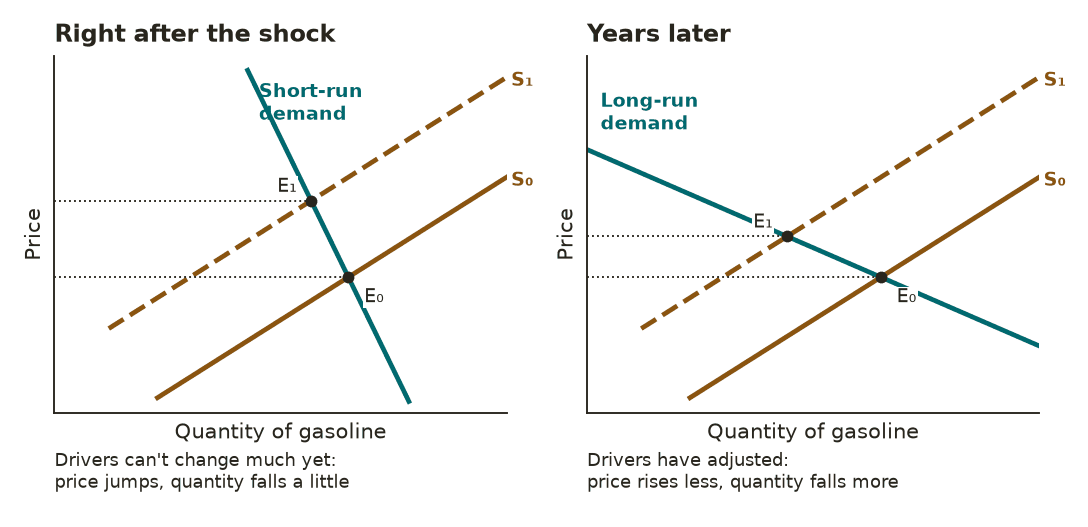
This is one reason price spikes tend to fade. As buyers find substitutes and sellers find new supplies, the price that jumped at first eases back. The Price Check reading on gas prices applies this to the pump.
3 Who really pays
When the government taxes a good, the law names who must send in the money. That doesn’t settle who bears the cost. As a Marginal Revolution University (MRU) video puts it, “who pays the tax does not depend on who writes the check to the government.” OpenStax calls the question tax incidence: how “a tax burden is divided between consumers and producers.”
The answer depends on who can adjust more easily. The side of the market with more options, such as more substitutes or more time, shifts more of the burden onto the other side. OpenStax uses cigarettes as an example. Because smokers’ demand changes little when the price rises, a tax on cigarette makers is mostly passed on to buyers as higher prices. The same reasoning applies to tariffs, which are taxes on imports. The Tariffs reading takes up who paid for recent ones.
WATCH Who Pays the Tax? and Tax Incidence Explained with Supply and Demand (Marginal Revolution University)
4 When prices can’t move
Every scarce good gets rationed somehow. When a law holds a price below where it would settle, the good doesn’t become less scarce. Something other than the price does the rationing: waiting in line, lower quality, connections, or rules about who goes first.
The gas lines of 1973–74 are the classic case. Federal price controls, made stricter after the oil embargo of October 1973, held gasoline prices below the market level, and signs like “Gas shortage! Sales limited to 10 gallons of gas per customer” went up. A study of California found that the time drivers spent waiting added between 13 and 84 percent to the price of a gallon in the worst months of that winter. The price on the pump stayed low, but the full price did not.
A smaller episode let economists measure this. In 1980, price rules forced some California stations to sell gas below the going price, while nearby stations charged more. Robert Deacon and Jon Sonstelie surveyed drivers at both. Drivers chose between waiting for cheaper gas and paying more to skip the line, and their choices showed they valued their time at about their after-tax wage. Those who chose to wait were more likely to be unemployed, with lower costs of waiting. In a follow-up study, the authors found that the waiting, together with the extra gas drivers bought on each trip to make the wait worth it, used up an estimated 116 percent of the money the controls saved them.
Rent control shows both sides of a price limit. Rebecca Diamond, Tim McQuade, and Franklin Qian studied a 1994 law that extended rent control in San Francisco. It worked for many of the tenants it covered: they were less likely to be displaced from the city. But landlords covered by the law cut the supply of rental housing by 15 percent, often by selling to owner-occupants or redeveloping their buildings. The authors conclude that the lost supply “likely drove up market rents in the long run,” working against the law’s own goals. The tenants who were protected and the renters who paid more were different people. The Price Check reading on housing returns to this trade-off.
WATCH Price Ceilings: Rent Controls and Price Ceilings: Misallocation of Resources (Marginal Revolution University)
5 Prices hidden in wages and places
Some prices hide inside other prices. Adam Smith noticed this in 1776: “The wages of labour vary with the ease or hardship, the cleanliness or dirtiness, the honourableness or dishonourableness of the employment.” A job that is dangerous, dirty, or done at night has to pay more to attract workers. Economists call the extra pay a compensating differential. The Choices reading showed how government agencies put a value on safety. Much of the evidence behind those values comes from the extra pay workers accept for riskier jobs.
Places work the same way. A city with good jobs, mild weather, or good schools draws people, and the competition shows up in rents and home prices. A cheaper town may be cheaper because fewer people want to live there. The price of housing is partly the price of where it is, a point the Housing and College readings build on.
Here are the five ideas side by side.
| The idea | Everyday example | Where it shows up in this series |
|---|---|---|
| The full price | A “free” clinic visit still costs time off work and a long wait. | Health Care, College |
| Responses grow with time | Drivers barely change at first, then buy cars that use less gas. | Gas Prices, Groceries |
| Who really pays | A tax on sellers shows up partly in the price buyers pay. | Who Pays for Tariffs?, Gas Prices |
| When prices can’t move | Gas lines in the 1970s; a waiting list for rent-controlled apartments. | Housing, Where Do Prices Come From? |
| Prices hidden in wages and places | A night shift pays more; a city with more jobs costs more to live in. | Housing, College, Choices |
Fair Challenges
Decide what you think of each challenge first, then open the response.
“People don’t really pay attention to prices.”
“For necessities, people can’t respond, so higher prices only hurt.”
“Price limits protect people in a crisis.”
“Safety rules don’t work, because people just take more risks.”
Economists also disagree among themselves. Three live debates:
- How much do people offset safety gains? Peltzman found offsets large enough to cancel the benefits of 1960s safety rules. Federal crash data show large gains from seat belts. Researchers still argue over how much drivers adjust for any given rule.
- Can temporary price limits help in an emergency? Weber argues that well-designed limits can buy time while supply recovers. Studies of gas lines and rent control show how limits shift rationing to waiting and shrink supply. Much depends on design and on how long the limits last.
- How much do people react to prices they don’t see? Chetty and his coauthors found a large effect from sales taxes left off the price tag. How far the finding reaches, to fees added at checkout or prices buried in other bills, is still being studied.
Notice what evidence can settle and what it can’t. How much people adjust, how long it takes, who ends up bearing a tax, and what happens under a price limit are questions evidence can answer, even when studies disagree. Whether scarce goods should go to those who pay, those who wait, or those who need them most, and how much hardship now is worth more supply later, are questions of values.
What Economics Adds
LISTEN Why Housing Is Artificially Expensive and What Can Be Done About It on EconTalk, with Bryan Caplan and host Russ Roberts, October 21, 2024, with transcript. Caplan argues that rules holding back new housing, not landlords, drive rents up.
LISTEN Cost of Living Crisis: Democratic Economics on the World Economic Forum’s Radio Davos, with Isabella Weber, November 5, 2026, with transcript. Weber explains why she thinks keeping essentials affordable matters for democracy, and where she sees a role for price controls.
The Normative Question
When something people need gets scarce, should its price be allowed to rise, be held down, or should people be helped to pay it? A rising price rations what is available and draws in more supply, but it falls hardest on those with the least. A price limit protects people now, but it rations by waiting and can shrink supply later. Help with paying keeps the price signal, but someone has to fund it, and it takes time to reach people. Economics can show what each choice costs and who bears the cost. Choosing among them depends on how much weight you give to people who have the good now and to those who will need it later, and on who you trust to decide.
Key Terms in Plain Words
- Full price
- Everything you give up to get something: money, time, and risk.
- Price elasticity of demand
- How much buyers change what they buy when the price changes.
- Short run
- The period before people have had time to fully adjust to a price change.
- Long run
- The period after people have had time to change cars, homes, jobs, or suppliers.
- Tax incidence
- Who really bears the cost of a tax, buyers or sellers, and in what shares.
- Statutory incidence
- Who the law says must pay a tax to the government.
- Price ceiling
- A legal maximum price, such as rent control or a cap on gas prices.
- Non-price rationing
- Deciding who gets a scarce good by waiting, rules, quality, or connections instead of price.
- Compensating differential
- Extra pay that makes up for a job’s danger, discomfort, or bad hours.
- Natural experiment
- A real-world event that splits people into groups almost as if at random, letting researchers compare them.
- Salience
- How visible a price or tax is when people decide.
- Offsetting behavior
- Taking more risk when something makes you feel safer.
Sources
- Quotations, figures, examples, and videos in this sheet come from the sources below, current as of November 6, 2026.
- Start Here
- Gary S. Becker, “The Economic Way of Looking at Life,” Nobel Prize lecture, December 9, 1992 nobelprize.org
- Sonia Jaffe, Robert Minton, Casey B. Mulligan, and Kevin M. Murphy, Chicago Price Theory, 2nd ed., Princeton University Press, 2026 press.princeton.edu
- Marginal Revolution University, “Elasticity of Demand.” youtube.com
- The Full Price
- RAND Corporation, “The Health Insurance Experiment: A Classic RAND Study Speaks to the Current Health Care Reform Debate,” Research Brief RB-9174, 2006 rand.org
- Joseph P. Newhouse, “The Use of Experiments in Health Care,” Harvard Kennedy School, 2015 (30 percent figure) hks.harvard.edu
- Centers for Disease Control and Prevention, “STATE System Excise Tax Fact Sheet.” cdc.gov
- Time And Who Pays
- Steven A. Greenlaw, David Shapiro, and Daniel MacDonald, Principles of Microeconomics 3e, Section 5.3, “Elasticity and Pricing”, OpenStax, 2022 openstax.org
- Congressional Budget Office, Effects of Gasoline Prices on Driving Behavior and Vehicle Markets, January 2008 cbo.gov
- Marginal Revolution University, “Who Pays the Tax?.” youtube.com
- Marginal Revolution University, “Tax Incidence Explained with Supply and Demand.” youtube.com
- When Prices Can’T Move
- Michael Corbett, “Oil Shock of 1973–74,” Federal Reserve History federalreservehistory.org
- Valerie A. Ramey and Daniel J. Vine, “How Much Have Things Really Changed?” working paper, June 2010 (summarizing Frech and Lee, 1987, on the time cost of gas lines, and on 1970s oil price controls) econweb.ucsd.edu
- Robert T. Deacon and Jon Sonstelie, “Rationing by Waiting and the Value of Time: Results from a Natural Experiment,” Journal of Political Economy 93, no. 4 (1985): 627–647 journals.uchicago.edu
- Robert T. Deacon and Jon Sonstelie, “The Welfare Costs of Rationing by Waiting,” Economic Inquiry 27, no. 2 (1989): 179–196 econpapers.repec.org
- Rebecca Diamond, Tim McQuade, and Franklin Qian, “The Effects of Rent Control Expansion on Tenants, Landlords, and Inequality: Evidence from San Francisco,” American Economic Review 109, no. 9 (2019): 3365–3394 aeaweb.org
- Marginal Revolution University, “Price Ceilings: Rent Controls.” youtube.com
- Marginal Revolution University, “Price Ceilings: Misallocation of Resources.” youtube.com
- Prices Hidden In Wages And Places
- Adam Smith, An Inquiry into the Nature and Causes of the Wealth of Nations, 1776, Book I, Chapter X (Library of Economics and Liberty edition) econlib.org
- Thomas E. Borcherding and Eugene Silberberg, “Shipping the Good Apples Out: The Alchian and Allen Theorem Reconsidered,” Journal of Political Economy 86, no. 1 (1978): 131–138 journals.uchicago.edu
- Fair Challenges
- Raj Chetty, Adam Looney, and Kory Kroft, “Salience and Taxation: Theory and Evidence,” American Economic Review 99, no. 4 (2009): 1145–1177 aeaweb.org
- U.S. Department of Energy, “Low-Income Energy Affordability Data (LEAD) Tool” fact sheet, July 2024 energy.gov
- Isabella M. Weber, “Could Strategic Price Controls Help Fight Inflation?” The Guardian, December 29, 2021, listed by the Political Economy Research Institute, University of Massachusetts Amherst (argument) peri.umass.edu
- Sam Peltzman, “The Effects of Automobile Safety Regulation,” Journal of Political Economy 83, no. 4 (1975): 677–725 doi.org
- National Highway Traffic Safety Administration, “Seat Belt Safety: Buckle Up America.” nhtsa.gov
- Podcasts (With Transcripts)
- EconTalk, “Why Housing Is Artificially Expensive and What Can Be Done About It (with Bryan Caplan),” October 21, 2024 econtalk.org
- World Economic Forum, Radio Davos, “Cost of Living Crisis: Democratic Economics – Isabella Weber,” November 5, 2026 weforum.org