What Does the Fed Do?
Who runs it, how it sets interest rates, and why it is kept at arm’s length from politics
Start Here: Twelve Votes, One Price
On September 16, 2026, twelve officials in Washington voted, 12 to 0, to raise one interest rate by a quarter of a percentage point. It was the first increase since 2023. The rate they raised is one most people never pay: the rate banks charge one another for overnight loans. Yet within days, rates on savings accounts, credit cards, and new car loans began to move as well.
Six weeks later, the same group met again and held the rate steady at 3.75 to 4 percent. This time the vote was 10 to 2. Both dissenters wanted another increase, because inflation was still running well above the target.
This reading follows the Macro Foundations steps. Define It asks what the Federal Reserve is, why the United States created it, how it is organized, and what Congress told it to do. Measure It shows how to read its interest rate and its balance sheet. Explain It shows how the Fed sets rates today, how its decisions reach households, what it does in a crisis, and why it is kept at arm’s length from elected officials.
The framework from the Foundations readings applies here too. An interest rate is a price: the price of using money now instead of later. Like other prices, it guides choices, here between spending and saving, borrowing and lending. The Fed sets one short-term rate directly and leaves markets to set the rest. Rules that protect Fed officials from being fired are a kind of property right in the job, designed to give them reasons to look past the next election. And the Fed, unlike a business, can’t go bankrupt, which raises a question that runs through the reading: what disciplines an institution that losses can’t?
WATCH Monetary Policy and the Federal Reserve (Marginal Revolution University; recorded in 2017, so the chair it names has since changed)
Define It: What Is the Federal Reserve?
1 A bank for banks and for the government
A central bank is not a bank where you can open an account or take out a loan. Its customers are banks and the government. The Federal Reserve, usually called the Fed, does several things no ordinary bank can:
- It issues the currency. The paper bills in your wallet say “Federal Reserve Note.” About $2.5 trillion of them are in circulation.
- It holds banks’ reserves. Banks keep accounts at the Fed, and they use the money in those accounts, called reserves, to pay one another. That links back to the reading on money and banking.
- It is the government’s bank. The U.S. Treasury keeps its main checking account at the Fed.
- It sets the short-term interest rate. This is monetary policy, the main subject of this reading.
2 Why the United States has one
The United States tried central banking twice before. The First Bank of the United States (1791–1811) and the Second Bank (1816–1836) each lost its charter when Congress refused to renew it, partly from fear of concentrated financial power. For most of the next century, the country had no central bank. Under the National Banking system after the Civil War, money was hard to expand when demand for it rose, and bank panics came again and again.
The Panic of 1907 was the turning point. With no central bank to lend to banks short of cash, the financier J. P. Morgan organized private bankers to stop the run. Congress decided the country should not have to rely on one private banker the next time. It formed a commission to study other countries’ systems, and on December 23, 1913, the Federal Reserve Act became law. As a compromise between those who wanted one central bank and those who feared one, the act created a system of regional Reserve Banks overseen by a board in Washington.
3 How it is organized
That compromise still shapes the Fed. It has three main parts:
| Part | Who | How they are chosen |
|---|---|---|
| Board of Governors | Seven governors in Washington, D.C., including a chair and vice chairs | Nominated by the president and confirmed by the Senate. Governors serve 14-year terms, staggered so one ends every two years. The chair serves a 4-year term as chair. |
| 12 Reserve Banks | Regional banks in cities such as Boston, Atlanta, St. Louis, and San Francisco | Each bank’s president is chosen by its own board of directors, with the approval of the Board of Governors, not by the president of the United States. |
| Federal Open Market Committee (FOMC) | The group that sets interest rates: 12 voting members | All seven governors, the president of the New York Fed, and four of the other eleven Reserve Bank presidents, who rotate yearly. All twelve presidents take part in the discussion. It meets eight times a year. |
The design mixes public and private, and Washington with the regions. Member banks hold stock in their regional Reserve Bank, but that stock is not like owning a company: the Reserve Banks are not run for profit. The Board is not funded by Congress; the Fed pays its own way from the interest on the bonds it holds. Those choices were made on purpose, to keep monetary policy at some distance from politics, as section 12 explains.
4 What Congress told it to do
The Fed has several jobs:
- Monetary policy: setting interest rates to keep prices stable and employment high.
- Lender of last resort: lending to sound banks when they run short of cash, especially in a panic.
- Supervising banks: examining banks’ books and enforcing rules, along with other regulators.
- Running payments: moving money between banks, including through its FedNow instant-payment service.
- Watching financial stability: looking for risks that could spread across the financial system.
Its goals for monetary policy come from Congress. The Federal Reserve Reform Act of 1977 told the Fed to promote “maximum employment, stable prices, and moderate long-term interest rates.” Because the third goal usually follows from the second, the first two are called the dual mandate.
Congress didn’t define those goals with numbers. In 2012, the Fed set its own: inflation of 2 percent a year, measured by the price index for personal consumption expenditures (PCE). It reaffirmed that target in 2025. The Fed sets a number for inflation but not for jobs, and its statement explains why. Over the long run, inflation “is primarily determined by monetary policy.” Maximum employment, in contrast, “is not directly measurable and changes over time owing largely to nonmonetary factors,” such as workers’ skills and the way people find jobs.
Measure It: Reading the Fed’s Numbers
5 The policy rate
The federal funds rate is the interest rate banks charge one another for overnight loans of reserves. The FOMC doesn’t set a single number. It sets a target range, a quarter of a percentage point wide, and the market rate settles inside it. In October 2026, the target range was 3.75 to 4 percent, and the average rate in the market, called the effective federal funds rate, was about 3.88 percent.
The graph shows the rate since 2000, next to inflation. It shows two cuts to near zero, in 2008 and 2020, and the fastest increases in decades in 2022 and 2023, after inflation reached about 7 percent. Starting in September 2024, the Fed cut its rate by a total of 1.75 percentage points. Then, in September 2026, with an oil shock pushing prices up, it raised the rate again.
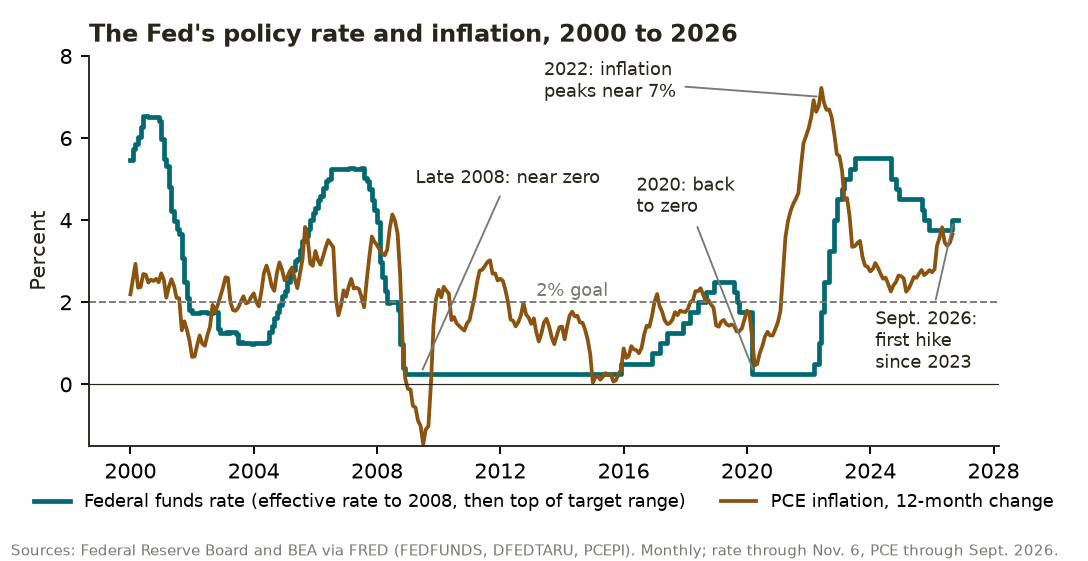
Inflation has been above the 2 percent target every month since March 2021. In September 2026, PCE inflation was 3.6 percent. Core PCE inflation, which leaves out food and energy because their prices jump around, was 3.1 percent. The gap between the two shows how much of the recent rise came from energy.
6 The balance sheet
Like any bank, the Fed has a balance sheet: a list of what it owns and what it owes. Unlike any other bank, what it owes includes the nation’s money.
| What it includes | |
|---|---|
| Assets (what the Fed owns) | Mostly U.S. Treasury securities, about $4.6 trillion, and mortgage-backed securities issued by government-sponsored agencies; also any loans to banks. |
| Liabilities (what the Fed owes) | Paper currency, about $2.5 trillion; bank reserves, about $2.9 trillion; the Treasury’s checking account; and funds that money market funds and others place with the Fed overnight. |
When the Fed buys a bond, it pays by adding reserves to the seller’s bank account. Its assets and its liabilities both grow. That is how the Fed creates the base on which banks build, and it is why the size of the balance sheet matters.
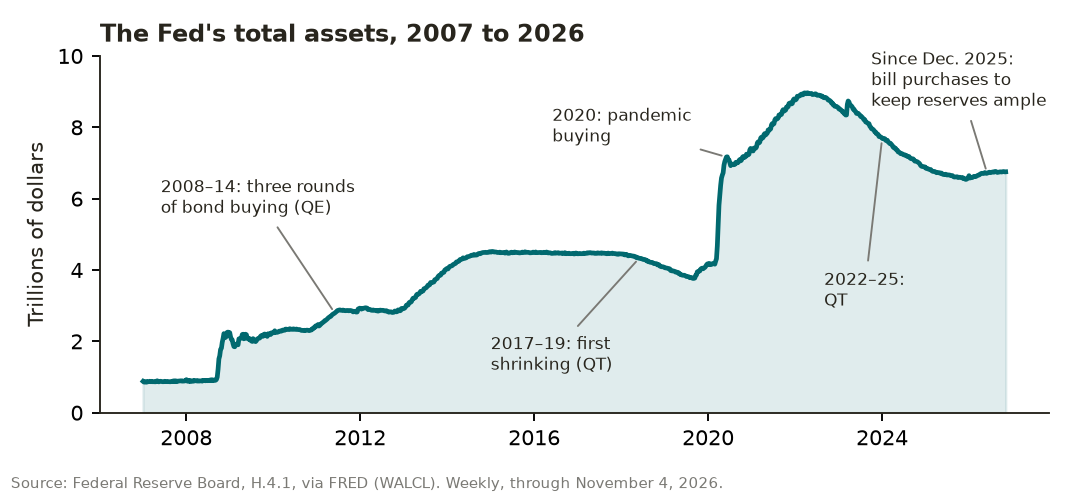
The second graph shows how much the size has changed. In early 2007, the Fed held less than $1 trillion in assets. To fight the 2008 crisis and its aftermath, it bought bonds in three rounds, and its assets grew to about $4.5 trillion. It began to shrink them in 2017, then bought on a huge scale in 2020, reaching nearly $9 trillion in 2022. From June 2022 to October 2025, it let $2.2 trillion of bonds run off. Since December 2025, it has been buying short-term Treasury bills again, in smaller amounts, to keep reserves from falling too low. On November 4, 2026, its assets were $6.75 trillion.
READ The Fed’s Balance Sheet and Ample Reserves (Page One Economics, Federal Reserve Bank of St. Louis, February 2026)
7 Is policy tight or loose?
A 4 percent interest rate isn’t high or low on its own. What matters to a borrower is the real interest rate: the rate minus the inflation expected over the life of the loan. With inflation near 3.5 percent, a 4 percent policy rate is a real rate of only about half a percentage point.
Economists judge whether policy is tight or loose by comparing the real rate with the neutral rate, the real rate that would neither speed up nor slow down an economy running at full strength. Above neutral, policy is tight. Below it, policy is loose. The trouble is that no one can observe the neutral rate. It has to be estimated from models, and the estimates differ, change over time, and are revised. The New York Fed publishes two well-known estimates and warns that they are not official forecasts. As with M1 in the money reading and potential output in the reading on booms and busts, check what is being estimated before reading a trend into it.
Explain It: How the Fed Works
8 How the Fed sets a rate today
Since 2008, banks have held far more reserves than they need for daily payments: about $2.9 trillion in November 2026. The Fed calls this an ample-reserves system. With so many reserves around, the Fed can’t move the federal funds rate by adding or removing a few billion dollars of them. Instead, it sets the interest rates it pays and charges, which economists call administered rates:
- Interest on reserve balances (IORB): the rate the Fed pays banks on their reserves, 3.90 percent since October 29, 2026. It is the Fed’s main tool.
- The overnight reverse repurchase (ON RRP) rate: 3.75 percent. Money market funds and other firms that can’t earn interest on reserves can lend to the Fed overnight at this rate.
- The discount rate (primary credit rate): 4 percent. Sound banks can borrow from the Fed at this rate, at what the Fed calls its discount window.
- The standing repo rate: 4 percent. Banks and securities dealers can borrow overnight at this rate, putting up Treasury bonds as collateral.
Why does the rate the Fed pays guide the rate banks charge one another? Because no bank will lend its reserves to another bank for less than it can earn, risk-free, by leaving them at the Fed. The rate the Fed pays acts as a floor. When the Fed raises it, banks demand more from one another, and the federal funds rate rises too. The diagram shows the idea.
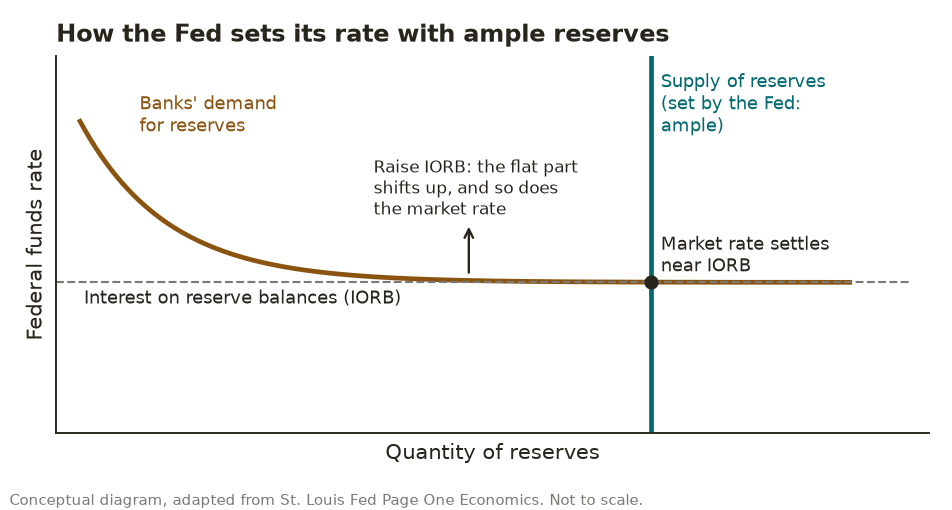
This is why the Fed now administers a price rather than a quantity. It sets the rate it pays, and lets banks choose how many reserves to hold at that rate. Its bond purchases since December 2025 aren’t meant to change interest rates. They are meant to keep reserves on the flat part of the curve, so that the floor keeps working.
WATCH How the Federal Reserve Worked: Before the Great Recession, What Are Open Market Operations? and How the Federal Reserve Works: After the Great Recession (Marginal Revolution University; recorded in 2018 and earlier, when interest on reserves was called IOER)
READ How Does the Fed Use Its Monetary Policy Tools to Influence the Economy? and How the Fed Implements Monetary Policy with Its Tools (Federal Reserve Bank of St. Louis)
9 From one overnight rate to your life
The Fed sets one overnight rate. Markets carry it the rest of the way, through several channels:
- Borrowing costs. Banks set rates on credit cards, car loans, and business loans with an eye on the federal funds rate. Longer-term rates, such as those on mortgages, depend on where markets expect the Fed’s rate to go over the next several years.
- Saving. Higher rates pay savers more, which makes waiting to spend more attractive.
- Asset prices. Higher rates tend to lower the prices of stocks, bonds, and homes, so households feel less wealthy and spend less.
- The dollar. Higher U.S. rates attract money from abroad and tend to raise the dollar’s value, which makes imports cheaper and exports harder to sell.
- Expectations. If people believe the Fed will keep inflation near 2 percent, they set wages and prices with that in mind, which helps make it true.
All of this takes time. Milton Friedman wrote in 1960 that monetary policy works “only after a considerable lag and over a long period and that the lag is rather variable.” Estimates of how long range from under a year to two years or more. So the Fed has to act on forecasts, knowing they may be wrong.
The Fed also has limits. It can’t make oil cheaper or ships move faster. When a supply shock pushes prices up and output down at the same time, as the reading on booms and busts describes, raising rates fights inflation but makes the slowdown worse, and cutting rates does the reverse. The Fed must choose which risk to accept. That is the dilemma of 2026: an oil shock from the war with Iran has pushed inflation up while the economy keeps growing.
WATCH Monetary Policy: The Negative Real Shock Dilemma (Marginal Revolution University)
TRY IT Federal Reserve Dual Mandate Interactive (an interactive from Marginal Revolution University. Decide how the Fed should respond to different shocks.)
10 When the rate hits zero
By the end of 2008, the federal funds rate was near zero, and the economy was still shrinking. A rate can’t go much below zero, because people can always hold cash, which pays nothing. So the Fed turned to other tools:
- Quantitative easing (QE). The Fed bought long-term Treasury bonds and mortgage-backed securities, starting in November 2008, to push down long-term interest rates such as mortgage rates. It paid for them by creating reserves, which is why its balance sheet grew so much.
- Forward guidance. The Fed told the public how long it expected to keep rates low. In December 2012, for example, it said rates would likely stay near zero at least as long as unemployment stayed above 6.5 percent and expected inflation stayed close to its goal.
Both returned in 2020. When the time came to tighten, the Fed reversed course: it raised rates and let bonds run off without replacing them, which is called quantitative tightening (QT). Economists still debate how much QE lowered long-term rates and how much it helped the economy, and Fair Challenge 5 takes up who gained from it.
11 Lender of last resort
In a panic, even sound banks can run short of cash, as the money and banking reading explains. A central bank can lend to them, because it can create reserves. In 1873, the British journalist Walter Bagehot set out the classic rule in his book Lombard Street. A Fed official summarized it this way in 2009: to stop a panic, central banks should “lend early and freely (ie without limit), to solvent firms, against good collateral, and at ‘high rates.’”
Each part of the rule has a purpose. Lending freely stops the panic. Lending only to solvent firms and against good collateral protects the central bank and avoids rescuing firms that made bad bets. A penalty rate makes banks borrow from markets first when they can.
The Fed has used this role in every recent crisis:
- 2008: it lent to banks and, for the first time since the 1930s, to securities dealers and other firms outside banking.
- 2020: it set up emergency programs, starting in March, to keep credit flowing to businesses, state and local governments, and money market funds.
- 2023: after Silicon Valley Bank failed, it created the Bank Term Funding Program, which lent to banks for up to a year against Treasury and agency bonds valued at their full face value, not their lower market price. It stopped making new loans on March 11, 2024.
Lending at full face value broke one part of Bagehot’s rule, and that is the catch. A promise of rescue can lead banks to take more risks, knowing that the Fed will lend if things go wrong. This is moral hazard again, now on the scale of the whole financial system. Each rescue may make the next crisis less likely to spread, and the next round of risk-taking more likely to happen.
WATCH The Fed as Lender of Last Resort (Marginal Revolution University)
12 Independence and accountability
Why keep the Fed at a distance? Elected officials face a temptation. Lower interest rates feel good before an election. The inflation they cause shows up later. Tapes from the White House show that President Richard Nixon pressed Fed chair Arthur Burns to ease policy before the 1972 election. Economists still debate how much that pressure shaped Burns’s choices, but inflation, which had been just over 1 percent in 1964, reached more than 14 percent in 1980. Paul Volcker, chair from 1979, brought it down with very high interest rates and two recessions. Unemployment reached nearly 11 percent before inflation fell below 5 percent.
Evidence from other countries points the same way. In a 1993 study of sixteen rich countries, economists Alberto Alesina and Lawrence Summers found that more independent central banks had lower and more stable inflation, with no sign of slower growth or higher unemployment. Later studies found the link strongest in developing countries, and the St. Louis Fed notes that independence is only one of several reasons inflation fell around the world.
How independence is built. Governors serve 14-year terms, longer than any president’s. They can be removed only “for cause,” not for disagreeing with a president about interest rates. The Fed pays for itself instead of asking Congress for money each year. Independence has limits, though. It was won in steps. During World War II, the Fed agreed, at the Treasury’s request, to keep interest rates on government debt low, so the government could borrow cheaply. It gave up that promise only in the Treasury–Fed Accord of March 1951, which separated monetary policy from government borrowing.
How it answers to the public. Independence is a delegation, not a blank check. Congress wrote the Fed’s goals and can change them by law. The chair testifies to Congress twice a year and delivers a written Monetary Policy Report. The FOMC releases a statement after each meeting, minutes three weeks later, and full transcripts after five years. The Fed’s financial statements are audited.
What disciplines the Fed? A business that loses money must change course or close. The Fed can’t go bankrupt. In good years it sends its profits to the Treasury: about $109 billion in 2021. But when it raised rates in 2022, it began paying banks more interest on reserves than it earned on its bonds, many of them bought when rates were low. Since September 2022, it has lost money. Rather than ask Congress for funds, it records the losses as a “deferred asset” and will repay them from future earnings before sending the Treasury anything more. The total peaked at about $246 billion in early 2026 and was about $232 billion in November, so the Fed is earning money again. The losses don’t stop the Fed from working. But they mean the Treasury, and so taxpayers, receive less, and that is part of the case against paying interest on reserves, in Fair Challenge 3.
2026: a test in court. In June 2026, the Supreme Court ruled 5 to 4 on an attempt to remove a Fed governor. It held that a governor can’t be removed without notice and a chance to respond, and that “cause” must be a substantial reason connected to the job. It also said the Federal Reserve Act’s protections against removal are constitutional, tracing them to the First and Second Banks of the United States. Whether the governor can be removed is still being decided in a lower court.
Critics on the left and right see the Fed’s independence differently. Some on the left argue that an unelected body makes choices, such as how much unemployment to risk, that should be made by elected officials. Some on the right argue that the Fed has grown far beyond its original job, through its bond buying, bank rules, and emergency lending, without enough accountability. Fair Challenge 4 takes up the case.
The Fed in the News
Fall 2026 has been a busy season for the Fed. Several stories come back to the questions in this reading.
A hike, then a pause. The September increase was the first since 2023. In October, the FOMC held steady but said, “Inflation remains elevated.” Two members voted for another increase. The Fed’s statement also noted that the economy was growing strongly, that productivity growth was strong, and that unemployment had changed little: the supply-shock dilemma of section 9, in real time.
A new chair. A new Fed chair took office on May 22, 2026, for a term that runs to May 2030. He has signaled changes in how the Fed talks to the public. At his October press conference, he said he doesn’t “believe in forward guidance absent exigent circumstances, absent a crisis.”
Fewer rate decisions. The FOMC will still meet eight times a year. But in 2027, one meeting will be devoted to long-run strategy, with no vote on rates and no statement, and in 2028 two will be. The chair called the schedule “an institutional choice, affecting the nature and the quality of our deliberations.”
A smaller balance sheet? A Balance Sheet Task Force is studying how large the Fed’s balance sheet should be and what it should hold. Its recommendations are expected early in 2027. The chair has also floated a new Treasury–Fed accord, an agreement on which agency handles which tasks, echoing 1951. Supporters see a chance to clarify roles. Critics, including economists at the Peterson Institute for International Economics, warn that a new accord could give the Treasury more say over the Fed and weaken its independence.
A new framework, a year old. In August 2025, the Fed revised its long-run strategy. It dropped the approach it adopted in 2020, which had aimed to let inflation run somewhat above 2 percent for a time to make up for earlier years below it. The previous chair said the idea of an intentional, moderate overshoot “had proved irrelevant,” because “there was nothing intentional or moderate about the inflation that arrived” in 2021.
The court case. The Supreme Court’s June ruling, described in section 12, settled the rules for removing a governor but left the case itself to a lower court.
Fair Challenges
Decide what you think of each challenge first, then open the response.
“The Fed caused the 2021–22 inflation.” / “The Fed had nothing to do with it.”
“Raising rates can’t fix an oil shock, so the Fed should ignore it.”
“Paying banks interest on reserves is a giveaway.”
“An unelected Fed is undemocratic; elected officials should set interest rates.”
“Fed policy helps Wall Street more than Main Street.”
Economists also disagree among themselves. Three live debates:
- How big should the balance sheet be? Some economists want the Fed to shrink its holdings, hold only Treasury securities, and return to scarcer reserves. Others say the ample-reserves system has worked well, controlling rates smoothly even through crises, and that shrinking too far risks disruptions in money markets like the one in September 2019. The new task force will weigh in early in 2027.
- Where is the neutral rate? If the neutral rate has risen since 2019, a 4 percent policy rate is less tight than it looks, and inflation may need higher rates to come down. If it is still low, policy is already tight enough. The estimates differ, and the answer matters for every decision the Fed makes.
- Do we need a central bank at all? Some economists, including advocates of free banking and of a gold standard, argue that competition or a fixed rule would serve better than a committee. Most economists, pointing to the panics before 1913 and the record since 1951, disagree. The money and banking reading takes up gold.
Notice what evidence can settle and what it can’t. How fast interest rates affect inflation and jobs, how much QE moved long-term rates, how independence relates to inflation, and who gains when rates fall are questions evidence can answer, even if the answers are still coming in. How to weigh a little more inflation against a little more unemployment, how much power to give unelected experts, and how much risk taxpayers should bear when the Fed rescues the financial system are questions of values.
What Economics Adds
LISTEN The Risks of Politicizing the Federal Reserve on EconoFact Chats, with economist Kenneth Kuttner of Williams College, January 18, 2026. Kuttner explains why central banks are insulated from political pressure and what happens when that insulation fails.
LISTEN The New Monetary Economics on the Marginal Revolution Podcast, with economists Tyler Cowen and Alex Tabarrok of George Mason University, December 3, 2024, with transcript. They argue that paying interest on reserves has blurred the line between monetary and fiscal policy and that the Fed controls less than textbooks suggest.
The Normative Question
The Fed’s governors are appointed, not elected, and they serve long terms that are hard to cut short. That design has helped keep inflation low and stable over most of the last forty years, and it guards against the temptation to lower rates before an election. But it also hands a small group of experts choices that affect every worker, borrower, and saver: how much unemployment to risk to bring inflation down, whom to rescue in a crisis, and how large a role to play in the financial system. How much power over money should we give officials voters can’t remove, and what checks should they answer to? More independence may mean steadier prices and less political meddling. More democratic control may mean policy that answers more directly to voters, and more temptation. Economics can show what each choice has cost in the past and who bore the cost. Choosing between them depends on how you weigh stable prices, jobs, accountability, and trust in experts.
Key Terms in Plain Words
- Central bank
- A government bank that issues the currency, holds banks’ reserves, and sets short-term interest rates.
- Federal Open Market Committee (FOMC)
- The 12-member Fed committee that sets interest rates.
- Monetary policy
- Actions by a central bank to influence interest rates, inflation, and employment.
- Dual mandate
- The goals Congress gave the Fed: maximum employment and stable prices.
- Federal funds rate
- The interest rate banks charge one another for overnight loans of reserves.
- Reserves
- Money banks keep in their accounts at the Fed and use to pay one another.
- Interest on reserve balances (IORB)
- The rate the Fed pays banks on their reserves; its main tool for setting rates.
- Ample reserves
- A level of reserves large enough that small changes in supply don’t move the federal funds rate.
- Open market operations
- Fed purchases and sales of government bonds, which add or drain reserves.
- Real interest rate
- An interest rate minus expected inflation.
- Neutral rate
- The real interest rate that would neither speed up nor slow down the economy; it must be estimated.
- Quantitative easing (QE) and tightening (QT)
- Large Fed bond purchases to lower long-term rates, and the reverse.
- Forward guidance
- Fed statements about the likely future path of interest rates.
- Lender of last resort
- A central bank’s role of lending to sound banks short of cash in a panic.
- Moral hazard
- Taking more risk because someone else will bear part of the loss.
- Central bank independence
- Legal protections that let a central bank set policy without direction from elected officials.
Sources
- Quotations, figures, examples, and videos in this sheet come from the sources below, current as of November 6, 2026.
- Fed Decisions And Statements
- Federal Reserve Board, FOMC statement and implementation note, September 16, 2026 federalreserve.gov
- Federal Reserve Board, Minutes of the Federal Open Market Committee, September 15–16, 2026 federalreserve.gov
- Federal Reserve Board, “Federal Reserve Issues FOMC Statement,” October 28, 2026 federalreserve.gov
- Federal Reserve Board, “Implementation Note Issued October 28, 2026.” federalreserve.gov
- Federal Reserve Board, transcript of the chair’s press conference, October 28, 2026 federalreserve.gov
- Federal Open Market Committee, Statement on Longer-Run Goals and Monetary Policy Strategy, August 2025 federalreserve.gov
- Jerome H. Powell, speech on the economic outlook and framework review, August 22, 2025 federalreserve.gov
- How The Fed Is Organized
- Federal Reserve Board, “How Is the Federal Reserve System Structured?” (FAQ on governors’ terms and appointments) federalreserve.gov
- Federal Reserve Board, “Federal Open Market Committee.” federalreserve.gov
- Federal Reserve Board, “Who Owns the Federal Reserve?” (FAQ) federalreserve.gov
- History
- Federal Reserve History, “Federal Reserve Act Signed into Law.” federalreservehistory.org
- Federal Reserve History, “The Treasury–Fed Accord.” federalreservehistory.org
- Federal Reserve History, “The Great Inflation.” federalreservehistory.org
- Federal Reserve History, “Federal Reserve Reform Act of 1977.” federalreservehistory.org
- Federal Reserve History, “The Great Recession and Its Aftermath.” federalreservehistory.org
- Burton A. Abrams, “How Richard Nixon Pressured Arthur Burns: Evidence from the Nixon Tapes,” Journal of Economic Perspectives 20, no. 4 (2006) aeaweb.org
- Data And Graphs
- Federal Reserve Bank of St. Louis, FRED: Federal Funds Effective Rate (DFF) and Federal Funds Target Range, Upper Limit (DFEDTARU) fred.stlouisfed.org
- Federal Reserve Bank of St. Louis, FRED: Personal Consumption Expenditures Price Index (PCEPI) and core PCE (PCEPILFE), from the Bureau of Economic Analysis fred.stlouisfed.org
- Federal Reserve Bank of St. Louis, FRED: Total Assets of the Federal Reserve (WALCL) fred.stlouisfed.org
- Federal Reserve Bank of St. Louis, FRED: Reserve Balances with Federal Reserve Banks (WRESBAL) fred.stlouisfed.org
- Federal Reserve Bank of St. Louis, FRED: Currency in Circulation (WCURCIR) and U.S. Treasury Securities Held by the Federal Reserve (TREAST) fred.stlouisfed.org
- Federal Reserve Bank of St. Louis, FRED: Earnings Remittances Due to the U.S. Treasury (RESPPLLOPNWW), the deferred asset fred.stlouisfed.org
- Federal Reserve Board, “Federal Reserve Balance Sheet Developments,” May 2026 federalreserve.gov
- Federal Reserve Bank of New York, “Measuring the Natural Rate of Interest” (Laubach-Williams and Holston-Laubach-Williams estimates) newyorkfed.org
- How The Fed Sets Rates
- Federal Reserve Bank of St. Louis, Page One Economics, “How Does the Fed Use Its Monetary Policy Tools to Influence the Economy?” May 2022 stlouisfed.org
- Federal Reserve Bank of St. Louis, Page One Economics, “The Fed’s Balance Sheet and Ample Reserves,” February 2026 stlouisfed.org
- Federal Reserve Bank of St. Louis, In Plain English, “How the Fed Implements Monetary Policy with Its Tools.” stlouisfed.org
- Federal Reserve Bank of St. Louis, Open Vault, “How Does the Fed Influence Interest Rates Using Its New Tools?” August 2020 stlouisfed.org
- Federal Reserve Bank of St. Louis, Review, “Monetary Policy Implementation with Ample Reserves,” May 2025 stlouisfed.org
- Federal Reserve Board, “Implementing Monetary Policy in an ‘Ample-Reserves’ Regime: The Basics,” FEDS Notes, July 1, 2020 federalreserve.gov
- Federal Reserve Education, “Open for Business: Understanding the Fed’s Discount Window.” federalreserveeducation.org
- Federal Reserve Bank of St. Louis, Regional Economist, “Examining the Long and Variable Lags in Monetary Policy,” May 2023 stlouisfed.org
- Lender Of Last Resort
- Brian F. Madigan, “Bagehot’s Dictum in Practice: Formulating and Implementing Policies to Combat the Financial Crisis,” speech, August 21, 2009 federalreserve.gov
- Federal Reserve Board, “Bank Term Funding Program.” federalreserve.gov
- Federal Reserve Board, “Funding, Credit, Liquidity, and Loan Facilities.” federalreserve.gov
- Independence And Accountability
- Federal Reserve Board, “Federal Reserve Board Announces Reserve Bank Income and Expense Data and Transfers to the Treasury for 2021,” March 21, 2022 federalreserve.gov
- Federal Reserve Board, “Federal Reserve Board Announces Reserve Bank Income and Expense Data and Transfers to the Treasury for 2022,” January 13, 2023 federalreserve.gov
- Federal Reserve Bank of St. Louis, On the Economy, “Fed Remittances to the Treasury: Explaining the ‘Deferred Asset,’” November 2023 stlouisfed.org
- Alberto Alesina and Lawrence H. Summers, “Central Bank Independence and Macroeconomic Performance: Some Comparative Evidence,” Journal of Money, Credit and Banking 25, no. 2 (1993) econpapers.repec.org
- Federal Reserve Bank of St. Louis, “Central Bank Independence and Inflation.” stlouisfed.org
- Congressional Research Service, “Trump v. Cook: The Supreme Court and Removal of Federal Reserve Governors,” LSB11449 congress.gov
- Brookings Institution, “Who Has to Leave the Federal Reserve Next?” (terms of the chair and governors) brookings.edu
- Peterson Institute for International Economics, Policy Brief 26-9, on a new Treasury–Fed accord, June 2026 (argument) piie.com
- Fair Challenges
- Ben S. Bernanke and Olivier Blanchard, “What Caused the U.S. Pandemic-Era Inflation?” Brookings Institution brookings.edu
- Andreas Bartscher and others, “Monetary Policy and Racial Inequality,” Federal Reserve Bank of New York Staff Report 959 newyorkfed.org
- Michele Lenza and Jiri Slacalek, “Quantitative Easing Did Not Increase Inequality in the Euro Area,” ECB Research Bulletin, January 2019 ecb.europa.eu
- George Selgin, Floored! How a Misguided Fed Experiment Deepened and Prolonged the Great Recession, Cato Institute, 2018 (argument) cato.org
- Scott Sumner, “Teaching the Fed as the Hero,” Econlib, June 29, 2021 (argument) econlib.org
- Videos And Interactives
- Marginal Revolution University, “Monetary Policy and the Federal Reserve.” youtube.com
- Marginal Revolution University, “How the Federal Reserve Worked: Before the Great Recession.” youtube.com
- Marginal Revolution University, “What Are Open Market Operations?” youtube.com
- Marginal Revolution University, “How the Federal Reserve Works: After the Great Recession.” youtube.com
- Marginal Revolution University, “Monetary Policy: The Negative Real Shock Dilemma.” youtube.com
- Marginal Revolution University, “The Fed as Lender of Last Resort.” youtube.com
- Marginal Revolution University, “Federal Reserve Dual Mandate Interactive Practice.” mru.org
- Podcasts (With Transcripts)
- EconoFact Chats, “The Risks of Politicizing the Federal Reserve” (with Kenneth Kuttner), January 18, 2026 econofact.org
- Marginal Revolution Podcast, “The New Monetary Economics” (Tyler Cowen and Alex Tabarrok), December 3, 2024 mercatus.org