Should Government Fight Recessions?
Keynesian and neoclassical views of what happens after a shock
Start Here: Two Recessions, Two Responses
The reading on booms and busts showed how shocks move the economy. This one asks what should happen next. Compare the two most recent U.S. recessions:
| 2007–09: Financial crisis | 2020: Pandemic | |
|---|---|---|
| The shock | A housing crash and a financial crisis cut spending | Shutdowns and fear of the virus cut spending and production at once |
| The response | The Federal Reserve cut interest rates to near zero. The 2009 Recovery Act added tax cuts and spending, first estimated at $787 billion over ten years. | The Federal Reserve cut interest rates to near zero. Congress passed three large relief packages between early 2020 and early 2021. |
| Unemployment | Peaked at 10.0% in October 2009 and stayed at 9% or higher until September 2011 | Jumped from 3.5% to 14.8% in April 2020, and fell below 4% by December 2021 |
| What followed | A slow recovery, with low inflation | A fast recovery, then inflation that peaked at 9.1% in June 2022 |
Inflation here is the 12-month change in the Consumer Price Index.
WATCH Game of Theories: The Keynesians (Marginal Revolution University)
Define It: Two Views of the Same Model
1 Same model, different speeds
Both schools of thought use the AD-AS model. Both agree that a drop in aggregate demand (AD) can push the economy into a recessionary gap. They disagree mainly about two things: how fast wages and prices adjust, and whether government can act well and in time.
The neoclassical view adds one more curve. Over the long run, once wages and prices have fully adjusted, output returns to potential GDP whatever the price level. OpenStax draws this as long-run aggregate supply (LRAS), “a vertical line at the level of potential GDP.” The graph shows the same increase in spending through each lens:
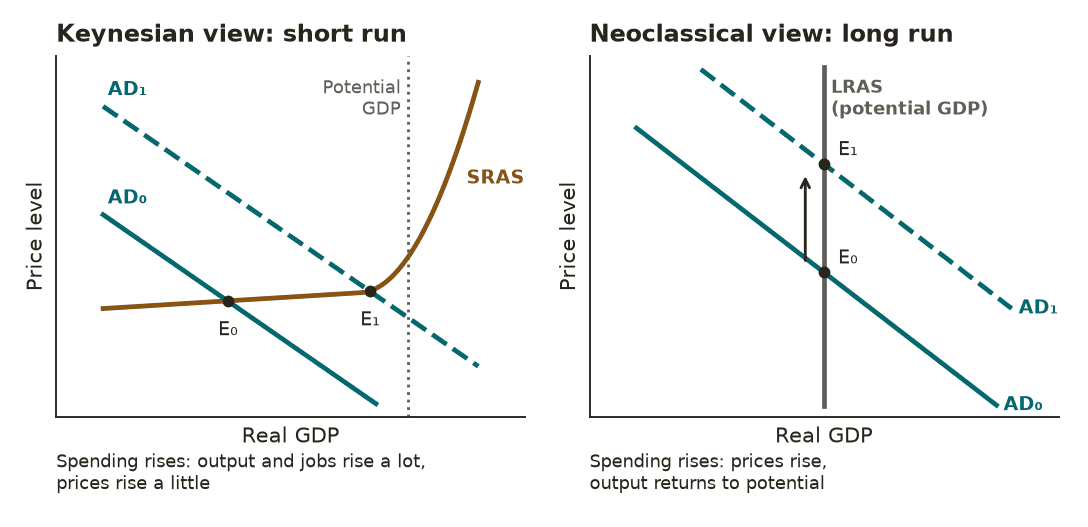
When the economy has lots of idle workers and machines, as on the left, more spending mostly raises output. When the economy is at potential, as on the right, more spending mostly raises prices. The debate is about which picture fits a given moment, and for how long.
2 The Keynesian view: demand rules the short run
John Maynard Keynes wrote during the Great Depression, when output collapsed and millions were out of work for years. His followers start from two ideas. First, recessions usually begin with a drop in spending. Second, wages and prices are sticky: they “do not respond to decreases or increases in demand,” at least not quickly. So when spending falls, firms cut output and jobs instead of prices.
Why would wages and prices stick? Changing prices has costs, called menu costs, “like the costs of printing a new set of menus with different prices in a restaurant.” Wages are even harder. Keynes stressed what OpenStax calls the coordination argument: even if most workers would accept a pay cut as long as everyone else took one too, “a market-oriented economy has no obvious way to implement a plan of coordinated wage reductions.”
Keynesians also point to the multiplier. “One person’s spending becomes another person’s income,” so a drop in spending can ripple outward, and so can a boost. A related idea is the paradox of thrift. As a St. Louis Fed essay puts it, if everyone cuts spending at once to save more, total saving can fall, “because one person’s spending is someone else’s income.” What is wise for one family can hurt the economy when everyone does it at the same time.
The policy conclusion: when the economy sits in a recessionary gap, government should help close it, with lower interest rates, tax cuts, or more spending. Keynes did not want government to run the economy. OpenStax notes that he thought government should keep total demand high enough for full employment, but that this “did not imply that the government should attempt to set prices and wages throughout the economy, nor to take over and manage large corporations or entire industries directly.”
His best-known line is often quoted out of context. Writing in 1923, Keynes granted that a classic theory of money was “probably true” in the long run, then added: “But this long run is a misleading guide to current affairs. In the long run we are all dead. Economists set themselves too easy, too useless a task if in tempestuous seasons they can only tell us that when the storm is long past the ocean is flat again.” His point was that people live in the short run, not that the future doesn’t matter.
3 The neoclassical view: markets adjust
The neoclassical view goes back to the economists Keynes argued with, and to the French economist Jean-Baptiste Say. Say’s law holds that “supply creates its own demand.” OpenStax judges that it “does seem a good approximation for the long run.” The modern version, developed by Milton Friedman, Robert Lucas, and others, starts from this idea: “even if wages and prices are ‘sticky’, or slow to change, in the short run, they are flexible over time.”
If wages and prices adjust, a recessionary gap closes on its own. Costs fall, SRAS shifts back right, and output returns to potential. Policy that tries to help can arrive late. Friedman warned that monetary policy works with “long and variable lags”: it takes time to affect the economy, and the delay is hard to predict. A stimulus that lands after recovery has begun can push the economy into an inflationary gap.
Lucas and others added the idea of rational expectations: people use all the information they have, including what they expect policymakers to do. A 1978 Minneapolis Fed essay summed up the challenge to active policy. If people see a stimulus coming, “any policy move to stimulate aggregate spending will be largely dissipated by price rises.”
The policy conclusion: don’t try to fine-tune. OpenStax says neoclassical economists “do not believe in ‘fine-tuning’ the economy.” They favor “a stable economic environment with a low rate of inflation,” with tax rates that are “low and unchanging.” The bigger task is raising potential GDP itself, through investment in skills, capital, and technology, and rules that make it easier to hire and to find work.
4 A third voice: the Austrian view
Friedrich Hayek, Keynes’s great rival in the 1930s, offered a different story, one that OpenStax does not cover. In the Austrian view, the problem starts in the boom, not the bust. When a central bank holds interest rates artificially low, the low rate sends a false price signal. It tells businesses that people have saved more for the future than they really have. Firms start long-term projects, such as homes and factories, that turn out not to be worth finishing. Peter Boettke summarizes the theory: credit expansion “generates a malinvestment in the capital structure during the boom period that must be corrected in the bust phase.”
This view fits the price-signals idea from earlier readings: prices guide, and losses discipline. Here the price that misleads is the interest rate. The policy conclusion is to avoid creating the boom in the first place, and to let the bust clear out bad investments rather than prop them up. Critics, including the MRU video below, ask why experienced business owners would be fooled again and again, and why a correction should throw so many people out of work. The video calls the Austrian view non-mainstream, but suggests it may explain some features of business cycles.
WATCH Game of Theories: The Austrians (Marginal Revolution University)
JUST FOR FUN Fear the Boom and Bust: Keynes vs. Hayek on EconStories, a 2010 rap video by John Papola and Russ Roberts. It’s fun, and it gives both sides a fair hearing.
Measure It: What the Evidence Shows
5 How big is the multiplier?
The Keynesian case rests partly on the multiplier: does a dollar of government spending raise GDP by more than a dollar? Economist Valerie Ramey reviewed a decade of new research in 2019. For government purchases, she found that multipliers are “positive but less than or equal to unity.” Most estimates fall “in a surprisingly narrow range of 0.6 to 1.” In plain words, spending raises GDP, but usually by no more than the amount spent, and sometimes less, because it can crowd out private spending.
Two findings cut the other way. Ramey notes that multipliers “could be higher” when interest rates are stuck near zero, as they were after 2008, though “the evidence for multipliers above one during recessions or times of slack is typically not robust.” And many studies find that tax changes have large effects. One lesson: the type of policy matters as much as the size.
6 Who acts in time?
Timing is where the two schools meet the record. Christina and David Romer studied U.S. recoveries after World War II. They found that the Federal Reserve “typically responds to downturns with prompt and large reductions in interest rates,” while discretionary fiscal policy “rarely reacts before the trough in economic activity, and even then the responses are usually small.” Congress takes time to agree, and new spending takes time to reach people. That is one reason most economists now see the Fed as the first responder.
Part of fiscal policy needs no vote at all. The Congressional Budget Office (CBO) describes automatic stabilizers: in a downturn, “income tax payments decline as incomes fall, and unemployment insurance spending increases as more people claim unemployment benefits.” The reverse happens in a boom. These changes start right away and fade as the economy recovers. Because they need no new law, they avoid the timing problem.
7 Two recoveries, measured
Back to the opening question. Here is what careful estimates say, and how much they leave open.
For the 2009 Recovery Act, CBO estimated that by late 2010 the law had raised real GDP by “between 1.1 percent and 3.5 percent” and lowered unemployment by 0.7 to 1.9 percentage points. That range is wide on purpose. CBO built it to “encompass most economists’ views.” Even with hindsight, careful analysts disagree by a factor of three about what the law did.
For 2020, the recession lasted only two months. In a 2025 Brookings podcast about his research with Mark Watson, James Stock noted that for the first time in 60 years, GDP returned to its pre-recession trend. He credited the fiscal response with playing an important role, but said its contribution to inflation remains an open question, adding that “everybody agrees that there is some role, at a minimum some role.” Estimates of that role differ widely, even among Federal Reserve economists:
| Study | Question asked | Estimate |
|---|---|---|
| San Francisco Fed, October 2021 (forecast) | How much would the 2021 relief package raise core inflation? | About 0.3 percentage point a year through 2022 |
| San Francisco Fed, March 2022 (look back) | How much did pandemic fiscal support raise U.S. inflation compared with other rich countries? | About 3 percentage points by the end of 2021, with “considerable uncertainty” |
Economist John Cochrane of the Hoover Institution argues more strongly that “the cause of the recent inflation was massive fiscal stimulus.” The 2022 San Francisco Fed authors add the other side of the ledger: without the spending, the economy might have tipped into deflation and slower growth, which would have been harder to manage. Both can be true. A response can speed the recovery and add to inflation at the same time.
Explain It: Where the Debate Stands
8 Riding two horses
Most economists today don’t pick one school. As OpenStax puts it, “many mainstream economists believe both the Keynesian and neoclassical perspectives.” Nobel laureate Robert Solow described the split this way: “At short time scales, I think, something sort of ‘Keynesian’ is a good approximation, and surely better than anything straight ‘neoclassical.’ At very long time scales, the interesting questions are best studied in a neoclassical framework.”
How short is short? OpenStax offers “a reasonable guess” that the effects of a demand shock “might last two to five years” before wages and prices bring the economy back to potential. It calls that guideline “frustratingly imprecise.” Much of the debate is about where a given recession falls in that range.
Some common ground has emerged. The Fed usually moves first. Automatic stabilizers help. And debt limits what government can do next time. In February 2026, CBO projected federal debt held by the public at 101 percent of GDP this year, rising to 120 percent in 2036. As an MRU video warns, if governments borrow in every downturn and never pay the debt down, “we’ll eventually back ourselves into a corner with no ammunition, just when we need it most.”
9 Supply shocks: the hard case
The case for stimulus is strongest when a recession comes from a drop in demand. It is weakest after a supply shock. When SRAS shifts left, potential output itself may have fallen, so there is less slack to fill. An MRU video explains that in this situation fiscal policy is “relatively powerless”: a big boost to demand “could increase real growth somewhat but mostly at the cost of much higher inflation.”
The 2026 oil shock, discussed in the reading on booms and busts, is an example. Output has held up while inflation has risen. Through either lens, more spending would mostly add to the price increases. This is why both schools tend to agree on supply shocks, even when they disagree about demand shocks.
10 Rules or judgment?
A newer form of the debate is about how policymakers should decide. Some economists want the Fed to follow a simple rule, such as the Taylor rule, which sets interest rates based on inflation and the output gap. Supporters say rules make policy easier to predict and harder to bend under political pressure. The Federal Reserve Board calls such rules “useful benchmarks,” but it does not follow them mechanically. It says that “the U.S. economy is highly complex,” that rules “do not capture that complexity,” and that key inputs, such as potential output, are hard to measure. The next reading in this series takes up money and the Federal Reserve.
WATCH The Limits of Fiscal Policy and Game of Theories: The Great Recession (Marginal Revolution University)
Fair Challenges
Decide what you think of each challenge first, then open the response.
“Government spending always creates jobs.”
“Recessions are the economy healing itself, so leave them alone.”
“The stimulus checks caused all the inflation.”
“Deficits don’t matter in a recession, so spend whatever it takes.”
Economists also disagree among themselves. Three live debates:
- How large is the multiplier when the economy is weak? Ramey finds most spending multipliers between 0.6 and 1 and calls the evidence for larger ones in slack times “not robust.” Others argue that multipliers are larger when interest rates are near zero and the Fed does not push back. The answer shapes how much a stimulus can do in a deep recession.
- How much did fiscal policy add to the 2021–22 inflation? Estimates from the San Francisco Fed alone range from about 0.3 to about 3 percentage points, depending on the method and the question. Cochrane argues fiscal stimulus was the main cause. Stock calls the size of its role an open question.
- Should the Fed follow a rule? Supporters of rules say they make policy predictable and limit mistakes driven by politics or forecasting errors. The Federal Reserve Board answers that rules depend on numbers, such as potential output, that cannot be measured precisely, and that the economy is too complex for a simple formula.
Notice what evidence can settle and what it can’t. How fast wages adjust, how large multipliers are, and how long policy takes to work are questions evidence can address, even when studies disagree. How much unemployment to accept to avoid inflation, how far to trust government to act wisely and on time, and how much debt to leave to future taxpayers are questions of values.
What Economics Adds
LISTEN Was the Economic Recovery from COVID-19 Unique? on the Brookings Podcast on Economic Activity, with James Stock, May 29, 2025, with transcript
LISTEN Are We Doing This Again? Andrew Ross Sorkin on “1929” on the Hoover Institution’s GoodFellows, with John Cochrane and Niall Ferguson, December 17, 2025, with transcript. The 1929 discussion comes first; the panel disagrees about what turned the crash into the Great Depression.
The Normative Question
When the economy falls into a recession, should government act quickly, or wait and let wages and prices adjust? Acting fast can shorten the pain for workers who lose their jobs, but it risks arriving late, adding to inflation, and adding to the debt. Waiting avoids those risks, but it asks the unemployed to bear the cost while markets adjust. Economics can measure the trade-offs. Deciding which risks are worth taking is a judgment about values, and reasonable people weigh them differently.
Key Terms in Plain Words
- Keynesian economics
- The view that spending drives short-run swings and that sticky wages and prices can keep the economy below potential for years.
- Neoclassical economics
- The view that wages and prices adjust over time, returning the economy to potential GDP.
- Long-run aggregate supply (LRAS)
- A vertical line at potential GDP, showing output once wages and prices have fully adjusted.
- Sticky wages and prices
- Wages and prices that adjust slowly because of contracts, menu costs, and habits.
- Menu costs
- The costs to a business of changing its prices.
- Expenditure multiplier
- The idea that a change in spending changes GDP by more than the original amount, because one person’s spending is another’s income.
- Paradox of thrift
- If everyone tries to save more at once, spending and incomes fall, and total saving may not rise.
- Automatic stabilizers
- Taxes and benefits that change on their own as the economy rises and falls, with no new law.
- Discretionary fiscal policy
- Changes in taxes or spending that require new decisions by Congress.
- Policy lags
- The delay between a problem appearing and a policy taking effect.
- Rational expectations
- The idea that people use all available information, including expected policy, to forecast the future.
- Malinvestment
- In the Austrian view, investment in projects that look profitable only because interest rates sent a false signal.
Sources
- Quotations, figures, examples, and videos in this sheet come from the sources below, current as of November 6, 2026.
- The Two Views
- David Shapiro, Daniel MacDonald, and Steven A. Greenlaw, Principles of Macroeconomics 3e, Section 11.1, “Macroeconomic Perspectives on Demand and Supply”, OpenStax, 2022 openstax.org
- David Shapiro, Daniel MacDonald, and Steven A. Greenlaw, Principles of Macroeconomics 3e, Section 12.2, “The Building Blocks of Keynesian Analysis”, OpenStax, 2022 openstax.org
- David Shapiro, Daniel MacDonald, and Steven A. Greenlaw, Principles of Macroeconomics 3e, Section 12.4, “The Keynesian Perspective on Market Forces”, OpenStax, 2022 openstax.org
- David Shapiro, Daniel MacDonald, and Steven A. Greenlaw, Principles of Macroeconomics 3e, Section 13.1, “The Building Blocks of Neoclassical Analysis”, OpenStax, 2022 openstax.org
- David Shapiro, Daniel MacDonald, and Steven A. Greenlaw, Principles of Macroeconomics 3e, Section 13.2, “The Policy Implications of the Neoclassical Perspective”, OpenStax, 2022 openstax.org
- David Shapiro, Daniel MacDonald, and Steven A. Greenlaw, Principles of Macroeconomics 3e, Section 13.3, “Balancing Keynesian and Neoclassical Models”, OpenStax, 2022 openstax.org
- John Maynard Keynes, A Tract on Monetary Reform (London: Macmillan, 1923), chapter 3, Project Gutenberg edition gutenberg.org
- E. Katarina Vermann, “Wait, Is Saving Good or Bad? The Paradox of Thrift,” Page One Economics, Federal Reserve Bank of St. Louis, May 2012 stlouisfed.org
- Federal Reserve Bank of St. Louis, “Examining Long and Variable Lags in Monetary Policy,” Regional Economist, May 2023 stlouisfed.org
- Clarence W. Nelson, “Rational Expectations—Fresh Ideas that Challenge Some Established Views of Policy Making,” Federal Reserve Bank of Minneapolis, 1978 minneapolisfed.org
- Peter J. Boettke, “Austrian School of Economics,” The Concise Encyclopedia of Economics, Econlib econlib.org
- Marginal Revolution University, “Game of Theories: The Keynesians.” youtube.com
- Marginal Revolution University, “Game of Theories: The Austrians.” youtube.com
- John Papola and Russ Roberts, “Fear the Boom and Bust: Keynes vs. Hayek,” EconStories, January 2010 youtube.com
- The Two Recessions
- U.S. Bureau of Labor Statistics, “Unemployment Rate” (UNRATE), via FRED, Federal Reserve Bank of St. Louis fred.stlouisfed.org
- U.S. Bureau of Labor Statistics, “Consumer Price Index for All Urban Consumers: All Items in U.S. City Average” (CPIAUCNS), 12-month change, via FRED, Federal Reserve Bank of St. Louis fred.stlouisfed.org
- Congressional Budget Office, “Estimated Impact of ARRA Employment and Economic Output From October 2010 Through December 2010,” February 23, 2011 cbo.gov
- The Evidence
- Valerie A. Ramey, “Ten Years After the Financial Crisis: What Have We Learned from the Renaissance in Fiscal Research?” Journal of Economic Perspectives 33, no. 2 (Spring 2019): 89–114 econweb.ucsd.edu
- Christina D. Romer and David H. Romer, “What Ends Recessions?” NBER Working Paper 4765, June 1994 nber.org
- Congressional Budget Office, Effects of Automatic Stabilizers on the Federal Budget: 2026 to 2036, August 2026 cbo.gov
- Regis Barnichon, Luiz Edgard Oliveira, and Adam H. Shapiro, “Is the American Rescue Plan Taking Us Back to the ’60s?” FRBSF Economic Letter 2021-27, Federal Reserve Bank of San Francisco, October 18, 2021 frbsf.org
- Òscar Jordà, Celeste Liu, Fernanda Nechio, and Fabián Rivera-Reyes, “Why Is U.S. Inflation Higher than in Other Countries?” FRBSF Economic Letter 2022-07, Federal Reserve Bank of San Francisco, March 28, 2022 frbsf.org
- John H. Cochrane, “Good Job, Fed,” Hoover Digest, Summer 2024, Hoover Institution (argument) hoover.org
- Where The Debate Stands
- Congressional Budget Office, The Budget and Economic Outlook: 2026 to 2036, Executive Summary, February 2026 cbo.gov
- Marginal Revolution University, “The Dangers of Fiscal Policy.” youtube.com
- Marginal Revolution University, “The Limits of Fiscal Policy.” youtube.com
- Marginal Revolution University, “Game of Theories: The Great Recession.” youtube.com
- Board of Governors of the Federal Reserve System, “Policy Rules and How Policymakers Use Them.” federalreserve.gov
- Podcasts (With Transcripts)
- Brookings Podcast on Economic Activity, “Was the Economic Recovery from COVID-19 Unique?” with James Stock, interviewed by Louise Sheiner, May 29, 2025 brookings.edu
- Hoover Institution, GoodFellows, “Are We Doing This Again? Andrew Ross Sorkin on ‘1929’ and the GoodFellows on 2025,” December 17, 2025 hoover.org