Where Does Money Come From?
What money does, how we count it, and how banks make more of it
Start Here: Where Is Your Money Right Now?
Picture all the money Americans could spend today without selling anything. In September 2026, the Federal Reserve counted about $20 trillion of it. Only about $2.4 trillion was paper bills and coins. The rest, roughly 88 cents of every dollar, existed only as numbers in bank accounts.
Coins are getting rarer still. On November 12, 2025, the U.S. Mint struck its last penny for circulation. Each one cost the Mint 3.69 cents to make and ship in 2024, nearly four times its face value. The pennies already out there are still legal money; the government just stopped making new ones.
This reading follows the Macro Foundations steps. Define It asks what money is, where it came from, and what counts as money today. Measure It shows how the Federal Reserve counts it. Explain It shows what banks do, how they earn a profit, what can go wrong, and how banks create new money when they lend. The next reading takes up the Federal Reserve itself.
The framework from the Foundations readings applies here too. A deposit is a property right: your legal claim on the bank. Interest rates are prices that guide savers and borrowers. Profits lure banks to lend where the payoff is worth the risk. Losses discipline them when they guess wrong, unless someone else absorbs the losses. That last point is the thread that runs through the whole reading.
WATCH What Is Money? (Marginal Revolution University)
Define It: What Makes Money Money?
1 Life without money
Imagine a world of barter, where every trade swaps one good for another. A plumber who wants bread has to find a baker who needs plumbing, at the same time. Economists call this the double coincidence of wants, and it is rare. Most of the day would be spent searching for trading partners instead of working.
Money ends the search. The plumber sells plumbing to anyone for money and buys bread from any baker with it. That frees people to specialize, the source of the gains from trade described in Why Do We Trade? It also lets prices do their work: when every good is priced in the same unit, prices can carry information, as Where Do Prices Come From? explains.
2 How money came about
Money was rarely invented by decree. More often, traders settled on whatever goods others would accept, and those goods came to serve as money. History offers many examples:
- Cowrie shells. Small, durable, and hard to fake, strings of cowrie shells were used in payments in China from around 1000 BCE, and later in many other parts of the world.
- Stone money on Yap. On the Pacific island of Yap, large carved stone wheels served as money. Big stones often stayed put when they changed hands; everyone simply knew who owned them. Milton Friedman pointed out that this is not so different from gold that sits in a vault while its ownership changes on paper.
- Coins. The kingdom of Lydia, in what is now Turkey, made some of the first coins, around 650 BCE, from a natural mix of gold and silver made to set weights. A stamped coin saved buyers and sellers from weighing and testing metal at every sale.
- Tobacco and cigarettes. Colonial Virginia used tobacco as money. In World War II prisoner-of-war camps, economist R. A. Radford, himself a prisoner, saw cigarettes become the camp’s money. Prices were quoted in cigarettes, even by prisoners who didn’t smoke.
- Paper money that failed. The Continental Congress paid for the Revolutionary War with paper notes backed only by the hope of future taxes. It printed so many that they lost nearly all their value, giving rise to the saying “not worth a Continental.” In the 2000s, Zimbabwe printed money until prices rose by billions of percent a month and the government issued 100-trillion-dollar notes.
The lesson of these examples is that people accept money because they expect others to accept it. When that expectation breaks, as it did for the Continental and the Zimbabwe dollar, people abandon the money.
3 What money does
Economists define money by what it does, not by what it is made of. Money has three main functions:
- Medium of exchange: people accept it as payment for goods and services.
- Unit of account: prices, wages, and debts are measured in it, so you can compare the price of a car with a year of rent.
- Store of value: it can be held and spent later. It does this job well only if prices stay fairly stable.
Some textbooks add a fourth function, a standard of deferred payment: debts that will be repaid in the future are written in money. To do these jobs well, the Federal Reserve’s education program notes, money should be divisible, portable, acceptable, scarce, durable, and stable in value. Cowrie shells passed most of these tests. Fresh fish would not.
TRY IT Functions of Money (an interactive from Marginal Revolution University. Sort everyday examples by which function of money they show.)
4 Commodity money and fiat money
Commodity money has value of its own: gold, silver, shells, cigarettes. Commodity-backed money is paper that can be swapped for a set amount of a commodity, as dollars once could be swapped for gold. Fiat money has no backing at all. It is money because the government declares it legal tender for debts and taxes, and because people trust it to hold its value.
The United States moved from one to the other in steps:
- 1900: the Gold Standard Act made gold the sole standard for the dollar.
- 1933–34: in the Great Depression, the government required Americans to turn in their gold coins and bars, banned the redemption of dollars for gold at home, and raised the official price of gold from $20.67 to $35 an ounce. The Gold Reserve Act of 1934 completed the change.
- 1971: the United States stopped exchanging dollars for gold even with foreign governments, ending its last official link to gold.
What holds up the value of a fiat dollar, then? Three things: people expect others to accept it; the government accepts it for taxes; and the central bank keeps it from losing value too fast. The third is the job of the Federal Reserve, the subject of the next reading. A gold standard limits how fast money can grow, which can protect against inflation. But, as St. Louis Fed economist Scott Wolla notes, it also ties the money supply to gold discoveries and to gold flowing in and out of the country, which can make prices and the economy less stable.
5 What counts as money today?
Applying the three functions gives a rough sorting:
| Examples | Why | |
|---|---|---|
| Money | Currency; checking deposits; savings deposits | Accepted for payment, or moved into a checking account in moments. |
| Near money | Small certificates of deposit (CDs); retail money market funds | Hold value and turn into money quickly, but are not usually spent directly. |
| Not money | Credit cards; gift cards; airline miles; stocks; gold | A credit card is a loan you repay later with money. Gift cards and miles work at only some places. Stocks and gold store value, but you can’t pay for groceries with them. |
| Gray zone | Payment app balances; payment stablecoins; bitcoin | An app balance is a claim on a company that holds bank deposits. A stablecoin is a token that promises a steady dollar value. Bitcoin is used for some payments, but its price swings make it a poor unit of account for most people. |
The gray zone is where much of the news is. Section 12 and the news box return to it.
Measure It: Counting the Money Supply
6 The monetary base, M1, and M2
There is no single line between money and almost-money, so the Federal Reserve publishes several measures, ordered by liquidity: how quickly and cheaply something can be spent without losing value.
- The monetary base: currency plus the reserves banks keep in their accounts at the Federal Reserve. It is the money the Fed creates directly. In September 2026 it was about $5.4 trillion.
- M1: currency held by the public, checking deposits, and savings deposits. About $20.1 trillion.
- M2: M1 plus small CDs (under $100,000) and retail money market funds. About $23.4 trillion, up 5.7 percent from a year earlier.
The graph shows what each measure is made of.
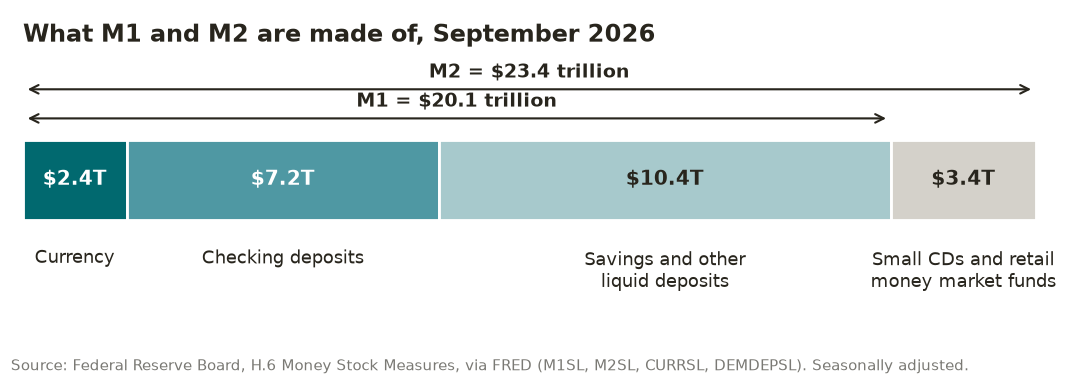
Two things stand out. Currency is a small slice. And reserves, the largest part of the monetary base, aren’t in M1 or M2 at all, because they belong to banks, not to the public. Reserves are the money banks use to pay one another.
7 Check the definition before reading the trend
In May 2020, M1 jumped from about $4.9 trillion to $16.3 trillion in a single month. No one printed $11 trillion. The Federal Reserve had changed the definition: banks had been free since April 2020 to let savers make unlimited transfers from savings accounts, so savings deposits now worked like checking deposits and moved into M1. Marginal Revolution University added a note to its video for the same reason.
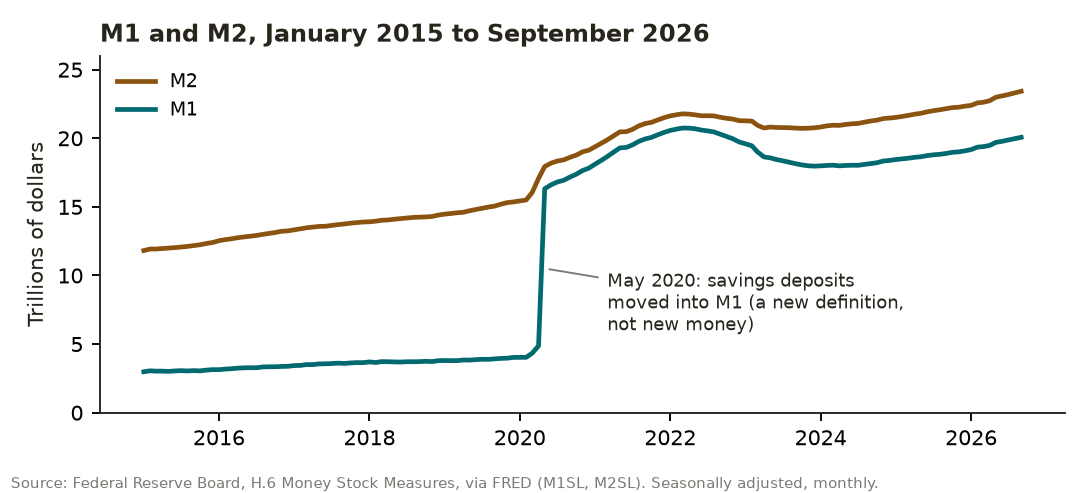
M2 is the better guide across that break, because it counted savings deposits all along. It tells a real story. M2 grew about 40 percent from February 2020 to its peak in March 2022, during the pandemic. Then, from late 2022 through early 2024, it was lower than a year earlier, the first such declines in the series since it began in 1959. How those swings relate to inflation is the subject of the inflation and Federal Reserve readings.
Explain It: What Banks Do
8 Four jobs
A bank is a business that takes deposits and makes loans. In doing so, it does four jobs:
- It runs payments. Checks, debit cards, and transfers all move money from one bank account to another. In 2025, Americans made an average of 47 payments a month: 16 by credit card, 15 by debit card, and 6 in cash. Cash was 14 percent of all payments and about 20 percent of in-person ones. The Federal Reserve’s FedNow service, launched in July 2023, lets banks settle payments instantly, at any hour.
- It connects savers and borrowers. Banks are financial intermediaries. A saver doesn’t have to find a business that needs a loan; the bank does that.
- It turns short-term deposits into long-term loans. Depositors want their money available any day. Borrowers want years to repay a mortgage or business loan. Banks bridge the two, which economists call maturity transformation. It is useful, and, as section 10 shows, it is also the source of bank runs.
- It screens and spreads risk. Banks judge which borrowers are likely to repay, and lend to many of them, so one default doesn’t sink a depositor.
Banks aren’t the only lenders. Credit unions are owned by their members. Money market funds, private credit funds, and other “shadow banks” do some of the same jobs without taking insured deposits, and they face lighter rules. In mid-2026, the Federal Deposit Insurance Corporation (FDIC) insured 4,238 banks and savings institutions. In 1984 there were about 14,400 commercial banks alone.
WATCH What Are Shadow Banks? (Marginal Revolution University)
9 How a bank earns a profit
A bank’s balance sheet shows what it owns and what it owes. Assets are what it owns: reserves, government bonds, and loans. Liabilities are what it owes: mostly deposits, which customers can withdraw. Capital is the difference, the owners’ stake. Here is a simple bank, in millions of dollars:
| Balance sheet item | Type | Before | After a $1 million loan |
|---|---|---|---|
| Reserves (at the Fed and in the vault) | Asset | $10 | $10 |
| Securities (mostly government bonds) | Asset | $20 | $20 |
| Loans | Asset | $70 | $71 |
| Deposits | Liability | $90 | $91 |
| Capital (the owners’ stake) | Capital | $10 | $10 |
| Total assets = liabilities + capital | $100 | $101 |
The bank earns interest on its loans and bonds, pays interest on its deposits, and keeps the difference, plus fees. The gap between what it earns and what it pays, measured against its interest-earning assets, is its net interest margin. In the second quarter of 2026, U.S. banks earned a net interest margin of 3.32 percent and a total profit of $90.1 billion, a 1.37 percent return on their assets.
Capital matters because it absorbs losses first. In the example, capital is 10 percent of assets. If 5 percent of the bank’s assets went bad, the owners would lose half their stake, but depositors would still be paid. If more than 10 percent went bad, capital would be gone. Borrowing a lot relative to capital, called leverage, raises the owners’ return in good years and their losses in bad ones. That is the trade-off at the heart of the capital debate in the Fair Challenges.
10 What can go wrong
Banking is a business of managing risks:
- Credit risk: borrowers don’t repay.
- Interest-rate risk: the bank holds long-term loans or bonds at fixed rates, while the rates it must pay depositors can rise. When rates rise, the market value of old, low-rate bonds falls.
- Liquidity risk: depositors want their money faster than the bank can turn its assets into cash without selling at a loss.
- Concentration risk: too many loans or depositors in one industry or place.
- Operational risk: fraud, mistakes, and cyberattacks.
A bank run is the most dramatic failure. Because a bank keeps only part of its deposits in cash and reserves, it can’t pay everyone at once. If depositors fear the bank will fail, each has a reason to withdraw first, and the fear can make the failure happen. Douglas Diamond and Philip Dybvig, who shared the 2022 Nobel Prize in economics, showed that this can happen even to a sound bank.
The United States has had many waves of bank failures: the panics of the 1800s, thousands of failures in the early 1930s, the savings-and-loan crisis of the 1980s, and the 2008 financial crisis. Economists Charles Calomiris and Stephen Haber count twelve systemic banking crises in the United States since 1840, and none in Canada, a contrast they trace to how each country’s politics shaped its banks. In their account, Canada allowed a few large banks with branches across the country, each spread over many regions and industries, while the United States long limited banks to a single state, or even a single office, leaving thousands of small banks tied to local economies.
WATCH Four Reasons Financial Intermediaries Fail (Marginal Revolution University)
11 Managing the risks
What banks do themselves. Banks spread their loans across many borrowers, screen borrowers before lending, keep a cushion of liquid assets, hedge against swings in interest rates, and hold capital. A bank that does these poorly earns more in good times and fails in bad ones, as Silicon Valley Bank did.
What government adds. Four main tools:
- Deposit insurance. Congress created the FDIC in 1933, after thousands of banks failed. Today it insures at least $250,000 per depositor, per bank, for each type of account. Since 1933, the FDIC says, no depositor has lost a penny of insured funds. Banks pay for the insurance; in mid-2026 the fund held 1.48 percent of insured deposits.
- Capital and liquidity rules. Regulators require banks to fund part of their assets with owners’ capital and to hold enough liquid assets to survive a period of withdrawals.
- Supervision and stress tests. Examiners review banks’ books, and the largest banks must show they could survive a severe recession on paper.
- A lender of last resort. The Federal Reserve can lend to sound banks that are short of cash. The next reading explains how.
These tools come with a trade-off. When deposits are guaranteed, depositors stop watching how their bank takes risks, and a bank’s owners keep the gains from risky bets while others bear part of the losses. Economists call this moral hazard, and it is the reason losses no longer discipline banks as fully as they discipline other businesses. Capital rules and supervision try to supply the discipline that guarantees take away. Some economists, such as George Selgin, argue that a freer system would need fewer guarantees. They point to Scotland in the early 1800s, where, in Selgin’s account, competing private banks issued their own notes with little regulation and the system stayed unusually stable.
12 How banks create money
Here is the part that surprises most people. When a bank makes a loan, it doesn’t hand over someone else’s savings. It types a new deposit into the borrower’s account. Look again at the balance sheet: the $1 million loan added $1 million in loans and $1 million in deposits. That deposit is new money. The Bank of England put it plainly in 2014: “the majority of money in the modern economy is created by commercial banks making loans.” When a loan is repaid, the process runs in reverse, and that money disappears.
Banks can’t create money without limit. Each loan must be profitable: the bank has to find borrowers who will repay at a rate that covers its costs and risks. Each loan needs capital behind it, under the rules above. And once the borrower spends the money, it usually moves to another bank, so the lending bank must have the reserves to settle the payment, or attract deposits or other funding to replace them. The interest rate the Federal Reserve pays on reserves also shapes how much banks want to lend, the subject of the next reading.
WATCH Fractional Reserve Banking and the Money Multiplier Made Simple (Marginal Revolution University; recorded in 2017, when banks still had to hold 10 percent of checking deposits as reserves)
Money and Banking in the News
Several of the biggest stories in banking as of fall 2026 come back to the questions in this reading: what counts as money, who may create it, and who bears the losses.
Stablecoins. A payment stablecoin is a digital token that promises to be worth one dollar, backed by safe assets. The Federal Reserve counted about $320 billion of stablecoins in spring 2026, mostly used for trading crypto-assets. A 2025 law, the GENIUS Act, sets the first federal rules. Issuers must hold at least a dollar of cash, bank deposits, or short-term Treasury bills for each token. They may not pay interest, and the tokens are not insured or backed by the government. The rules take effect January 18, 2027. The open question is whether stablecoins will pull deposits out of banks, reducing what banks can lend.
Tokenized deposits. Banks are answering with their own digital tokens. A tokenized deposit is an ordinary bank deposit represented on a blockchain. In June 2026, twelve of the largest U.S. banks announced plans for a shared network by 2027.
Rewriting the capital rules. In March 2026, federal bank regulators proposed new capital rules to replace a 2023 plan, and a separate change to a leverage rule for the largest banks took effect April 1, 2026. The regulators said the proposals would modestly reduce capital requirements for large banks, better match them to risk, and reduce penalties on mortgage lending. A Federal Reserve governor who dissented estimated that, together with proposed stress-test changes, the largest banks’ core capital requirements would fall 4.8 percent.
“Debanking.” Some customers and industries have said banks closed their accounts for political or social reasons. In 2025, bank regulators stopped examining banks for “reputation risk,” and an executive order, “Guaranteeing Fair Banking for All Americans,” directed them to remove it from their rules. In October 2026, the Office of the Comptroller of the Currency (OCC), which regulates national banks, reported that all nine of the largest national banks had policies from 2020 to 2025 that may have limited services because of customers’ political or religious views or lawful industries, such as oil and gas, firearms, and digital assets. The Bank Policy Institute, a bank industry group, responded that “it’s in banks’ best interest to take deposits, lend to and support as many consumers and businesses as possible,” and that banks must still be free to manage financial-crime risks under anti-money-laundering laws.
Banks lending to other lenders. Private credit funds and other nonbank lenders have grown fast. The Boston Fed found in November 2026 that banks had lent $1.7 trillion to these firms, up about 40 percent since late 2024, partly because of new reporting rules. That links the less regulated lenders back to insured banks.
Cash and access. Cash is now 14 percent of payments, and the penny is gone. In 2023, the FDIC found, 4.2 percent of U.S. households had no bank account, and 14.2 percent had one but also used check cashers, payday lenders, or similar services.
For later readings. Bills in Congress would cap credit card interest rates at 10 percent, a price ceiling with familiar trade-offs. The dollar’s role as the world’s main reserve currency and the Federal Reserve’s tools come next.
Fair Challenges
Decide what you think of each challenge first, then open the response.
“Banks just lend out the money people deposit.” / “Banks create money out of thin air.”
“Fiat money is a confidence trick; we should go back to gold.” / “A government that prints its own money can pay for anything.”
“Bitcoin is the future of money.” / “Crypto is all fraud.”
“Deposit insurance and bailouts make banks reckless.” / “Without them, panics would topple sound banks too.”
“Capital rules choke lending.” / “Banks need far more capital.”
Economists also disagree among themselves. Three live debates:
- How much capital is enough? Admati and Hellwig argue for much higher levels. The 2026 proposals move the other way for the largest banks. Studies differ on how much more capital raises banks’ costs and lowers lending.
- Should deposit insurance cover more? In 2023, the FDIC compared keeping the current limit, insuring all deposits, and insuring business payment accounts more fully. It leaned toward the last, which would protect payrolls without insuring every large deposit, but it noted that any expansion weakens depositor discipline.
- Will stablecoins drain bank lending? A May 2026 Federal Reserve note finds that banks have adapted to past innovations, such as money market funds, and that stablecoin reserves often flow back into banks. A New York Fed staff report finds that banks serving stablecoin issuers hold more reserves and make fewer loans. Research at the Bank for International Settlements finds that stablecoins and deposits are partial substitutes. A September 2026 analysis by the White House Council of Economic Advisers estimates that banning interest on stablecoins adds little to bank lending.
Notice what evidence can settle and what it can’t. How banks create money, how often runs sink sound banks, how much capital and insurance cost, and how far stablecoins draw deposits away are questions evidence can answer, even if the answers are still coming in. How much risk taxpayers should bear, how much freedom banks and new private monies should have, and how to weigh stability against access, cost, and innovation are questions of values.
What Economics Adds
LISTEN Inside the Mysterious World of Credit Cards on EconTalk, with payments expert Patrick McKenzie and host Russ Roberts, May 19, 2025, with transcript. McKenzie explains how card payments work, who earns money from them, and whether cash and debit users pay for credit card rewards.
LISTEN The Rise and Fall of Global Currencies on EconoFact Chats, with economic historian Barry Eichengreen of the University of California, Berkeley, May 10, 2026, with transcript. Eichengreen traces how currencies from ancient coins to the dollar won and lost the world’s trust, and what that means for the dollar and stablecoins.
The Normative Question
Deposit insurance and emergency lending protect depositors and stop panics, but they shift part of the risk of bank failures from bank owners to everyone else. If taxpayers and other banks stand behind deposits, how far should that guarantee reach, and how much of their own money should bank owners have to put at risk in return? More capital and narrower guarantees put more of the losses on owners and large depositors, but may raise the cost of loans. Broader guarantees and lighter rules make runs less likely and lending cheaper, but ask others to share in the losses. Economics can show what each choice costs and who bears it. Choosing among them depends on how you weigh stability, cost, freedom, and fairness.
Key Terms in Plain Words
- Barter
- Trading goods or services directly, without money.
- Double coincidence of wants
- When each trader has what the other wants, which barter requires.
- Medium of exchange
- Something widely accepted as payment.
- Unit of account
- The measure in which prices and debts are stated.
- Store of value
- Something that can be held and spent later without losing much value.
- Liquidity
- How quickly and cheaply an asset can be spent or turned into money.
- Commodity money
- Money with value of its own, such as gold or shells.
- Fiat money
- Money with no backing, accepted because the government declares it legal tender and people trust it.
- Monetary base
- Currency plus the reserves banks hold at the Federal Reserve.
- M1 and M2
- Measures of money: M1 is currency, checking, and savings deposits; M2 adds small CDs and retail money funds.
- Financial intermediary
- A firm, such as a bank, that moves funds from savers to borrowers.
- Balance sheet
- A list of what a firm owns (assets) and owes (liabilities), with capital as the difference.
- Bank capital
- The owners’ stake in a bank, which absorbs losses before depositors.
- Net interest margin
- What a bank earns on loans and securities minus what it pays on deposits, as a share of its assets.
- Bank run
- When many depositors withdraw at once because they fear the bank will fail.
- Deposit insurance
- A guarantee that depositors will be repaid up to a limit if a bank fails.
- Moral hazard
- Taking more risk because someone else will bear part of the loss.
- Stablecoin
- A digital token designed to keep a steady value, such as one dollar, backed by reserve assets.
Sources
- Quotations, figures, examples, and videos in this sheet come from the sources below, current as of November 6, 2026.
- Start Here
- Federal Reserve Bank of St. Louis, FRED, “M1” (M1SL), from the Federal Reserve Board’s H.6 release fred.stlouisfed.org
- Federal Reserve Bank of St. Louis, FRED, “Currency Component of M1” (CURRSL), from the Federal Reserve Board’s H.6 release fred.stlouisfed.org
- Associated Press, “US Mint Presses Final Pennies as Production Ends after More than 230 Years,” November 13, 2025, via The Gazette gazette.com
- United States Mint, 2024 Annual Report (unit cost of the penny) usmint.gov
- Marginal Revolution University, “What Is Money?.” youtube.com
- Define It
- OpenStax, Principles of Macroeconomics 3e, Section 14.1, “Defining Money by Its Functions.” openstax.org
- Federal Reserve Bank of St. Louis, “Money and Inflation: A Functional Relationship,” Page One Economics, March 2013 stlouisfed.org
- British Museum, Money Gallery (Room 68) guide (cowrie shells; Lydian coins) britishmuseum.org
- Milton Friedman, “The Island of Stone Money,” Hoover Institution Working Papers in Economics E-91-3, 1991 miltonfriedman.hoover.org
- Federal Reserve Bank of Cleveland, “Paper Money and Inflation in Colonial America,” Economic Commentary 2015-06 (tobacco money) clevelandfed.org
- R. A. Radford, “The Economic Organisation of a P.O.W. Camp,” Economica 12, no. 48 (1945): 189–201 msuweb.montclair.edu
- Federal Reserve Bank of San Francisco, “Independence: Colonial and Continental Currency.” frbsf.org
- Federal Reserve Education, “What Is Money?” (functions and characteristics) federalreserveeducation.org
- Marginal Revolution University, “Functions of Money” interactive learn.mru.org
- Congressional Research Service, “Brief History of the Gold Standard in the United States,” R41887 congress.gov
- Federal Reserve History, “Gold Reserve Act of 1934.” federalreservehistory.org
- Federal Reserve History, “Nixon Ends Convertibility of U.S. Dollars to Gold and Announces Wage/Price Controls,” August 1971 federalreservehistory.org
- Scott A. Wolla, “Would a Gold Standard Brighten Economic Outcomes?” Page One Economics, Federal Reserve Bank of St. Louis, January 2015 stlouisfed.org
- Scott A. Wolla, “Bitcoin: Money or Financial Investment?” Page One Economics, Federal Reserve Bank of St. Louis, March 2018, via FRASER fraser.stlouisfed.org
- Measure It
- OpenStax, Principles of Macroeconomics 3e, Section 14.2, “Measuring Money: Currency, M1, and M2.” openstax.org
- Federal Reserve Bank of St. Louis, FRED, “M2” (M2SL), from the Federal Reserve Board’s H.6 release fred.stlouisfed.org
- Federal Reserve Bank of St. Louis, FRED, “Demand Deposits” (DEMDEPSL), from the Federal Reserve Board’s H.6 release fred.stlouisfed.org
- Federal Reserve Bank of St. Louis, FRED, “Monetary Base; Total” (BOGMBASE) fred.stlouisfed.org
- Federal Reserve Board, “Money Stock Measures - H.6 Release, Technical Q&As” (savings deposits moved into M1) federalreserve.gov
- Federal Reserve Board, H.6 release of February 23, 2021 (reclassification after the April 24, 2020, change to Regulation D) federalreserve.gov
- Explain It
- OpenStax, Principles of Macroeconomics 3e, Section 14.3, “The Role of Banks.” openstax.org
- Federal Reserve Financial Services, “2026 Diary of Consumer Payment Choice.” frbservices.org
- Federal Reserve Financial Services, 2026 Diary of Consumer Payment Choice, full report (PDF) frbservices.org
- Federal Reserve Board, “FedNow Service.” federalreserve.gov
- Marginal Revolution University, “What Are Shadow Banks?.” youtube.com
- Federal Deposit Insurance Corporation, “FDIC-Insured Institutions Reported Return on Assets of 1.37 Percent and Net Income of $90.1 Billion in Second Quarter 2026,” August 25, 2026 fdic.gov
- Federal Deposit Insurance Corporation, statement on the Quarterly Banking Profile, second quarter 2026 fdic.gov
- Federal Reserve Bank of St. Louis, FRED, “Commercial Banks in the U.S.” (USNUM, discontinued) fred.stlouisfed.org
- The Royal Swedish Academy of Sciences, press release on the 2022 Prize in Economic Sciences (Bernanke, Diamond, and Dybvig) nobelprize.org
- Federal Reserve Board, Review of the Federal Reserve’s Supervision and Regulation of Silicon Valley Bank, April 2023 federalreserve.gov
- Charles W. Calomiris and Stephen H. Haber, Fragile by Design: The Political Origins of Banking Crises and Scarce Credit, Princeton University Press, 2014 (argument) press.princeton.edu
- Michael D. Bordo, Angela Redish, and Hugh Rockoff, “Why Didn’t Canada Have a Banking Crisis in 2008 (or in 1930, or 1907, or …)?” NBER Working Paper 17312 nber.org
- Marginal Revolution University, “Four Reasons Financial Intermediaries Fail.” youtube.com
- Federal Deposit Insurance Corporation, “Understanding Deposit Insurance.” fdic.gov
- Federal Deposit Insurance Corporation, “1930–1939” (FDIC history) fdic.gov
- Federal Deposit Insurance Corporation, The First Fifty Years, prologue (bank failures in 1934) fdic.gov
- Cato Institute, “An Updated Interview with George Selgin on Free Banking and Bitcoin” (argument) cato.org
- OpenStax, Principles of Macroeconomics 3e, Section 14.4, “How Banks Create Money.” openstax.org
- Michael McLeay, Amar Radia, and Ryland Thomas, “Money Creation in the Modern Economy,” Bank of England Quarterly Bulletin, 2014 Q1 bankofengland.co.uk
- Federal Reserve Board, “Reserve Requirements.” federalreserve.gov
- Federal Reserve Bank of St. Louis, FRED, “Reserve Balances with Federal Reserve Banks” (WRESBAL) fred.stlouisfed.org
- Federal Reserve Bank of St. Louis, “Teaching the Linkage Between Banks and the Fed: R.I.P. Money Multiplier,” Page One Economics, September 2021 stlouisfed.org
- Marginal Revolution University, “Fractional Reserve Banking and the Money Multiplier Made Simple.” youtube.com
- In The News
- Federal Reserve Board, Financial Stability Report, May 2026, “Funding Risks” (stablecoins) federalreserve.gov
- Congressional Research Service, report R49351 (the GENIUS Act, P.L. 119-27) congress.gov
- Office of the Comptroller of the Currency, Bulletin 2026-50, GENIUS Act final rule occ.gov
- Federal Reserve Bank of Kansas City, “A Brief History of Deposit Tokens and Tokenized Deposits.” kansascityfed.org
- Federal Reserve Board, press release on proposals to modify capital requirements, March 19, 2026 federalreserve.gov
- Federal Reserve Board, statement by Governor Michael S. Barr on the capital proposals, March 19, 2026 federalreserve.gov
- Federal Reserve Board, “Agencies Issue Final Rule to Modify Certain Regulatory Capital Standards,” November 25, 2025 federalreserve.gov
- Office of the Comptroller of the Currency, “OCC Ceases Examinations for Reputation Risk,” News Release 2025-21, March 20, 2025 occ.gov
- Federal Register, Executive Order 14331, “Guaranteeing Fair Banking for All Americans,” August 12, 2025 federalregister.gov
- Office of the Comptroller of the Currency, News Release 2026-90, review of the nine largest national banks, October 14, 2026 occ.gov
- Bank Policy Institute, “BPInsights: December 13, 2025” (response to the OCC’s account-closure review; argument) bpi.com
- Federal Reserve Bank of Boston, “Bank Lending to Non-Bank Financial Intermediaries Reaches $1.7 Trillion,” November 4, 2026 bostonfed.org
- Federal Reserve Bank of Cleveland, “The Accounts of the Unbanked and Underbanked,” Economic Commentary 2026-02 (citing the FDIC’s 2023 survey) clevelandfed.org
- Federal Deposit Insurance Corporation, National Survey of Unbanked and Underbanked Households fdic.gov
- Congress.gov, S.381, 10 Percent Credit Card Interest Rate Cap Act, 119th Congress congress.gov
- Fair Challenges
- Marginal Revolution University, Econ Duel, “Sumner/White: Fiat Money vs. the Gold Standard.” learn.mru.org
- Federal Reserve Bank of Cleveland, “Will US Firms Adopt Stablecoins?” Economic Commentary 2026-22 clevelandfed.org
- Federal Deposit Insurance Corporation, “Joint Statement by the Department of the Treasury, Federal Reserve, and FDIC,” March 12, 2023 fdic.gov
- Anat Admati and Martin Hellwig, The Bankers’ New Clothes: What’s Wrong with Banking and What to Do about It, Princeton University Press (argument) press.princeton.edu
- Federal Deposit Insurance Corporation, Options for Deposit Insurance Reform, 2023 fdic.gov
- Federal Reserve Board, “Banks in the Age of Stablecoins: Lessons from Their Historical Responses to Financial Innovations,” FEDS Notes, May 1, 2026 federalreserve.gov
- Michael Junho Lee and Donny Tou, “Stablecoin Disintermediation,” Federal Reserve Bank of New York Staff Report 1185, February 2026 newyorkfed.org
- Rashad Ahmed and Iñaki Aldasoro, “Are Stablecoins and Bank Deposits Substitutes?” BIS Working Paper 1382, October 2026 bis.org
- White House Council of Economic Advisers, “Effects of Stablecoin Yield Prohibition on Bank Lending,” September 15, 2026 (argument) whitehouse.gov
- Podcasts (With Transcripts)
- EconTalk, “Inside the Mysterious World of Credit Cards (with Patrick McKenzie),” May 19, 2025 econtalk.org
- EconoFact Chats, “The Rise and Fall of Global Currencies” (with Barry Eichengreen), May 10, 2026 econofact.org