What Sets the Price of Borrowing?
Interest rates, saving, investing, and limits on what lenders may charge
Start Here: The 10 Percent Question
Most people who carry a credit card balance pay a high price for it. In the third quarter of 2026, the average interest rate on credit card accounts that were charged interest was 22.36 percent a year, according to the Federal Reserve. Someone who carries a $3,000 balance at that rate pays several hundred dollars a year just for the use of the money.
In January 2026 the White House called for a one-year cap of 10 percent on credit card interest rates. A bill in the Senate, the 10 Percent Credit Card Interest Rate Cap Act, would write a cap into law. Its sponsor is an independent, and its cosponsors include a Republican and two Democrats. Congress.gov lists no action on the bill since it was sent to committee, and no cap is in effect. The idea is popular for an obvious reason: it would cut the price of borrowing for millions of people in half.
The Foundations readings give us the tools. Where Do Prices Come From? showed how supply and demand set a price, and Does Rent Control Make Housing Affordable? showed what happens when the law holds a price down. Why Do Some Jobs Pay More Than Others? showed that a wage is a price. This reading takes up the other price that touches almost everyone: the interest rate, the price of borrowing.
The Interest Rate Is a Price
A financial market brings together people who have money they don’t need right now and people who want to use money now and pay it back later. OpenStax’s Principles of Economics describes the two sides: “Those who save money (or make financial investments, which is the same thing), whether individuals or businesses, are on the supply side of the financial market. Those who borrow money are on the demand side of the financial market.”
Savers expect to be paid for waiting, and borrowers expect to pay for not waiting. That payment is the rate of return, and the simplest rate of return is the interest rate. As OpenStax puts it, “The laws of demand and supply continue to apply in the financial markets.” A higher interest rate makes people borrow less and save more. A lower rate does the reverse.
Demand for borrowing shifts when people’s plans change. OpenStax gives two examples. In the technology boom of the late 1990s, “many businesses became extremely confident that investments in new technology would have a high rate of return, and their demand for financial capital shifted to the right.” During the Great Recession of 2008 and 2009, demand shifted to the left. Supply shifts too. When households save more, more money is available to lend, and the interest rate tends to fall. What Does the Fed Do? explains how the central bank moves short-term interest rates. This reading is about the market forces underneath.
WATCH Saving and Borrowing (Marginal Revolution University)
Where Firms Get Money
Businesses need money to build plants, buy equipment, and pay workers before the sales come in. OpenStax lists four main sources:
| Source | How it works | Trade-off |
|---|---|---|
| Early-stage investors | Owners, friends, “angel investors,” and venture capital firms put money into new firms in exchange for a share of ownership. | Willing to take big risks, because a few huge successes can make up for many failures. |
| Profits | An established firm reinvests some of its own earnings. | New firms have few profits to reinvest, and even large firms have bad years. |
| Borrowing | A bank loan or a bond: the firm promises to repay the money plus interest on a schedule. | The firm keeps control, but it must pay whether or not sales are good. |
| Selling stock | “Stock represents firm ownership.” Buyers become part owners. | No repayment is required, but the firm answers to shareholders and a board of directors. |
Each choice moves risk around. A bondholder gets a fixed promise and is paid before the owners. A shareholder gets no promise at all, but shares in the gains if the firm does well. Why Do Profits and Losses Matter? showed that profits draw money toward firms that serve customers well, and losses pull it away. Financial markets are how that money moves.
The people who watch over a firm’s managers are part of the system too. Economists call this corporate governance: the board of directors, outside auditors, and large investors. OpenStax uses Lehman Brothers as a warning. In 2008, the 164-year-old investment bank failed after its board did too little to keep managers from taking excessive risks. In OpenStax’s words, “corporate governance failed to provide investors with accurate financial information about the firm’s operations.” Markets for money work only as well as the information that flows through them.
Where Savers Put Money
Savers face three questions about any place to put their money. What is the expected return? What is the risk, meaning how uncertain is that return? And how liquid is it, meaning how easily can the money be turned back into cash to spend? No investment wins on all three. OpenStax summarizes the trade-offs:
| Investment | Return | Risk | Liquidity |
|---|---|---|---|
| Savings account | Low | Very little | High |
| Certificate of deposit | Low to medium | Very little | Medium |
| Bonds | Medium | Low to medium | Medium |
| Stocks | High | Medium to high | Medium |
| Mutual funds | Medium to high | Medium to high | Medium to high |
| Housing | Medium | Medium | Low |
A bank account is the safe end. As OpenStax puts it, “low risk means low rate of return but high liquidity.” Where Does Money Come From? explains why deposit insurance makes bank accounts so safe. Stocks are at the other end: higher returns on average, with no promise in any one year.
Bonds have a twist that surprises many people. A bond pays a fixed rate of interest. If market interest rates rise after the bond is issued, new bonds pay more, so no one will pay full price for the old one. OpenStax explains: “When interest rates rise, bonds previously issued at lower interest rates will sell for less than face value.” When rates fall, old bonds sell for more. Bond prices and interest rates move in opposite directions.
The best answer to risk is old advice. Spreading money across many investments means that one failure doesn’t sink the whole. A saver who does this, OpenStax notes, “is following the old proverb: ‘Don’t put all your eggs in one basket.’” A mutual fund lets a small saver own a little of many companies at once.
WATCH Investing: Why You Should Diversify (Marginal Revolution University)
Why It’s Hard to Get Rich Quick
If some stocks will rise more than others, why not just buy those? The problem, OpenStax explains, is that “many other financial investors are trying to do the same thing.” If a company is expected to earn big profits, buyers have already pushed up its stock price. To beat the market, an investor has to find news that no one else has noticed yet, and new news is, by definition, hard to predict. So stock prices follow what OpenStax calls “a random walk with a trend”: on any given day they are “just as likely to rise as to fall,” but over time the upward steps tend to be larger, so stocks gradually climb.
The evidence is hard on stock pickers. S&P Dow Jones Indices, which publishes the S&P 500, compares professionally managed funds with the market every year. In 2025, “79% of all active large-cap U.S. equity funds underperformed the S&P 500.” That was worse than usual, but OpenStax notes that “it is typically true that half or two-thirds of the mutual funds that attempted to pick stocks which would rise more than the market average actually ended up performing worse than the market average.” That is why many savers buy an index fund, which simply owns a slice of the whole market. John Bogle, who founded Vanguard, created the index mutual fund.
WATCH How Expert Are Expert Stock Pickers? (Marginal Revolution University)
1 The slow, boring way
OpenStax offers a less exciting plan for building wealth: get more education and training, and start saving early so that compound interest has time to work. Compound interest means, in the words of the Federal Reserve Bank of St. Louis, that “interest is calculated on both the original deposit and previously credited interest.” Interest earns interest, so savings grow faster each year.
Benjamin Franklin made the point with his own money. When he died in 1790, he left £1,000 each to Boston and Philadelphia, to be lent at 5 percent interest to young tradesmen getting started. By 1991, the St. Louis Fed reports, the two funds were worth roughly $6.5 million combined. Franklin put the idea in a famous line from his Advice to a Young Tradesman: “Money can beget Money, and its Offspring can beget more.”
Many households have little room to save. In the Federal Reserve’s 2025 survey, 63 percent of adults said they would cover a $400 emergency expense with cash or its equivalent. The rest would have to borrow, sell something, or couldn’t cover it at all. For many of them, a credit card is the backup plan. That is why the price of that credit matters so much.
When the Law Caps the Price of Borrowing
A limit on interest rates is called a usury law, and it is one of the oldest kinds of price control. Many states have them. OpenStax shows what supply and demand predict when a cap is set below the rate the market would set: “quantity demanded will exceed quantity supplied,” so “a number of people who want to have credit cards and are willing to pay the prevailing interest rate will find that companies are unwilling to issue cards to them. The result will be a credit shortage.”
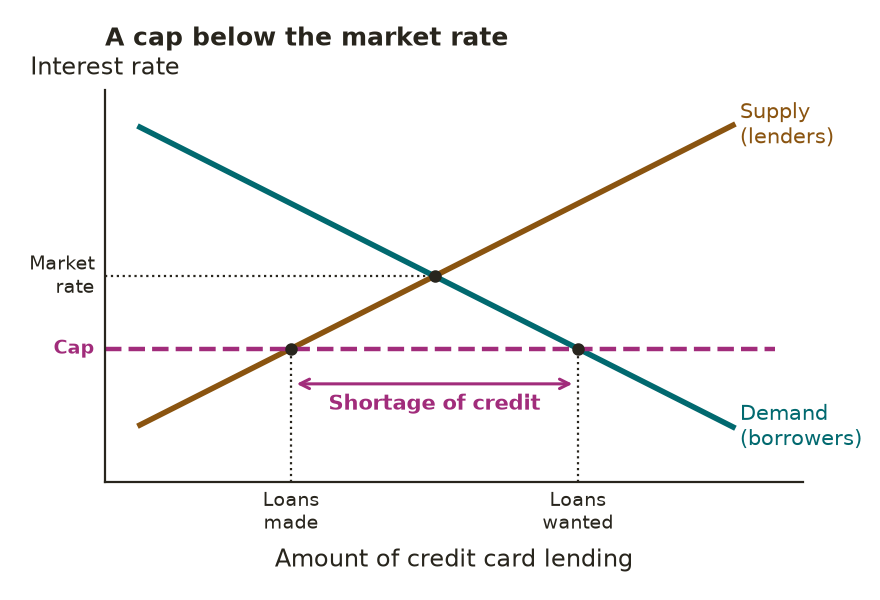
Who gets turned away? Lenders charge higher rates to borrowers who are more likely not to repay. Under a cap, the loans that can no longer be priced to cover their risk are the ones that disappear. So the borrowers most likely to lose access are the ones with the weakest credit, often the same people the cap was meant to help. A cap set well above the market rate does nothing at all. OpenStax calls it “nonbinding.”
2 What the evidence shows
The best recent evidence comes from economists at the Federal Reserve Bank of New York. They studied three states, South Dakota, Illinois, and North Dakota, that capped rates on payday, installment, and auto-title loans at 36 percent, including fees, between 2016 and 2021. Banks and credit unions were exempt. Using credit records for millions of borrowers, they compared these states with similar states that had no cap. Their finding: “credit to the riskiest borrowers contracts under usury limits without improving delinquencies.” For borrowers with the lowest credit scores, debt fell by about 17 percent and the number of accounts by about 20 percent, but they were no less likely to fall behind on their bills.
The study also found a surprise. Lenders shifted credit to borrowers who were somewhat less risky, and those borrowers got more credit without more missed payments. In the authors’ words, “The unexpected winners from rate caps, it seems, are somewhat less risky borrowers who get more credit under usury limits without more delinquency.” Total borrowing in the three states barely changed. The cap moved credit from the riskiest borrowers to safer ones.
A 10 percent cap on credit cards would be far lower than the 36 percent caps in those states. Two economists at the Federal Reserve Bank of Philadelphia built a model of the credit card market using administrative data on credit card accounts. They found that under a 10 percent cap, lenders “would significantly reduce credit limits for high-risk borrowers,” making the policy “welfare-reducing” for that group. They also offer one reason card rates look so high: defaults usually happen only when a balance nears its credit limit, while most cardholders use only a small part of their limit. The interest lenders charge has to cover those occasional large losses.
Supporters of a cap answer with their own numbers. Brian Shearer of the Vanderbilt Policy Accelerator, a university research center that favors a cap, estimates that a 10 percent cap would save borrowers about $100 billion a year. He argues that card issuers earn enough to absorb most of the cut, mainly by trimming rewards and advertising. Even his estimate, though, finds that lending would shrink for borrowers with credit scores below 600. The two sides agree on the direction. They disagree about how many people would lose credit, and whether the savings for everyone else are worth it.
The United States already has one national rate cap. The Military Lending Act, as the Defense Department applies it today, limits the rate on most consumer loans to active-duty service members and their families to 36 percent, including fees. The Consumer Financial Protection Bureau notes that under the law, lenders “can refuse to lend” to service members if their rates would be higher. Does Rent Control Make Housing Affordable? tells the same story about a different price: a cap helps the people who still get the good at the lower price, and hurts the people who can no longer get it at all.
When Financial Markets Fail: 2008
Financial markets can also go badly wrong. OpenStax opens its chapter on financial markets with the housing crash. In 2006, the value of homes in the United States minus what owners still owed on them peaked at $13 trillion. By 2008 it had fallen to $8.8 trillion, and by 2010 U.S. homeowners’ wealth had shrunk by $14 trillion. Many home buyers had borrowed more than they could repay. When home prices fell, the losses spread to the banks and investment firms that held those loans, including Lehman Brothers. Where Does Money Come From? and What Does the Fed Do? tell the banking side of that story. The lesson for this reading is that the price of borrowing works only when lenders and borrowers both face the cost of getting it wrong.
The Seen and the Unseen
Rules about borrowing and saving have effects we see right away and effects that are easy to miss.
| Case | The seen | The unseen |
|---|---|---|
| Interest rate cap | A lower rate on the card in your wallet. | The applicant who is turned down, and the smaller credit limit for someone with a thin credit record. |
| Payday loan | A high fee for a two-week loan. | The overdraft fee, late rent, or lost car the borrower was trying to avoid. |
| A hot stock tip | The friend who doubled their money. | The many who lost money on tips, and the slow gains from a simple index fund. |
| Saving early | Less spending money at age 20. | The doubling and redoubling of those savings by age 60. |
People have argued about interest for more than two thousand years. Aristotle held that money is barren: coins can’t breed more coins, so charging for a loan seemed unnatural. Medieval Christian teaching built on his view and treated most interest as a sin. In 1787 the English philosopher Jeremy Bentham answered in Defence of Usury, a series of letters that ends with one addressed to Adam Smith. Bentham poked fun at Aristotle, who, he wrote, “had never been able to discover, in any one piece of money, any organs for generating any other such piece.” Bentham’s point was that borrowed money buys things that do produce more, like tools, seed, and shops. He concluded that “no man of ripe years and of sound mind, acting freely, and with his eyes open, ought to be hindered, with a view to his advantage, from making such bargain, in the way of obtaining money, as he thinks fit.” Today’s debate turns on Bentham’s conditions: whether every borrower is acting freely and “with his eyes open.”
READ THE ORIGINAL Defence of Usury (by Jeremy Bentham (1787), free at the Library of Economics and Liberty)
The Debate: Should the Law Cap Interest Rates?
The case for. Supporters argue that some borrowers don’t act with their eyes open. They borrow in an emergency, underestimate how long it will take to repay, or don’t realize how fees add up. The Consumer Financial Protection Bureau found that “four out of five payday loans are rolled over or renewed within 14 days,” and that three out of five payday loans went to borrowers whose fees ended up larger than the amount they borrowed. Supporters also argue that card issuers earn large profits, so a cap would mostly cut those profits and rewards, not lending. And they point out that the country has long capped rates for service members.
The case against. Critics argue that a cap doesn’t make lending to risky borrowers any less risky. It just makes that lending unprofitable, so it stops. The New York Fed study found exactly that pattern: less credit for the riskiest borrowers, with no drop in missed payments. Critics say the better tools are clearer disclosure, more competition among lenders, and help for people building credit, which lower prices without creating a shortage. In Bentham’s spirit, they also argue that adults should be free to make their own bargains.
The evidence can say a lot about who gains and who loses from a cap. It can’t say how much a lower rate for millions of borrowers is worth compared with lost credit for the riskiest few, or how far the law should go in protecting people from their own choices.
Fair Challenges
- “Interest is unfair: money shouldn’t make money.” Interest pays the lender for waiting and for the risk of not being repaid, and it lets borrowers use money now for things that produce more later. Whether particular rates are fair is a question of values.
- “Credit card companies charge 21 percent because they can.” Part of the rate covers losses from borrowers who don’t repay, and part may reflect profits. How large each part is, is a question of evidence, and researchers at the Philadelphia Fed and Vanderbilt give different answers. What profit is acceptable is a question of values.
- “The stock market is gambling.” A bet moves money from losers to winners. A share of stock is part ownership of a business that makes things and earns profits, which is why stocks have climbed over long periods. Picking individual stocks, though, is closer to a bet than most people think.
- “Anyone can beat the market with research.” Thousands of professionals do that research full time, and most of their funds still trail the market in most years. That is a question of evidence, and the evidence is strong.
- “Banks should lend to everyone at the same rate.” Borrowers differ in how likely they are to repay. A single rate would be too high for safe borrowers or too low for risky ones, so lenders would turn the risky ones away. Whether society should help risky borrowers in other ways is a question of values.
- “A cap just cuts bank profits.” Some of the cost would come out of profits and rewards. The Fed studies find that some would also come out of credit for the riskiest borrowers. How much of each is a question of evidence.
Notice what evidence can settle and what it can’t. Who loses credit under a cap, how often stock pickers beat the market, and how fast savings compound are empirical questions. Whether interest is fair, and how far the law should protect borrowers from their own choices, are questions of values.
What Economics Adds
Economics doesn’t say whether any interest rate is fair. It says the interest rate is a price, and that, like other prices, it carries information and rations what is scarce. That helps explain why riskier borrowers pay more, why bond prices fall when rates rise, why most stock pickers trail the market, and why a cap can shrink credit for the people with the fewest choices. It does not decide how to weigh those people against everyone who would pay less.
READ The Power of Compounding: How Time Helps Money Grow (Page One Economics, Federal Reserve Bank of St. Louis, 2026)
READ The Unintended Effects of Interest Rate Caps: Credit Rationing for Risky Borrowers (Liberty Street Economics, Federal Reserve Bank of New York, 2026)
READ How to Accumulate Personal Wealth (OpenStax, Principles of Microeconomics 3e, Section 17.3, free online)
LISTEN John Bogle on Investing on EconTalk, April 9, 2007, with transcript. The founder of Vanguard and creator of the index mutual fund talks with host Russ Roberts about how he built the fund, the risks of bond funds, and how studying economics changed his life.
The Normative Question
Economics can predict what a cap on interest rates will do: lower the price for borrowers who still get credit, and shrink credit for the riskiest ones. It can’t say whether that trade is worth making. Should the law cap what lenders may charge, if a cap means some people can’t borrow at all? Your answer depends on how you weigh lower costs for many against lost access for some, how much you trust borrowers to judge their own deals, and whether you think the law or the market better protects people with the fewest choices.
Key Terms in Plain Words
- Interest rate
- The price of borrowing money, as a percent of the amount borrowed per year.
- Financial market
- A market where savers supply money and borrowers demand it.
- Rate of return
- What an investment pays, as a percent of what was put in.
- Risk
- How uncertain the return on an investment is.
- Liquidity
- How easily an asset can be turned into cash to spend.
- Diversification
- Spreading money across many investments to lower risk.
- Bond
- A loan to a firm or government that pays interest on a schedule.
- Stock
- A share of ownership in a company.
- Index fund
- A fund that owns a slice of the whole market instead of picking stocks.
- Compound interest
- Interest earned on both the original amount and past interest.
- Usury law
- A law that limits the interest rate lenders may charge.
- Credit rationing
- When lenders turn borrowers away instead of raising the rate.
Sources
- Quotations, figures, examples, videos, and the podcast in this sheet come from the sources below, current as of November 9, 2026.
- The 10 Percent Question
- Board of Governors of the Federal Reserve System, “Consumer Credit — G.19,” release of November 6, 2026 (interest rate on credit card plans, accounts assessed interest, 2026 Q3) federalreserve.gov
- Congress.gov, “S.381 — 10 Percent Credit Card Interest Rate Cap Act,” 119th Congress, cosponsors and actions congress.gov
- Reuters, “Trump calls for one-year cap on credit card interest rates at 10%,” January 10, 2026 reuters.com
- The Interest Rate Is A Price
- OpenStax, Principles of Microeconomics 3e, Section 4.2, “Demand and Supply in Financial Markets.” openstax.org
- Where Firms Get Money
- OpenStax, Principles of Microeconomics 3e, Section 17.1, “How Businesses Raise Financial Capital” (including Lehman Brothers) openstax.org
- Where Savers Put Money
- OpenStax, Principles of Microeconomics 3e, Section 17.2, “How Households Supply Financial Capital.” openstax.org
- Why It’S Hard To Get Rich Quick
- OpenStax, Principles of Microeconomics 3e, Section 17.3, “How to Accumulate Personal Wealth.” openstax.org
- S&P Dow Jones Indices, “SPIVA U.S. Year-End 2025,” March 2026 spglobal.com
- Mary Hails and Scott A. Wolla, “The Power of Compounding: How Time Helps Money Grow,” Page One Economics, Federal Reserve Bank of St. Louis, November 2, 2026 (Franklin’s bequest; rule of 72) stlouisfed.org
- Board of Governors of the Federal Reserve System, Economic Well-Being of U.S. Households in 2025, May 2026, Executive Summary federalreserve.gov
- EconTalk, “John Bogle on Investing,” April 9, 2007 (Bogle and the index fund) econtalk.org
- When The Law Caps The Price Of Borrowing
- Rajashri Chakrabarti, Daniel Garcia, Donald Morgan, and Lee Seltzer, “Less for You, More for Me: Credit Reallocation and Rationing Under Usury Limits,” Federal Reserve Bank of New York Staff Report 1173, December 2025 newyorkfed.org
- Rajashri Chakrabarti, Gabriel Leonard, Donald P. Morgan, Thu Pham, and Lee Seltzer, “The Unintended Effects of Interest Rate Caps: Credit Rationing for Risky Borrowers,” Liberty Street Economics, Federal Reserve Bank of New York, June 3, 2026 libertystreeteconomics.newyorkfed.org
- Federal Reserve Bank of Philadelphia, “Borrower Behavior and Contract Heterogeneity in the Credit Card Market,” Research in Focus, on Satyajit Chatterjee and Burcu Eyigungor, Working Paper 26-03, February 2026 philadelphiafed.org
- Brian Shearer, “What Ever Happened to Usury?” Vanderbilt Policy Accelerator, January 29, 2026 (argument for a cap; $100 billion estimate) vanderbiltpolicyaccelerator.substack.com
- Vanderbilt University, “Bipartisan Caps on Credit Card Rates Could Save Americans Billions,” September 10, 2025 (summary of the Vanderbilt Policy Accelerator analysis) law.vanderbilt.edu
- Consumer Financial Protection Bureau, “What are my rights under the Military Lending Act?” consumerfinance.gov
- Consumer Financial Protection Bureau, “CFPB Finds Four Out of Five Payday Loans Are Rolled Over or Renewed,” March 25, 2014 consumerfinance.gov
- When Financial Markets Fail
- OpenStax, Principles of Microeconomics 3e, Chapter 17 Introduction, “Financial Markets.” openstax.org
- The Seen And The Unseen
- Jeremy Bentham, Defence of Usury (1787), Letters I and X, Library of Economics and Liberty econlib.org
- Videos (YouTube)
- Marginal Revolution University, “Saving and Borrowing.” youtube.com
- Marginal Revolution University, “Investing: Why You Should Diversify.” youtube.com
- Marginal Revolution University, “How Expert Are Expert Stock Pickers?” youtube.com
- Podcast
- EconTalk, “John Bogle on Investing,” April 9, 2007 econtalk.org