Why Do Some Jobs Pay More Than Others?
Wages, skills, unions, and discrimination in the labor market
Start Here: The Demand for Nurses
Registered nurses are the largest group of health care workers in the country, with about 3.4 million jobs. In May 2025 the median nurse earned $97,550 a year, or $46.90 an hour, according to the Bureau of Labor Statistics. That is well above the typical pay for all workers. The bureau expects about 180,800 openings for nurses each year over the next decade, and it gives a simple reason: “Demand for healthcare services is projected to increase because of the large number of older people, who typically have more medical problems than younger people.”
Nurses don’t all earn the same, even with the same license. Average pay for nurses ranged from about $77,000 in Alabama and South Dakota to $150,280 in California. And in South Carolina, as in every state, no one may work as a registered nurse without a state license.
The Foundations readings give us the tools. Where Do Prices Come From? showed that a price is set by supply and demand and works as a signal. How Do People Respond to Prices? showed that pay differences can make up for hard or risky work. When Does a Higher Price Pay Off? showed that how much people respond depends on their choices. This reading puts those tools to work in the market most of us know best: the market for our own work. A wage is a price, the price of an hour of work. A later reading in this series takes up the other price that touches almost everyone, the interest rate.
The Wage Is a Price
Employers don’t want workers for their own sake. They hire workers to produce something customers will buy. OpenStax’s Principles of Economics puts it this way: “Economists describe the demand for inputs like labor as a derived demand.” A hospital hires more nurses when more patients need care. A car plant hires fewer workers when car sales fall. The demand for labor comes from the demand for what labor makes.
How much is one more worker worth to an employer? Economists answer with the worker’s marginal product: in OpenStax’s words, “the additional output a firm can produce by adding one more worker.” Multiply that extra output by what it sells for, and you get the most an employer would pay for that worker.
This answers the puzzle. A wage doesn’t measure how important a whole job is. It measures the value of one more worker, given how many people can already do the job. Health care as a whole matters far more than football. But there are millions of nurses, so one more nurse adds a lot without being rare. There are few people who can play in the NFL, and the league’s games bring in billions of dollars from fans and broadcasters, so each player adds a great deal of value that few others can supply. Adam Smith noticed the same thing about water and diamonds: water is more useful, but diamonds are scarcer.
Supply matters as much as demand. When many people can and want to do a job, the supply of workers is large and pay is lower. When a job takes years of training or rare talent, supply is small and pay is higher. And as OpenStax points out, “There is no single labor market.” There is a market for nurses in Rock Hill, another for welders in Houston, and another for software engineers in Seattle. That is why the same job pays differently from state to state.
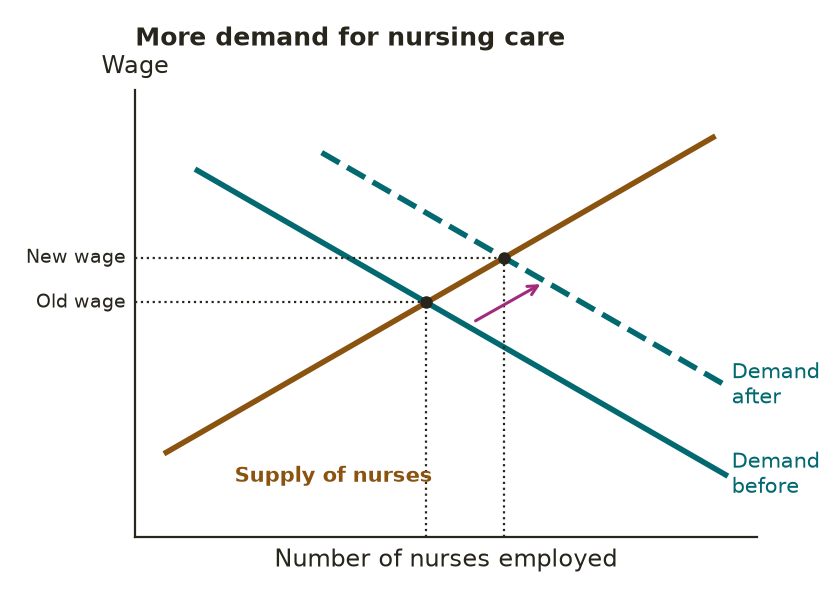
The graph shows what an aging population does to the market for nurses. More older patients raise the demand for nursing care. At the old wage, hospitals want more nurses than are available, so they offer more pay, signing bonuses, and better schedules. The higher pay draws more people into nursing programs and brings back nurses who had left the field. Over time, wages and the number of nurses both rise. Nursing programs, including the one at York Technical College, are part of how supply catches up.
WATCH The Marginal Product of Labor (Marginal Revolution University)
Why Pay Differs
If wages follow the value a worker adds, then pay differs because workers, jobs, and markets differ. These are the main reasons:
| Reason | What it means | Example |
|---|---|---|
| Skills and education | Workers who can produce more are worth more to employers. | In 2025 the median full-time worker with a bachelor’s degree earned $1,578 a week. A high school graduate earned $966. |
| Hard or risky work | Employers must pay more to fill unpleasant or dangerous jobs. | Night shifts, roofing, and commercial fishing. How Do People Respond to Prices? covers these pay differences. |
| Rare talent | Small differences in skill can mean very large differences in pay. | The NFL’s minimum salary is $840,000. In a smaller football league it is $64,000. |
| Limits on who may work | Licenses and other rules limit the number of workers in some jobs. | About 22 percent of U.S. workers held a government license in 2025. |
| Bargaining power | Unions on one side, or a single large employer on the other, can push pay above or below the competitive level. | Unions are covered below. Does the Minimum Wage Help Low-Wage Workers? covers employers with power over wages. |
| Discrimination | Some workers are paid or hired less for reasons that have nothing to do with their work. | Covered below. |
1 Does school build skills, or show them?
Education and pay go together. The Bureau of Labor Statistics reports that workers with more education earn more and are unemployed less:
| Highest education (age 25 and over) | Median weekly earnings, 2025 | Unemployment rate, 2025 |
|---|---|---|
| Less than a high school diploma | $770 | 6.1% |
| High school diploma | $966 | 4.3% |
| Some college, no degree | $1,062 | 3.8% |
| Associate’s degree | $1,135 | 3.0% |
| Bachelor’s degree | $1,578 | 2.8% |
| Master’s degree | $1,876 | 2.6% |
| Professional degree | $2,294 | 1.9% |
| Doctoral degree | $2,307 | 1.8% |
Why do graduates earn more? Gary Becker, who won the Nobel Prize in economics in 1992, made the best-known case. He argued that spending on education and training is an investment in human capital. Becker explained that “they are called human capital because people cannot be separated from their knowledge, skills, health, or values in the way they can be separated from their financial and physical assets.” In this view, school teaches skills that make workers more productive, and employers pay for those skills.
Bryan Caplan of George Mason University argues that much of the payoff comes from signaling instead. A degree shows employers that a person is smart, hard-working, and willing to finish what they start, whether or not the classes taught job skills. In The Case Against Education (2018) he argues that “very little of the return to college comes from skills or knowledge that is acquired in the classroom.” The two views don’t exclude each other: school can build skills and send a signal at the same time. The open question is how much each one matters, and the answer matters for policy. If school mostly builds skills, more schooling makes the whole economy more productive. If it mostly signals, more schooling mostly raises the bar that everyone must clear. Why Does College Cost So Much? looks at what students pay for that degree.
WATCH Human Capital and Signaling (Marginal Revolution University)
2 Winner-take-all markets
In a few markets, being slightly better than the next person brings far more pay. The Federal Reserve Bank of St. Louis calls these winner-take-all markets: markets “in which small differences in human capital translate into large differences in pay.” Professional sports, music, and online content are examples, because the best performers can reach millions of fans at once. The St. Louis Fed reports that only about 4 percent of online creators earn $100,000 or more a year, while millions earn very little. The football gap works the same way: NFL players are only somewhat better than players in smaller leagues, yet the NFL’s minimum salary is more than 13 times as large.
3 Who may do the job? Licensing
About 22 percent of U.S. workers held a government license in 2025, according to the Bureau of Labor Statistics. Nurses, electricians, barbers, cosmetologists, plumbers, and many others need one. A 2015 report by the Treasury Department, the Council of Economic Advisers, and the Labor Department found that the share of workers covered by state licensing laws “grew from less than 5 percent in the early 1950s to 25 percent by 2008.”
The report found real benefits and real costs. On the benefit side, “licensing can benefit consumers through higher-quality services and improved health and safety standards.” On the cost side, licensing raises the wages of licensed workers by about 10 to 15 percent in many studies, raises the prices customers pay, and makes it harder to move. Workers in the most-licensed jobs were less likely to move between states, because a new state often means a new license. Nurses have an answer to that problem: South Carolina belongs to the Nurse Licensure Compact, which lets a nurse licensed in one member state work in the others. Who Really Runs the Economy? looks at licensing as a barrier to entry.
When Demand Changes: A Case of Young Workers and AI
Because labor demand is derived demand, anything that changes what employers produce, or how they produce it, changes the demand for workers. New technology is the clearest example. It can make some workers more productive and raise their pay, and it can replace other workers and lower demand for them.
Young workers offer a current case. From April 2023 to December 2025, the unemployment rate for workers ages 18 to 24 rose by 3.5 percentage points, while the rate for workers ages 25 to 64 rose by only 0.6 points. Economists William Rodgers and Alice Kassens of the Federal Reserve Bank of St. Louis looked at what explains the difference. They found that “the decline in overall labor demand, as measured by job openings, accounts for most of the deterioration in young workers’ outcomes.” Hiring slowed, and new workers looking for their first job were hit hardest.
AI played a smaller but real part. The authors estimate that growing demand for AI-related jobs accounted for about 45 percent of the drop in the share of 18- to 24-year-olds with jobs and about one-third of the rise in their unemployment rate, with the largest effects on recent college graduates. Their conclusion is careful: “AI is not eliminating jobs across the economy. Instead, it is raising the bar for young workers trying to secure their first foothold in the labor market.” This is one study covering less than three years of a new technology. It is a reason to watch closely, not a final answer.
History offers a longer view. Tractors replaced most farm workers, and the computer replaced most typists. In each case, the jobs that disappeared were easy to see. The new jobs that the cheaper food and faster offices made possible were harder to see, and they took years to appear. Workers who lost their jobs did not always get the new ones. That is why economists study both the total number of jobs and who wins and loses along the way.
Unions
A labor union, OpenStax explains, “is an organization of workers that negotiates with employers over wages and working conditions.” Instead of each worker bargaining alone, the union bargains for all of them. This is called collective bargaining.
Union membership in the United States has fallen by half. In 1983, 20.1 percent of wage and salary workers belonged to a union. In 2025 the figure was 10.0 percent, or 14.7 million workers. The decline has been almost entirely in private businesses. In 2025, 32.9 percent of government workers belonged to a union, compared with 5.9 percent of private-sector workers. South Carolina has one of the lowest rates in the country, at 2.7 percent. The law has shaped these patterns. The National Labor Relations Act of 1935 gave workers the right to organize. The Taft-Hartley Act of 1947 let states allow workers to opt out of joining or paying a union at their workplace. South Carolina is one of the states that does.
4 What unions do to pay and jobs
In 2025 full-time union members had median weekly earnings of $1,404, compared with $1,174 for nonunion workers. But the Bureau of Labor Statistics warns that these comparisons “do not control for many factors that can be important in explaining earnings differences.” Union members are more likely to work in government, in utilities, and in certain regions and age groups. Studies that compare similar workers still find a union premium. OpenStax puts it at about 20 percent “even after adjusting for factors such as years of work experience and education level.”
Economics predicts a trade-off. A union that raises the wage above what the market would set gives its members more pay, but, as OpenStax notes, “when it pushes up the wage, it also reduces the firms’ incentive to hire.” That need not mean layoffs. It can mean fewer new hires, more machines, or a new plant in a state where unions are weaker. The trade-off is smaller when union workers are more productive. Union workers tend to stay in their jobs longer, which saves on hiring and training, and many unions run apprenticeship programs. The trade-off also changes when an employer has power over wages, a case Does the Minimum Wage Help Low-Wage Workers? takes up. There, a union can raise both pay and employment, just as a well-set minimum wage can.
5 Why did membership fall?
OpenStax lists four explanations that economists have offered: the shift from manufacturing to service jobs, where unions were weaker; competition from imports; laws on overtime, safety, and leave that gave workers protections unions once won; and U.S. laws that make unions harder to form than in many other countries. The first three trends also hit other rich countries, where unions stayed stronger. That points to the fourth explanation, the laws themselves, as part of the story, though economists still debate how large a part. How Unequal Is America? looks at whether the decline of unions helps explain rising inequality.
Discrimination
Discrimination in the labor market means paying or hiring workers differently because of their race, sex, or another trait that has nothing to do with the work. Pay gaps are easy to find. In 2024, women who worked full time earned a median of 83 percent of what men earned. But a pay gap alone doesn’t prove discrimination, because it can also reflect differences in jobs, hours, and experience. Economists have two tools for telling the two apart.
6 Comparing similar workers
The first tool is to compare workers who are alike in every way the data can measure. Claudia Goldin of Harvard won the 2023 Nobel Prize in economics for this kind of work on women’s pay. The Nobel committee summed up her finding: historically, much of the gap “could be explained by differences in education and occupational choices.” Today, however, “the bulk of this earnings difference is now between men and women in the same occupation, and … it largely arises with the birth of the first child.” Jobs that reward long and unpredictable hours pay much more per hour, and mothers are less likely to take them. Whether that reflects discrimination, free choice, or social expectations about who cares for children is a question the data alone can’t settle.
7 Sending fake résumés
The second tool is an experiment. Researchers send employers résumés that are identical except for a name that suggests the applicant’s race or sex. In a well-known 2004 study, Marianne Bertrand and Sendhil Mullainathan found that résumés with white-sounding names received 50 percent more callbacks than the same résumés with Black-sounding names.
A much larger study by Patrick Kline, Evan Rose, and Christopher Walters sent more than 83,000 applications to jobs at 108 of the largest U.S. employers. They found that distinctively Black names lowered the chance of hearing back from an employer by 2.1 percentage points, about 9 percent. That gap is smaller than in the earlier study, but it is still a gap between identical applicants. The gap was also concentrated: the 20 percent of companies that discriminated most accounted for about half of the lost callbacks. Companies that were more profitable, or that handled hiring through a central office, discriminated less.
8 Does competition punish discrimination?
Gary Becker’s first book, The Economics of Discrimination (1957), asked what discrimination costs the employer who practices it. His answer: an employer who turns away qualified workers because of their race or sex pays more for labor than a rival who hires the best person available. As OpenStax puts it, “If some businesses run by bigoted employers refuse to pay women and/or minorities a wage based on their productivity, then other profit-seeking employers can hire these workers.” Competition gives employers a reason to care “more about the color of money than about the color of skin.”
The evidence partly supports Becker. The finding that more profitable firms discriminate less fits his argument. But OpenStax also notes that “history teaches that market forces alone are unlikely to eliminate discrimination,” pointing to the century between the end of slavery and the Civil Rights Act of 1964. Competition works slowly when customers or co-workers share the prejudice, and when laws, such as the segregation laws of the Jim Crow South, require discrimination. Streetcars in the South show how. Around 1900, Southern cities began passing laws that required streetcars to seat Black and white riders separately. Economic historian Jennifer Roback found that the private companies running the cars did not ask for these laws, and many resisted them, because separate seating raised their costs and drove away riders. Some refused to enforce the laws for years, but as pressure from city and state governments grew, the companies gave in one by one. Becker’s force was real, but the law overpowered it. Congress passed the Equal Pay Act of 1963, which requires equal pay for equal work, and the Civil Rights Act of 1964, which bans job discrimination based on race, color, religion, sex, or national origin. The Equal Employment Opportunity Commission enforces these laws. People disagree about how far government should go beyond banning discrimination, and that is a question of values as much as evidence.
Immigration and Wages
Immigration adds workers, so it increases the supply of labor. Simple supply and demand predicts lower wages for workers who compete most directly with newcomers. But immigrants also buy goods, rent homes, and start businesses, which raises the demand for labor. The question is which effect is larger, and for whom.
The most thorough review comes from the National Academies of Sciences, Engineering, and Medicine (2017). It found that “when measured over a period of more than 10 years, the impact of immigration on the wages of natives overall is very small.” The workers most likely to see lower wages are earlier immigrants, “followed by native-born high school dropouts.” It found “little evidence that immigration significantly affects the overall employment levels of native-born workers,” though immigration does reduce the hours worked by teenagers. On government budgets, the effects of immigrants were “generally positive at the federal level and negative at the state and local levels,” largely because states and towns pay for schools. Economists still debate the size of the wage effects for the least-skilled workers, and a later reading will take up immigration in full.
The Seen and the Unseen
Labor-market rules have effects we see right away and effects that are easy to miss.
| Case | The seen | The unseen |
|---|---|---|
| Occupational license | A licensed worker with higher pay and a state seal of approval. | The person who couldn’t afford the training, and customers who pay more or do the work themselves. |
| Union contract | Higher wages and benefits for members. | Jobs not created, or work moved elsewhere. Or, where an employer had power over wages, pay that would have stayed too low without the union. |
| Degree requirement | A job posting that asks for a bachelor’s degree. | Capable workers without a degree who never get an interview. |
| Discrimination | The person hired. | The equally qualified person who never got a callback, and the output the economy lost. |
In 1899 John Bates Clark of Columbia University set out the marginal productivity theory used in this reading. He aimed “to show that the distribution of the income of society is controlled by a natural law, and that this law, if it worked without friction, would give to every agent of production the amount of wealth which that agent creates.” Two words carry a lot of weight in that sentence: “without friction.” Licensing, unions, employer power, and discrimination are all kinds of friction, so in the real world pay often departs from what workers add. Critics also challenged the word “natural.” Even if pay matched what each worker adds, they argued, that would not show that the pay was fair. Clark’s theory explains how wages are set. It doesn’t decide what people deserve.
READ THE ORIGINAL The Distribution of Wealth: A Theory of Wages, Interest and Profits (by John Bates Clark (1899), free at the Library of Economics and Liberty)
Two Debates
9 Should unions be easier to form?
The case for. Supporters see unions, in OpenStax’s words, as “the workers’ primary line of defense against efforts by profit-seeking firms to hold down wages and benefits.” A single worker has little bargaining power against a large employer, especially where there are few other employers nearby. Adam Smith made a similar point in 1776: “Masters are always and everywhere in a sort of tacit, but constant and uniform, combination, not to raise the wages of labour above their actual rate.” Employers, he noted, were fewer and could organize more easily, and the law of his day banned workers’ combinations but not employers’. OpenStax notes that forming a union is easier in Canada and many other countries, and that U.S. penalties for illegally firing union supporters are slight.
The case against. Critics argue that a union that raises wages above the market level protects workers who already have jobs at the expense of those who don’t, and can drive work to other states and countries. Supporters of laws like South Carolina’s, which let workers decide whether to join or pay a union, say no one should have to pay an organization as a condition of a job.
10 Should licensing be scaled back?
The case for. Customers often can’t judge whether an electrician or a nurse knows the job until something goes wrong. A license screens out the unqualified before harm is done. Supporters of licensing say that for jobs where mistakes can kill, a license is worth the cost.
The case against. Critics argue that many licenses protect existing workers more than customers, because current members of a trade often help write the rules. The 2015 federal report found that stricter licensing came with higher prices in 9 of the 11 studies it reviewed, and that some estimates show licensing reduces the number of people working in the licensed job. In one study, 100 more hours of required training cut the number of Vietnamese manicurists in a state by almost 18 percent.
Fair Challenges
- “Athletes and CEOs are overpaid.” Their pay reflects how much revenue they bring in and how few people can do what they do. That is a question of evidence, and the evidence for athletes is strong. Whether anyone deserves that much, and whether boards set CEO pay well, are partly questions of values and partly questions about how firms are run.
- “Immigrants take our jobs.” The best review finds very small effects on wages and employment for native-born workers overall, with larger effects for earlier immigrants and workers without a high school diploma. Immigrants also add to demand for labor. How to weigh gains for the country against losses for some workers is a question of values.
- “Unions are why the middle class shrank.” The decline of unions is one of several explanations for rising inequality, along with technology and trade. Economists disagree about how much each one matters. The size of the effect is a question of evidence. Whether unions are good for the economy is partly a question of values.
- “The pay gap proves discrimination.” A raw pay gap mixes discrimination with differences in jobs, hours, and experience. Résumé experiments show that some discrimination remains even between identical applicants. How much of the gap is discrimination is a question of evidence. What to do about the rest is a question of values.
- “A degree is just a piece of paper.” Graduates earn more, and economists debate how much of that comes from learning and how much from signaling. Either way, the degree pays off for the person who earns it. Whether society should spend more on it is the harder question.
- “Licensing protects the public.” Some licenses do. Others mostly raise prices and keep newcomers out. Which is which is a question of evidence for each job. How much risk customers should be allowed to take is a question of values.
Notice what evidence can settle and what it can’t. What a worker adds, how much a union or a license raises pay, and how often employers discriminate are empirical questions, and careful studies answer many of them. Whether pay is fair, and who should get to decide, are questions of values.
What Economics Adds
Economics doesn’t say that a wage is what a worker is worth as a person. It says that in a working market, pay tends to follow the value of what one more worker adds, and it explains why pay strays from that value. That helps explain why nurses earn more as the population ages, why a degree pays off, and why identical résumés can get different answers. It does not decide what any job should pay.
READ Human Capital (by Gary S. Becker, The Concise Encyclopedia of Economics, Library of Economics and Liberty)
READ The Labor Market for Influencers (Page One Economics, Federal Reserve Bank of St. Louis, 2026)
READ The Theory of Labor Markets (OpenStax, Principles of Microeconomics 3e, Section 14.1, free online)
LISTEN Bryan Caplan on the Case Against Education on EconTalk, February 12, 2018, with transcript. Caplan argues that most of the payoff from college comes from signaling, and host Russ Roberts presses him on the evidence. Becker’s Human Capital essay above makes the other case.
The Normative Question
Economics can explain why a backup quarterback earns more than a nurse: pay follows what one more worker adds and how many others can do the job. It can’t say whether that is how pay should work. Should pay reflect what an extra worker adds to output, or what the work is worth to society? And who should decide: employers and customers in the market, workers bargaining together, licensing boards, or voters through the law? Your answer depends on how you weigh freedom to make deals, fairness to workers who lack bargaining power, and the value of jobs that markets may underpay, and on whether you trust markets or rules to do that weighing better.
Key Terms in Plain Words
- Derived demand
- Demand for workers that comes from demand for what they produce.
- Marginal product
- The extra output from adding one more worker.
- Value of the marginal product
- The extra output from one more worker times its price.
- Human capital
- The skills, knowledge, and health that make a worker productive.
- Signaling
- Using a degree or other credential to show employers ability they can’t see directly.
- Winner-take-all market
- A market where small differences in skill bring very large differences in pay.
- Occupational license
- Government permission required to work in a job.
- Labor union
- An organization of workers that bargains with employers over pay and conditions.
- Collective bargaining
- Negotiation between a union and an employer on behalf of all the workers.
- Monopsony
- A market with one main employer, which can hold wages below what workers add.
- Labor-market discrimination
- Paying or hiring workers differently for reasons unrelated to their work.
- Résumé experiment
- A study that sends employers identical résumés that differ only in a name or other trait.
Sources
- Quotations, figures, examples, videos, and the podcast in this sheet come from the sources below, current as of November 9, 2026.
- The Demand For Nurses
- U.S. Bureau of Labor Statistics, Occupational Outlook Handbook, “Registered Nurses.” bls.gov
- U.S. Bureau of Labor Statistics, “Occupational Employment and Wages — May 2025,” news release, May 15, 2026 (state range of nurse pay) bls.gov
- South Carolina Department of Labor, Licensing and Regulation, Board of Nursing, “Nurse Licensure Compact.” llr.sc.gov
- Amanda Geiger, “The Labor Market for Influencers,” Page One Economics, Federal Reserve Bank of St. Louis, March 2026 (NFL and smaller-league minimum salaries; creator earnings) fraser.stlouisfed.org
- The Wage Is A Price
- OpenStax, Principles of Microeconomics 3e, Section 14.1, “The Theory of Labor Markets.” openstax.org
- OpenStax, Principles of Microeconomics 3e, Section 4.1, “Demand and Supply at Work in Labor Markets.” openstax.org
- Why Pay Differs
- U.S. Bureau of Labor Statistics, “Education pays, 2025.” bls.gov
- U.S. Bureau of Labor Statistics, Current Population Survey, Table 53, “Certification and licensing status of the employed by occupation, 2025 annual averages.” bls.gov
- Gary S. Becker, “Human Capital,” The Concise Encyclopedia of Economics, Library of Economics and Liberty econlib.org
- EconTalk, “Bryan Caplan on the Case Against Education,” February 12, 2018 (episode description) econtalk.org
- Department of the Treasury Office of Economic Policy, Council of Economic Advisers, and Department of Labor, Occupational Licensing: A Framework for Policymakers, July 2015 obamawhitehouse.archives.gov
- Young Workers And AI
- William M. Rodgers III and Alice L. Kassens, “How Shifts in Labor Supply and Demand Shape Outcomes for Young Workers,” On the Economy, Federal Reserve Bank of St. Louis, June 30, 2026 stlouisfed.org
- Unions
- U.S. Bureau of Labor Statistics, “Union Members — 2025,” news release, February 18, 2026 bls.gov
- U.S. Bureau of Labor Statistics, Southeast Information Office, “Union Members in South Carolina — 2025.” bls.gov
- OpenStax, Principles of Microeconomics 3e, Section 14.3, “Market Power on the Supply Side of Labor Markets: Unions.” openstax.org
- Adam Smith, An Inquiry into the Nature and Causes of the Wealth of Nations, Book I, Chapter VIII, “Of the Wages of Labour,” 1776, Library of Economics and Liberty econlib.org
- South Carolina Code of Laws, Title 41, Chapter 7, “Right to Work.” scstatehouse.gov
- Discrimination
- U.S. Bureau of Labor Statistics, “Highlights of women’s earnings in 2024.” bls.gov
- The Royal Swedish Academy of Sciences, “The Prize in Economic Sciences 2023,” press release (Claudia Goldin) nobelprize.org
- Marianne Bertrand and Sendhil Mullainathan, “Are Emily and Greg More Employable than Lakisha and Jamal? A Field Experiment on Labor Market Discrimination,” NBER Working Paper 9873, 2003; American Economic Review 94, no. 4 (2004) nber.org
- Patrick M. Kline, Evan K. Rose, and Christopher R. Walters, “Systemic Discrimination Among Large U.S. Employers,” NBER Working Paper 29053; Quarterly Journal of Economics 137, no. 4 (2022) nber.org
- OpenStax, Principles of Microeconomics 3e, Section 14.5, “Employment Discrimination” (Becker’s argument and antidiscrimination laws) openstax.org
- Jennifer Roback, “The Political Economy of Segregation: The Case of Segregated Streetcars,” Journal of Economic History 46, no. 4 (December 1986): 893–917 cambridge.org
- Immigration And Wages
- National Academies of Sciences, Engineering, and Medicine, The Economic and Fiscal Consequences of Immigration (2017), Summary nap.nationalacademies.org
- OpenStax, Principles of Microeconomics 3e, Section 14.6, “Immigration.” openstax.org
- The Seen And The Unseen
- John Bates Clark, The Distribution of Wealth: A Theory of Wages, Interest and Profits (1899), Preface, Library of Economics and Liberty econlib.org
- Videos (YouTube)
- Marginal Revolution University, “The Marginal Product of Labor.” youtube.com
- Marginal Revolution University, “Human Capital and Signaling.” youtube.com
- Podcast
- EconTalk, “Bryan Caplan on the Case Against Education,” February 12, 2018 econtalk.org