What Is a Good Deal Worth?
Consumer surplus, producer surplus, and deadweight loss
Start Here: The Deadweight Loss of Christmas
In 1993 the economist Joel Waldfogel asked a simple question about holiday gifts: are they worth what they cost? He surveyed two small groups of Yale undergraduates. For each gift, he asked what the giver probably paid and what the gift was worth to the student. His answer, published in the American Economic Review under the title “The Deadweight Loss of Christmas,” was that gift-giving “destroys between 10 percent and a third of the value of gifts.” Americans spent about $38 billion on holiday gifts in 1992, so he put the loss at $4 billion to $13 billion a year.
The idea is not that gifts are bad. It is that someone else chose. A $50 sweater you would never have bought for yourself might be worth $30 to you. The giver gave up $50, you received $30 of value, and $20 simply vanished.
The Foundations readings give us the starting point. Why Do We Trade? showed that people trade because both sides expect to gain. Where Do Prices Come From? showed how prices guide buyers and sellers toward those trades. When Does a Higher Price Pay Off? measured how much people respond when a price changes. This reading puts a dollar value on the gains from trade, and on what is lost when trades that would help both sides don’t happen. Along the way, Waldfogel’s Christmas study comes back as a lesson in how to weigh evidence.
The Model: What Each Side Gains
Every trade involves two numbers. One is the most a buyer would pay, which economists call willingness to pay. The other is the least a seller would accept, which depends on what it costs the seller to provide the good. The price lands somewhere in between, and both sides keep part of the difference.
Say a concert ticket is worth $120 to you and you pay $80. You gain $40. The seller would have taken $50, so the seller gains $30. Together, the trade creates $70 of value that didn’t exist before, and nobody had to lose for it to happen.
Jules Dupuit, a French engineer, saw this in 1844 while trying to decide whether bridges and canals were worth building. What people pay, he noticed, understates what a bridge is worth to them, because many would have paid more. Alfred Marshall named the buyer’s gain in 1890. The price a person pays, he wrote, “seldom comes up to that which he would be willing to pay rather than go without it.” The difference “may be called consumer’s surplus.”
1 Adding up across a market
A market has many buyers and sellers, each with different numbers. The demand curve lines up buyers from the one who values the good most to the one who values it least. The supply curve lines up sellers from the lowest cost to the highest. Consumer surplus is the area below the demand curve and above the price. Producer surplus is the area above the supply curve and below the price.
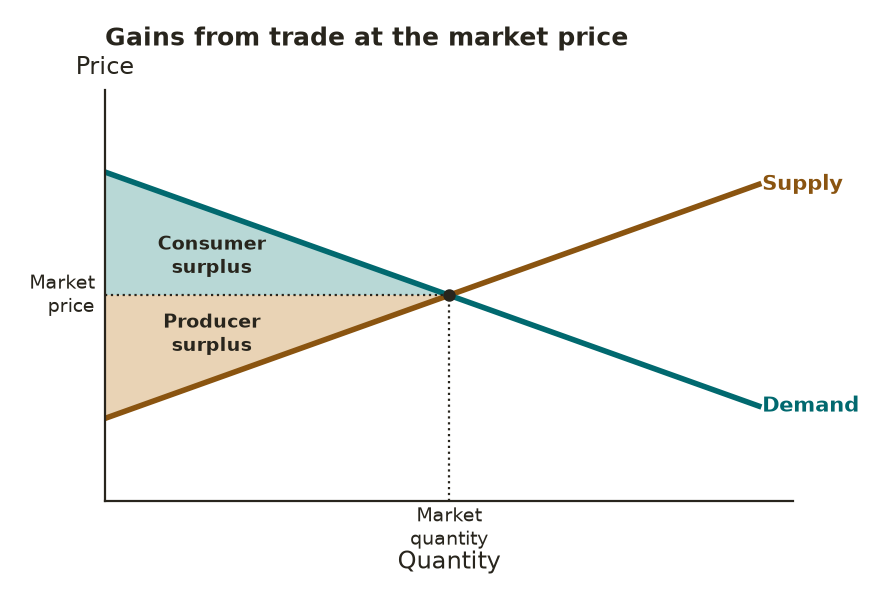
Here is the main result. At the market price, every buyer who values the good more than it costs to make gets one, and no unit is made that costs more than it is worth to the buyer. In OpenStax’s words, “Social surplus is larger at equilibrium quantity and price than it would be at any other quantity.” Economists call this efficiency. Where Do Prices Come From? described Vernon Smith’s classroom markets, in which “nearly all the possible gains from trade were captured.” The gains from trade are the total surplus.
WATCH What Is Consumer Surplus? (Marginal Revolution University. The video works through the triangle arithmetic briefly; that part is optional)
The Model: What Is Lost
A deadweight loss is the value of trades that would have helped both sides but don’t happen. It isn’t money moved from one person to another. It is value that disappears.
Say a bus trip to see a friend is worth $50 to you, and the ticket costs $40. You go, and you gain $10. Now a $20 tax raises the ticket to $60. You stay home. You lose the $10 you would have gained, the bus company loses a fare, and the government collects nothing, because there is no ticket to tax. Nobody gains from the trip that didn’t happen.
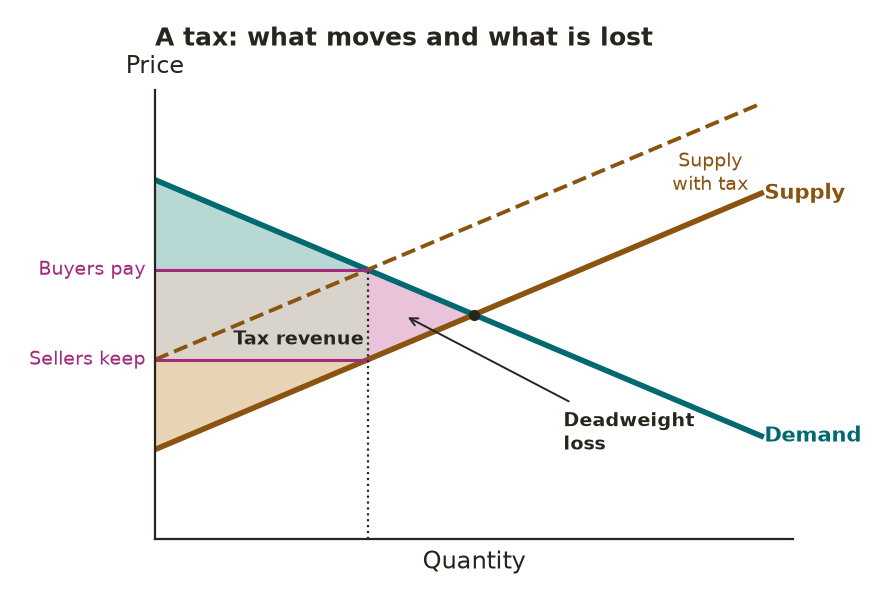
The graph shows the difference between the two effects of a tax. The gray rectangle is tax revenue. Buyers and sellers lose it, but the government gets it, so it is a transfer, not a loss to society as a whole. The pink triangle is different. It is the surplus from trades that no longer happen, and nobody gets it. Economists also call it the excess burden of a tax.
2 Where deadweight losses come from
- Taxes. Every tax that changes behavior creates some deadweight loss. The loss is larger when buyers or sellers respond more, because more trades disappear. That is why Frank Ramsey’s idea of taxing goods with inelastic demand, discussed in When Does a Higher Price Pay Off?, keeps the loss small.
- Price ceilings and floors. Rent control means fewer apartments, a minimum wage can mean fewer hours or jobs, and farm price supports mean crops that nobody wants at the support price. Does Rent Control Make Housing Affordable?, Does the Minimum Wage Help Low-Wage Workers? and Who Benefits from Farm Price Supports? cover each case. A ceiling also moves surplus from sellers to the buyers who still find a unit, which OpenStax says “helps to explain why consumers often favor them.” But sellers lose more than those buyers gain, so total surplus shrinks, and buyers can lose still more by waiting in line and searching, while the units that remain may not go to the people who value them most.
- Tariffs. A tariff is a tax on imports, and it blocks trades the same way. Who Pays for Tariffs? uses the term for the trades that no longer happen.
3 The bigger the wedge, the faster the loss grows
Arnold Harberger, a Chicago economist, made the triangle the standard way to measure these losses in the 1950s and 1960s. His formula carries a lesson that surprises most people: the loss rises with the square of the tax. Doubling a tax roughly quadruples the deadweight loss. A small tax blocks only trades that barely made sense. A large one starts to block trades that both sides valued a lot.
WATCH What Is Deadweight Loss? (Marginal Revolution University. The bus-trip story is the heart of it; the triangle arithmetic is optional)
The Evidence: Measuring Gains and Losses
Surplus is hard to see, because nobody writes down the most they would have paid. Economists measure it with experiments, surveys, and records of what people actually buy. Here are cases, starting with the strongest evidence.
4 Free digital goods
Erik Brynjolfsson and his coauthors ran large choice experiments asking people how much they would have to be paid to give up a service for a year. In 2017 the median answers were $17,530 for search engines, $8,414 for email, and $3,648 for digital maps. Because the price of these services is zero, almost all of that value is consumer surplus. How Do We Measure the Economy? explains why GDP misses it.
5 Ride-hailing and innovation
Economists working with Uber’s data estimated that in 2015 riders received about $1.60 in value for every dollar they spent, about $6.8 billion in consumer surplus across the United States. On a much larger scale, William Nordhaus estimated that from 1948 to 2001 innovators kept only about 2 percent of the value their innovations created, as Why Do Profits and Losses Matter? reports. Most of the rest went to buyers as consumer surplus. Most of the gain from new products ends up with the people who buy them.
6 Concert ticket resale
Phillip Leslie and Alan Sorensen used data on both first sales and resales of tickets to major rock concerts. They found that resale moves tickets from fans who value them less to fans who value them more, and raises “allocative efficiency by 5% on average.” But “a third of this increase is offset” by the costs of the scramble, as brokers and fans spend time and money racing to buy underpriced tickets so they can resell them. Resale creates surplus, and the race to capture it uses some of it up.
7 The 2018 tariffs
Mary Amiti, Stephen Redding, and David Weinstein measured both effects of the 2018 tariffs. By late 2018, the tariffs were costing U.S. consumers and importers about $3 billion a month in added tax, which is a transfer to the government, plus about $1.4 billion a month in deadweight loss, which nobody received. By the end of November the deadweight loss had reached $6.9 billion. The study separates the money that moved from the value that disappeared.
8 The income tax: how big is the loss?
Here the evidence needs weighing. In 1999 Martin Feldstein estimated that the deadweight loss of the income tax “may be as much as 30% of revenue,” and that raising existing tax rates could cost the economy more than $2 for each $1 of revenue. His estimates rested on his earlier study of how much taxable income responded to the 1986 tax reform, and the group of top earners at the heart of that study included only 57 tax returns.
In 2012 Emmanuel Saez, Joel Slemrod, and Seth Giertz reviewed the research that followed, which used better data and methods. They found that the best available estimates of the response are much smaller than Feldstein’s, and that at the middle of that range the extra burden is about 20 cents per added dollar of revenue for an across-the-board tax increase, and about 34 cents for one aimed at the top 1 percent. They also found that much of the response comes from avoidance, such as relabeling income, which tax law can reduce by closing loopholes rather than by cutting rates. The loss is real and grows with tax rates. Its size is smaller than the early estimates suggested.
9 Christmas gifts, revisited
Waldfogel’s famous result came from two small surveys of students at one university, 86 in the first and 58 in the second. Sara Solnick and David Hemenway tried again with 209 people, including staff, graduate students, and travelers in Boston and Philadelphia. Like Waldfogel, they asked people to set sentimental value aside. But they asked a different question: the smallest amount of money that would make you just as happy as the gift. The median gift was worth 11 percent more than it cost, and 51 percent of people valued their gift above its cost.
Part of the gap comes from the question. Asking what you would pay for something usually gets a lower number than asking what it would take to give it up, a point the Limits section returns to. Waldfogel himself treated a gift’s true value as falling somewhere between what students would pay for it and what it would take for them to part with it, which is one reason his estimate is a wide range. Waldfogel later ran a larger survey comparing gifts with things people bought for themselves and found that people’s own purchases gave them 10 to 18 percent more value per dollar. The best evidence says people usually choose better for themselves than others choose for them, but the loss is smaller than the famous headline, and none of these studies counts the sentimental value that may be the reason for the gift.
The Limits: What Surplus Can’t Tell Us
Surplus is a powerful tool, but it measures one thing. Thinkers from several traditions point to what it leaves out, and some of their criticisms apply to the fixes for market problems as much as to markets.
10 Willingness to pay depends on ability to pay
A wealthy buyer will pay more for almost anything than a poor one, so willingness to pay reflects income as well as need or desire. Total surplus counts a dollar of gain the same whoever gets it, a billionaire or a struggling family. It measures efficiency, not fairness. What Makes an Economy Just? takes up the question of fairness directly.
11 Paying and giving up are not the same
In a well-known set of experiments, Daniel Kahneman, Jack Knetsch, and Richard Thaler gave coffee mugs to some students and not others. Students who owned a mug asked roughly twice as much to sell it as other students would pay to buy one. So the answer to “What is it worth to you?” can depend on who owns it to start. This matters for the evidence above: the digital-goods study asked what people would accept to give something up, which tends to give a higher number than asking what they would pay.
12 Can value be measured and added up at all?
Economists in the Austrian tradition push further. Murray Rothbard argued in 1956 that we know about people’s values only through the choices they make. A voluntary trade shows that both sides expected to gain, but not how much. Adding one person’s gain to another’s assumes a common measuring stick for satisfaction that, on this view, doesn’t exist. Most economists still use surplus as a useful approximation, but the objection is a reminder that the dollar figures are estimates of something no one can observe directly.
13 The triangles may be too small
In 1967 Gordon Tullock argued that the standard triangles understate the cost of tariffs and monopolies. When a policy creates a prize, such as protection from foreign competition, people spend real resources lobbying to win it or keep it, and those resources could have produced something else. Economists call this rent-seeking. It is a cost of the fix, not of the market, and the ticket-resale scramble above is a small market version of the same idea.
14 The triangles may miss the biggest gains
Surplus analysis usually takes the goods as given and asks how well a market trades them. But the largest gains over time come from new goods and lower costs: electric light, antibiotics, the smartphone. Nordhaus’s 2 percent finding suggests those gains flow mostly to buyers. How Did the World Get Rich? tells that larger story.
15 Some trades people won’t allow
Alvin Roth, who helped design the systems that match kidney donors and patients, has found that “distaste for certain kinds of transactions is a real constraint,” even when both sides want the trade. He calls it repugnance. Bans on selling kidneys and on eating horse meat in California are examples. Surplus can count what a ban gives up, but it can’t say whether the ban is right. Who Should Decide? and The Moral Case for Markets take up that question.
Fair Challenges
- “If I got a good deal, the seller must have lost.” Usually both sides gain. You paid less than the most you would pay, and the seller got more than the least they would accept. The evidence on this is strong. Whether the split between buyer and seller is fair is a question of values.
- “A tax just moves money from people to the government. Nothing is lost.” The revenue is a transfer, but the trades the tax stops are a real loss, as the 2018 tariff estimates show. How large the loss is for a given tax is a question of evidence, and for the income tax the best recent estimates are smaller than early ones. Whether the spending the tax pays for is worth that cost is a question of values.
- “Ticket scalpers add nothing.” The best study finds that resale moves tickets to fans who value them more, but that about a third of that gain is used up by the race to buy and resell. Whether resale is fair to fans who can’t pay high prices is a question of values.
- “Holding prices down always helps buyers.” It helps the buyers who still find the good at the lower price. It hurts buyers who are shut out, and waiting and searching use up value. Sellers lose more than buyers gain. Whether helping some buyers is worth those costs is a question of values.
- “Economists care only about efficiency, not fairness.” Surplus measures efficiency, and economists say so. They also measure who gains and who loses, as in the studies above. Which matters more, and how much, is a question of values that economics alone can’t settle.
- “Gift-giving is wasteful.” The evidence is mixed and depends on how the question is asked. People usually choose somewhat better for themselves, but the measured loss leaves out sentimental value, which may be the point of the gift. Whether that value counts is partly a question of values.
Notice what evidence can settle and what it can’t. Whether a trade creates value, how many trades a tax or price control blocks, and how large the loss is are empirical questions, and careful studies answer many of them well. Whether a gain to one person is worth a loss to another is a question of values.
What Economics Adds
Dupuit was asking a practical question: should the state build this bridge? His answer was that “political economy has to take as the measure of the utility of an object the maximum sacrifice which each consumer would be willing to make in order to acquire the object.” That idea, refined by Marshall and measured by Harberger, still guides how governments weigh roads, regulations, and taxes. It gives a way to count what markets create and what rules destroy. It does not say which gains matter most or to whom.
READ THE ORIGINAL Principles of Economics, Book III, Chapter VI, “Value and Utility” (by Alfred Marshall, 8th edition (1920), free at the Library of Economics and Liberty)
READ Demand, Supply, and Efficiency (OpenStax, Principles of Economics 3e, Section 3.5, free online)
The Normative Question
Economics can measure the gains from a trade and the losses from a tax or price control, and it can show who receives each. It can’t decide how to weigh them. Should a dollar of gain count the same no matter who gets it? If a policy creates $100 of gain for wealthy households and $80 of loss for poor ones, total surplus rises. Is that an improvement? Your answer depends on how you weigh efficiency against fairness, and on whether you think other tools, such as taxes and transfers, should handle fairness while markets handle efficiency.
Key Terms in Plain Words
- Willingness to pay
- The most a buyer would pay for a good.
- Willingness to accept
- The least a person would take to give up a good or sell it.
- Consumer surplus
- The gap between the most a buyer would pay and the price the buyer pays.
- Producer surplus
- The gap between the price a seller receives and the least the seller would accept.
- Total surplus
- Consumer surplus plus producer surplus; the total gain from trade in a market. Also called social surplus.
- Gains from trade
- The value a trade creates for both sides together.
- Efficiency
- Making every trade that creates more value than it costs, and no trade that costs more than it is worth.
- Deadweight loss
- Value lost when trades that would have helped both sides don’t happen.
- Transfer
- Money that moves from one person or group to another, such as tax revenue, without being lost.
- Excess burden
- Another name for the deadweight loss of a tax: the cost beyond the revenue collected.
- Rent-seeking
- Spending resources to win a prize created by a rule, rather than by creating value.
- Repugnant transaction
- A trade both sides want that others think should not be allowed.
Sources
- Quotations, figures, examples, and videos in this sheet come from the sources below, current as of November 11, 2026.
- The Deadweight Loss Of Christmas
- Joel Waldfogel, “The Deadweight Loss of Christmas,” American Economic Review 83, no. 5 (1993): 1328–1336 jstor.org
- Sara J. Solnick and David Hemenway, “The Deadweight Loss of Christmas: Comment,” American Economic Review 86, no. 5 (1996): 1299–1305 ideas.repec.org
- Joel Waldfogel, “Does Consumer Irrationality Trump Consumer Sovereignty?” Review of Economics and Statistics 87, no. 4 (2005): 691–696 ideas.repec.org
- The Model
- OpenStax, Principles of Economics 3e, Section 3.5, “Demand, Supply, and Efficiency.” openstax.org
- Alfred Marshall, Principles of Economics, 8th ed. (1920), Book III, Chapter VI, “Value and Utility,” Library of Economics and Liberty econlib.org
- Jules Dupuit, “On the Measurement of the Utility of Public Works” (1844), translated by R. H. Barback, International Economic Papers 2 (1952): 83–110 competitionandappropriation.econ.ucla.edu
- Arnold C. Harberger, “The Measurement of Waste,” American Economic Review 54, no. 3 (1964): 58–76 jstor.org
- The Evidence
- Erik Brynjolfsson, Avinash Collis, and Felix Eggers, “Using Massive Online Choice Experiments to Measure Changes in Well-being,” Proceedings of the National Academy of Sciences 116, no. 15 (2019): 7250–7255 pnas.org
- Peter Cohen, Robert Hahn, Jonathan Hall, Steven Levitt, and Robert Metcalfe, “Using Big Data to Estimate Consumer Surplus: The Case of Uber,” NBER Working Paper 22627, September 2016 nber.org
- William D. Nordhaus, “Schumpeterian Profits in the American Economy: Theory and Measurement,” NBER Working Paper 10433, 2004 nber.org
- Phillip Leslie and Alan Sorensen, “Resale and Rent-Seeking: An Application to Ticket Markets,” Review of Economic Studies 81, no. 1 (2014): 266–300 academic.oup.com
- Mary Amiti, Stephen J. Redding, and David E. Weinstein, “The Impact of the 2018 Trade War on U.S. Prices and Welfare,” NBER Working Paper 25672, March 2019 nber.org
- Martin Feldstein, “Tax Avoidance and the Deadweight Loss of the Income Tax,” Review of Economics and Statistics 81, no. 4 (1999): 674–680 ideas.repec.org
- Emmanuel Saez, Joel Slemrod, and Seth H. Giertz, “The Elasticity of Taxable Income with Respect to Marginal Tax Rates: A Critical Review,” Journal of Economic Literature 50, no. 1 (2012): 3–50 aeaweb.org
- Open-access copy of Saez, Slemrod, and Giertz (2012), University of Nebraska–Lincoln DigitalCommons digitalcommons.unl.edu
- The Limits
- Daniel Kahneman, Jack L. Knetsch, and Richard H. Thaler, “Experimental Tests of the Endowment Effect and the Coase Theorem,” Journal of Political Economy 98, no. 6 (1990): 1325–1348 jstor.org
- Murray N. Rothbard, “Toward a Reconstruction of Utility and Welfare Economics” (1956), Mises Institute (argument from the Austrian tradition) mises.org
- Gordon Tullock, “The Welfare Costs of Tariffs, Monopolies, and Theft,” Western Economic Journal 5, no. 3 (1967): 224–232 onlinelibrary.wiley.com
- Alvin E. Roth, “Repugnance as a Constraint on Markets,” Journal of Economic Perspectives 21, no. 3 (2007): 37–58 dash.harvard.edu
- Videos (YouTube)
- Marginal Revolution University, “What Is Consumer Surplus?” youtube.com
- Marginal Revolution University, “What Is Deadweight Loss?” youtube.com