Who Benefits from Farm Price Supports?
What price supports do, who gains, who pays, and what the evidence shows
Start Here: A Record Year for Farm Payments
On October 7, 2026, the U.S. Department of Agriculture announced about $13.8 billion in payments to farmers under its two main price and revenue programs, Price Loss Coverage and Agriculture Risk Coverage, for the 2025 crop. It was the largest yearly payout since the programs began in 2014. It was only part of the total. In September, USDA’s economists forecast that direct government payments to farms would reach $47.4 billion in 2026, up 69.8 percent from $27.9 billion in 2025, even as net farm income was expected to fall 2.6 percent. The total includes $11 billion in one-time Farmer Bridge Assistance payments to growers of corn, soybeans, wheat, cotton, rice, and other row crops, which USDA described as a response to “temporary trade market disruptions and increased production costs.”
More is coming. The 2025 budget reconciliation law raised the target prices that trigger payments for crop years 2026 through 2030: from $3.70 to $4.10 a bushel for corn, from $8.40 to $10.00 for soybeans, and from $5.50 to $6.35 for wheat. It let farmers add up to 30 million new base acres, the acres on which payments are figured, raising the national total from about 274 million to about 304 million. It raised the payment limit per person from $125,000 to $155,000 and raised the support rate for sugar. The Congressional Budget Office estimated that the law’s changes to these farm programs would raise federal spending by about $52 billion over 10 years.
The Foundations readings give us the tools. Where Do Prices Come From? showed that a price is a signal: a low price for corn tells farmers that the world wants less corn and more of something else. Who Owns It, and Why Does It Matter? showed that ownership shapes who gains from a change in value. Why Do Profits and Losses Matter? showed that losses push people to move land, labor, and money to better uses. A price support changes all three. It mutes the signal of a low price, it raises the value of owning land that carries payments, and it softens the losses that would otherwise push resources elsewhere. Why Are Groceries So Expensive? looked at food prices from the shopper’s side. This reading looks at what happens when government sets a minimum for the farmer.
WATCH Who Really Benefits from Farm Subsidies? (Kite & Key Media, October 2026, a short video from a nonprofit with a free-market outlook)
What Farm Price Supports Are
A price support is a legal minimum price, which economists call a price floor. As the OpenStax textbook puts it, “Price floors are sometimes called ‘price supports,’ because they support a price by preventing it from falling below a certain level.” A floor matters only when it is binding, that is, when it sits above the price the market would set.
The graph shows the basic idea.
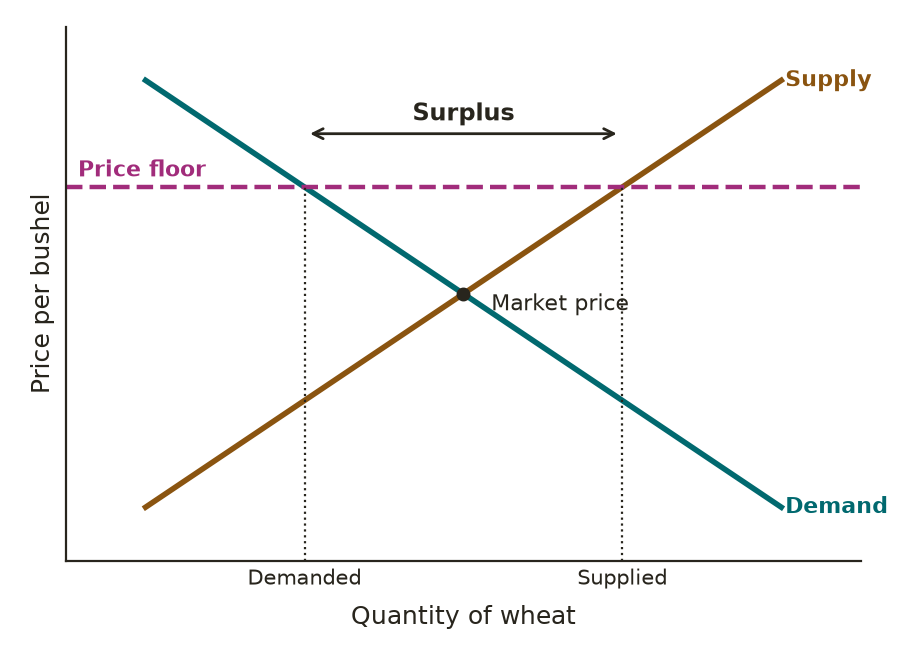
At the market price, the amount farmers want to sell equals the amount buyers want. At the higher floor, farmers grow more and buyers want less. Something has to happen to the extra. In the classic version, the government buys it and stores it. OpenStax sums up the result: “If the government is willing to purchase the excess supply (or to provide payments for others to purchase it), then farmers will benefit from the price floor, but taxpayers and consumers of food will pay the costs.” How Do People Respond to Prices? showed that supply responds more over time than right away. A support works the same way. In the first year, farmers have already planted, so the support mostly raises their income. Over the years, they plant more of the supported crops, farm more land, and bid up the price of land that carries payments.
WATCH Price Floors: The Minimum Wage (Marginal Revolution University; the same model applies to crops)
Not all price supports work the same way. The United States has used four main kinds:
| Type | How it works | Examples |
|---|---|---|
| Floors backed by government buying | The government lends to farmers with the crop as collateral, or buys the product outright, at a set price. If the market price falls below it, the government ends up holding the crop. | The 1933 Agricultural Adjustment Act and its loans through the Commodity Credit Corporation; dairy purchases, which rose from about $247 million in fiscal 1979 to about $2.7 billion in fiscal 1983 |
| Payments when prices or revenue fall | Market prices stay free, so no surplus piles up in government warehouses. Instead, taxpayers pay farmers the gap when prices or revenue fall below a target. Payments follow base acres, a farm’s historical acres, not what it plants this year. | Price Loss Coverage and Agriculture Risk Coverage, since 2014 |
| A true floor that remains: sugar | Loans at a set rate and limits on imports keep the U.S. price above the world price. | The 2025 law raised the loan rate for raw cane sugar from 19.75 to 24 cents a pound. |
| Insurance and emergency aid | The government pays part of the cost of crop insurance, and Congress or USDA adds one-time aid when prices crash or trade is disrupted. | Federal crop insurance; Farmer Bridge Assistance in 2026 |
Three design choices shape how a support works. The first is whether the government buys the surplus or simply pays the difference. Buying piles up stocks; paying keeps market prices free but sends the bill to taxpayers. The second is what payments are tied to: current production, which pushes farmers to grow more of the supported crop, or base acres, which pushes less on planting but more on the value of the land. The third is payment limits, which decide how much of the money the largest farms can collect.
READ Price Ceilings and Price Floors (OpenStax, Principles of Economics, 3rd edition, section 3.4)
More Than a Surplus
The graph shows only one response: more grown than buyers want at the floor. But a support changes every decision tied to it, not just how much of one crop to grow. Farmers, landowners, and food makers all adjust on the parts of the deal the program touches. Economists call these other dimensions margins. Each response makes sense for the person making it, and many of them work against what the program was meant to do.
The studies show people adjusting on each of these margins:
| Margin | How people respond | What studies found |
|---|---|---|
| What to plant | Shift land toward the crops that carry supports and away from crops that don’t. | Daniel Sumner of the University of California, Davis, writes that “economists agree that without them the production of subsidized crops would decline.” Federal crop insurance alone raised corn acreage about 1.7 percent in the Corn Belt. |
| How much land to farm | Plow up grassland and pasture that would otherwise stay in grass, since the government shares the risk of a bad year. | USDA economists estimated that crop insurance, marketing loans, and disaster payments added about 686,000 acres of cropland, about 2.9 percent, in 77 counties in North and South Dakota from 1998 to 2007. About 60 percent came from hay and pasture. |
| What land is worth | Bid up the rent and the price of land that carries payments. | A study summarized by USDA found that farm program payments may explain 15 to 30 percent of the value of farmland. |
| Base acres | Claim and keep base acres, since payments follow them. | Under the 2025 law, farmers claimed more new base acres than the 30 million allowed, so USDA cut every new allocation by 3.69 percent. |
| Business structure | Add family members or partners to an operation, since payment limits apply per person. | Operations made up only of family members have no limit on how many members can qualify through management. The 2018 farm bill widened “family” to include first cousins, nieces, and nephews. The 2025 law lets certain partnerships and companies multiply the limit by the number of owners. |
| Growing for the warehouse | Under the old floors, keep producing even when no buyer wants the output, because the government will take it. | By late 1983, the government held surplus cheese, butter, and dry milk worth about $4.2 billion. In 1986 and 1987, USDA paid dairy farmers to slaughter or export their entire herds and stay out of dairying for five years, to remove about 8.7 percent of the milk supply. |
Landowners respond too, and their response lasts longest. When buyers expect a piece of land to keep earning payments, they pay more for it. Economists call this capitalization: the value of the future payments gets built into today’s price. The farmers who owned the land when the program started, or when payments rose, collect that gain. The farmers who buy later collect nothing. As USDA economists put it, “farmers who buy land after the payments have already been capitalized into the land price do not benefit, since the capitalized value of the payments was, in effect, paid to the previous owner.” That creates a trap. A young farmer who buys land in 2026 pays up front for payments expected for years to come. If Congress later cuts the payments, the land loses value, and the young farmer takes the loss. A program that started as help for farmers becomes, over time, a reason to keep it going for people who bought in at the higher price. This is the farm version of a lesson from the rent control reading: rules last as long as people expect them to, and that expectation has a price.
Who Really Pays?
Economists agree on the main effects of farm price supports, and the agreement crosses political lines. Sumner writes that “farm subsidy programs typically transfer income from consumers and taxpayers to farm operators, especially to owners of farmland and other resources used in farm production,” and that “subsidies to farming are often simply subsidies to landowners.” In a history of U.S. farm policy written for Historical Statistics of the United States, economists Alan Olmstead and Daniel Sumner concluded that “most economists, including many former advocates of subsidies, have come to question whether there is any remaining rationale for these farm programs.” Economists Barry Goodwin and Vincent Smith of the American Enterprise Institute, a free-market research group, wrote that the 2025 increase in payment limits would “benefit only the largest farms producing crops eligible for subsidy (at most, the largest 3 percent of all farms).” The Environmental Working Group, an advocacy group that campaigns to cut farm subsidies, puts it the same way: “Farm subsidies already favor the largest farms.”
Not every study counts equally. Many studies compare places that get more payments with places that get less, but those places differ in other ways too, such as soil, weather, and crops. The strongest studies use changes in the rules that hit some farms and not others that are otherwise alike. One example shows why the difference matters. USDA economists Nigel Key and Michael Roberts found that areas with higher payments per acre saw farms grow larger faster, but they cautioned that “it is not possible to rule out other explanations.” Sumner adds that farm consolidation “has been a centuries-long trend, and farm programs have not conspicuously measurably slowed that process.” Whether payments make farms bigger is an open question. That bigger farms collect more of the money is not.
1 Who gets the checks
In 2024, large-scale family farms, those with at least $1 million a year in gross cash farm income, made up about 5 percent of U.S. farms and received 46 percent of Price Loss Coverage and Agriculture Risk Coverage payments. Small family farms made up 86 percent of farms and received 20 percent. USDA’s economists explain why: “Because these payments are tied to commodity programs and risk management, farms with higher production volumes of eligible commodities and market exposure are likely to receive larger payments.” Counting all the commodity programs, the Environmental Working Group found that in 2025 “the top 10% of farms received 59% of all commodity subsidies,” while “the smallest 80% of recipients only got 22% of payments.”
This is not a loophole. Sumner wrote that “the distribution of payments is inherent in the program’s structure; larger farms and wealthier individuals receive the bulk of payments, but not because of loopholes or legislative accidents, as is sometimes implied.” A program that pays by the bushel or by the acre pays most to whoever has the most bushels and acres. Sumner also notes that “commercial farm operators now have higher incomes than non-farm people and substantially more wealth than the average American.”
2 Land: Who captures the payment?
Simple economic theory makes a sharp prediction. Land is fixed in supply, so any payment tied to land should end up with the landowner, through higher rents and higher land prices. In 2006, the Congressional Research Service summarized the view of the time: “Economists widely agree that a large fraction of government farm payments passes through to landlords, and that government payments raise the price of land.” This matters because about 60 percent of the acres enrolled in the programs were rented.
Economist Barrett Kirwan tested the prediction with one of the strongest designs in the field. Published in the Journal of Political Economy in 2009, his study used several changes in the farm programs as natural experiments. He found that “farmers who rent the land they cultivate capture 75 percent of the subsidy, leaving just 25 percent for landowners.” That surprised many economists. Kirwan found that landowners took a larger share where the market for renting farmland was more competitive, so local conditions matter. Other studies found landowners capturing more, about 34 to 41 cents of each dollar in rents. Reviewing this work in 2010, Sumner, Julian Alston, and Joseph Glauber concluded that “it is clear that landowners do not receive all or even the majority of the benefits from farm subsidies.”
The best evidence improved on the old view without overturning it. In the short run, farmers who rent keep much of each payment. Over the long run, expected payments still get built into what farmland sells for, and that gain goes to whoever owned the land when expectations rose.
3 Sugar: Consumers pay
Sugar is the clearest case of an old-style floor still in place. The program offers loans to processors at a set rate, limits how much sugar enters the country at a low tariff, and since 2014 has set a minimum price and quantity limits on imports from Mexico. The Government Accountability Office found that after the 2014 agreements, “imports of Mexican sugar fell and prices rose, benefiting U.S. sugar producers but increasing the cost to consumers and the economy.” In 2022, U.S. consumers, including food manufacturers, “paid twice the world price for sugar.” According to studies GAO reviewed, the program costs consumers an estimated “$2.5 billion to $3.5 billion per year, yielding net costs to the economy of approximately $1 billion per year.” The costs are spread across everyone who buys anything sweet. The benefits go to a much smaller group of growers and processors.
4 Cotton: Paying the competition
In 2004, a World Trade Organization panel ruled that some U.S. cotton payments distorted world markets and hurt growers in other countries, especially Brazil. Brazil won the right to retaliate against U.S. exports. To head that off, the United States agreed in 2010 to pay $147.3 million a year into a fund for Brazil’s cotton sector. By October 2013, the payments totaled nearly $496 million. In 2014, the United States made a one-time final payment of $300 million to settle the case. In effect, taxpayers paid to support American cotton growers and then paid again to compensate their Brazilian competitors.
The Seen and the Unseen
D. Gale Johnson, an agricultural economist at the University of Chicago, spent much of his career studying farm programs around the world. He argued that government should step into farm markets “only when there is a strong affirmative case for so doing,” because “once an intervention is introduced, such as a price support, a price subsidy for consumers or an input price subsidy, it is very difficult to eliminate.” The expected gain, he wrote, “should be substantial because it is all too clear that the potential economic and social losses can be very large.”
READ THE ORIGINAL Agricultural Structural Policies (D. Gale Johnson, University of Chicago, 1986)
The evidence from farm programs shows both sides:
| Case | The seen | The unseen |
|---|---|---|
| Sugar | U.S. growers and processors get about twice the world price. | Consumers and food makers pay an estimated $2.5 billion to $3.5 billion a year. |
| Cotton, 2004–2014 | American cotton growers received payments. | Taxpayers paid Brazil’s cotton sector nearly $496 million, then $300 million more. |
| Dakota grasslands, 1998–2007 | Insurance and aid steadied farm income in a risky region. | About 686,000 more acres were plowed, mostly from hay and pasture. |
| Farmland | Owners see their land rise in value. | Beginning farmers pay higher prices and collect none of the gain. |
| 2026 | Payments forecast at $47.4 billion in a year of low crop prices. | Not yet known. Watch land rents and prices, the rush for new base acres, and how operations reorganize. |
The gains are real. A payment that arrives in a year of collapsing prices can keep a family on its land, and farmers who rent keep much of it in the short run. The best studies also find that most of the money goes to the largest operations, that part of it ends up in land prices, and that the costs fall on taxpayers, shoppers, and farmers abroad who never see the check.
The Case for Farm Supports
Farm supports have serious defenders, and their best arguments deserve a hearing, along with what the evidence says about them.
5 Henry A. Wallace: Parity in a collapse
From 1928 to 1932, the farm economy collapsed along with the rest of the economy, and many farm families lost their land. The Agricultural Adjustment Act of 1933 set out to restore “parity,” the buying power farm products had in 1909 to 1914. Henry A. Wallace, secretary of agriculture from 1933 to 1940, pushed for an “ever-normal granary”: the government would store grain in years of big crops and release it in short years, to keep prices from swinging. “We could prevent burdensome supplies from accumulating, and the corn price from breaking unduly,” he wrote, “by using corn supplies, accumulated in years of large crops, to reduce the acreage the following year.” Wallace’s case answered a real crisis. Like Justice Holmes in the rent control reading, it explains why supports began. It doesn’t settle whether today’s programs, serving a very different farm economy, still work.
6 Farming is risky
Modern defenders start with risk. Weather, disease, and world prices can turn a good year into a disaster, and a bad year falls on many farms at once. Sumner, a critic of most farm programs, grants that “the argument for using farm subsidies to smooth farm incomes is somewhat stronger.” But he adds a caution: in places like the Corn Belt, a small harvest tends to raise prices, so markets already provide a partial hedge, and “farm programs that provide payments to offset low prices may make income more variable.” The American Farm Bureau Federation, which represents farmers, argues that even with the 2026 payments, “all nine principal row crops are forecasted to have negative returns even after accounting for federal assistance,” and that “additional economic assistance” is needed.
7 Food security and foreign subsidies
Supporters also argue that a country should be able to feed itself, and that farmers abroad get subsidies too. OpenStax notes that high-income countries, including the United States, Europe, and Japan, spend roughly $1 billion a day supporting their farmers. Sumner lists these and other arguments, including stable markets, help for low-income farmers, and rural development, and reports that “economists who have tried to substantiate any of these benefits have been unable to do so.” Not every economist has agreed. Sumner, Alston, and Glauber note that Willard Cochrane, an influential agricultural economist of the mid-1900s, continued to favor price supports and limits on production.
Who Gets to Set Farm Supports?
Unlike rent control, farm supports are set almost entirely in Washington:
| Who | Role |
|---|---|
| Congress | Writes the farm bill, usually about every five years, and sets reference prices, loan rates, and payment limits. In 2025, it made major changes through a budget reconciliation law. |
| USDA | Runs the programs, sets payment rates under the law, and can pay one-time aid. Its Commodity Credit Corporation can borrow up to $30 billion at any one time from the Treasury, a cap in place since 1987. The 2026 bridge payments were authorized under the corporation’s charter. |
| Trade rules | World Trade Organization agreements limit the most trade-distorting supports, as the cotton case showed. |
| States | Play a small role in price supports, though many run their own farm and conservation programs. |
Farm programs show how hard a subsidy is to end once it starts. Olmstead and Sumner wrote that “subsidies have become entitlements that have proven very difficult to abolish, even during periods of prosperity.” The 1933 law was meant to answer an emergency. More than 90 years later, its descendants are still growing.
Fair Challenges
- “Without supports, family farms would disappear.” Most payments do go to family farms, but to the largest ones. In 2024, small family farms were 86 percent of farms and received 20 percent of Price Loss Coverage and Agriculture Risk Coverage payments. Sumner found “no long-term evidence” that farm programs “have successfully maintained the farm or rural populations in a region,” and farms have kept growing larger with the programs in place. Supports can help a particular farm survive a bad year. Whether farming as a way of life deserves help that other small businesses don’t get is a question of values.
- “Payments go to big agribusiness, not farmers.” Partly true. Most of the money goes to family farms, but to the largest family farms, those with $1 million or more in yearly sales. And the best study of land rents found that farmers who rent keep most of each payment in the short run. The fair version of the claim is not that farmers get nothing, but that a program paying by the acre or the bushel pays most to those with the most acres and bushels.
- “Supports keep food cheap.” Not where they work as floors. The sugar program keeps the U.S. price about twice the world price, and consumers pay billions a year for it. Today’s payments for grain and soybeans don’t raise store prices directly, because market prices stay free. By encouraging more planting, they may push the prices of those crops down a little. The cost then shows up in taxes rather than at the checkout.
- “Other countries subsidize, so we must.” Other countries do subsidize, often heavily. But a subsidy that lowers world prices hurts farmers abroad, and the cotton case shows that it can end with American taxpayers paying the competition. Some argue that supports are bargaining chips in trade talks, or a defense against other countries’ subsidies. Others argue that the best answer to another country’s subsidy is to let American consumers enjoy the cheaper goods. Which approach to take is partly a question of values and strategy.
- “Just let the market work.” Markets do offer farmers ways to manage risk, such as futures and forward contracts, and many farmers use them. But some losses come from government itself. USDA paid the 2026 bridge payments partly because of trade disruptions, and Cato Institute scholars, who favor ending most subsidies, point out that tariffs hurt the farmers whom Congress then pays. Supporters say a nation that creates a risk owes something to the people it hurts. Critics say the better fix is to stop creating the risk. How much risk farmers should carry themselves is a question of values.
Notice what evidence can settle and what it can’t. Who receives the payments, how farmers and landowners respond, and what happens to land values, planting, and sugar prices are empirical questions, and the best evidence answers them clearly. Whether farming deserves protection that other businesses don’t get, and who should pay for it, are questions of values.
What Economics Adds
On the main effects, the evidence is not close. Price supports raise production of the favored crops, send most of the money to the largest farms, raise the value of land that carries payments, and cost taxpayers and consumers more than the programs return. Floors backed by government buying, like the dairy program of the 1980s and the sugar program today, do the most harm, because they pile up surpluses or keep prices high for everyone. Payments that leave market prices free do less harm, but they still flow mostly to the largest operations and into land values. Where economists differ is mostly over whether and how to help farmers with risk: subsidized insurance against severe losses, limits on what any one farm can collect, or leaving more of the risk to markets.
READ Sugar Program: Alternative Methods for Implementing Import Restrictions Could Increase Effectiveness (U.S. Government Accountability Office, October 2023)
LISTEN Daniel Sumner on the Political Economy of Agriculture on EconTalk, February 9, 2015, with transcript. Agricultural economist Daniel Sumner explains who wins and loses from farm subsidies, how the programs changed from the New Deal on, and how they affect farmers abroad.
LISTEN The Growing Farm Subsidy Boondoggle on the Cato Daily Podcast, May 7, 2026. Scholars at the libertarian Cato Institute argue that subsidies mostly help the largest farms and that tariffs hurt the farmers Congress then pays.
The Normative Question
Economics can show who receives farm payments, who pays for them, and how farmers, landowners, and food makers respond. It can’t decide whether farming deserves protection from price swings that other businesses don’t get, or how to weigh a family farm’s survival in a bad year against the costs to taxpayers, shoppers, and beginning farmers. Should government protect farmers from falling prices, and if so, should it come as payments tied to prices and acres, or as insurance against severe losses, and who should be eligible to receive it? Your answer depends on how you weigh the risks farmers face against the costs to everyone else, and on how much you trust the people who write the rules.
Key Terms in Plain Words
- Price floor
- A legal minimum price.
- Price support
- A government program that keeps a farm price or income from falling below a set level.
- Surplus
- More is offered for sale at the current price than buyers want.
- Parity
- The 1930s goal of restoring the buying power farm products had in 1909 to 1914.
- Reference price
- The target price below which Price Loss Coverage pays farmers the difference.
- Base acres
- A farm’s historical acres, on which payments are figured, whatever it plants now.
- Capitalization
- When expected future payments get built into today’s price of an asset, such as land.
- Incidence
- Who actually ends up with a payment or bears a cost, whoever receives or pays it first.
- Import quota
- A limit on how much of a good may come into the country.
- Payment limit
- A cap on how much one person or business can collect from a program in a year.
- Margin
- Any part of a decision that can be adjusted, such as what to plant or how to organize a farm.
- Unintended consequence
- A result a policy’s authors did not aim for, often working against its goal.
Sources
- Quotations, figures, examples, video, and podcasts in this sheet come from the sources below, current as of November 8, 2026.
- Farm Payments In 2025 And 2026
- U.S. Department of Agriculture, “USDA Announces Record Payments of $13.8 Billion for 2025 Crop Year Revenue and Price Safety Net Programs,” October 7, 2026 usda.gov
- USDA Economic Research Service, Farm Sector Income Forecast, updated September 3, 2026 ers.usda.gov
- U.S. Department of Agriculture, “USDA Announces Enrollment Period for Farmer Bridge Payments,” February 20, 2026 usda.gov
- USDA Farm Service Agency, newsletter on Farmer Bridge Assistance payment rates, January 2026 fsa.usda.gov
- The 2025 Law
- Congressional Research Service, R48574, agriculture provisions of the 2025 budget reconciliation law (reference prices, base acres, payment limits, sugar loan rates, and CBO estimates) congress.gov
- Public Law 119-21 (2025), enrolled text congress.gov
- What Price Supports Are
- OpenStax, Principles of Economics, 3rd edition, section 3.4, “Price Ceilings and Price Floors.” openstax.org
- Alan L. Olmstead and Daniel A. Sumner, “Farm Policy,” Historical Statistics of the United States, Millennial Edition (Cambridge University Press) hsus.cambridge.org
- U.S. General Accounting Office, Effects and Administration of the 1984 Milk Diversion Program, RCED-85-126, July 29, 1985 gao.gov
- U.S. General Accounting Office, report on the Dairy Termination Program, RCED-89-96 gao.gov
- More Than A Surplus
- Daniel A. Sumner, “Agricultural Subsidy Programs,” The Concise Encyclopedia of Economics, Library of Economics and Liberty econlib.org
- USDA Economic Research Service, “Study Finds Crop Insurance Has Small Effect on Environmental Quality,” Amber Waves, September 5, 2017 ers.usda.gov
- Roger Claassen and others, Grassland to Cropland Conversion in the Northern Plains: The Role of Crop Insurance, Commodity, and Disaster Programs, USDA Economic Research Service, ERR-120, June 2011 ers.usda.gov
- Christopher Burns and others, Farmland Values, Land Ownership, and Returns to Farmland, 2000–2016, USDA Economic Research Service, ERR-245, February 2018 ers.usda.gov
- USDA Economic Research Service, “Decoupled Payments and Farmers’ Production Decisions Under Risk,” chapter 4 of Decoupled Payments in a Changing Policy Setting, AER-838 ers.usda.gov
- U.S. Government Accountability Office, Farm Programs: Information on Payments, GAO-18-384R, May 18, 2018 gao.gov
- USDA Farm Service Agency, Payment Eligibility and Payment Limitations fact sheet (2018 farm bill definition of family member) dts.fsa.usda.gov
- Who Really Pays
- Barry K. Goodwin and Vincent H. Smith, “Changes for Agriculture in the One Big Beautiful Bill Act,” American Enterprise Institute (argument) aei.org
- Environmental Working Group, “House Budget Bill’s Top Farm Subsidy Loopholes and Giveaways,” May 20, 2025 (argument) ewg.org
- Environmental Working Group, “‘Triple Dipping’ Taxpayer Dollars,” July 16, 2026 (argument; Farm Subsidy Database figures) ewg.org
- Nigel Key and Michael J. Roberts, Commodity Payments, Farm Business Survival, and Farm Size Growth, USDA Economic Research Service, ERR-51, November 2007 ers.usda.gov
- Daniel A. Sumner, “Farm Support and US Agricultural Policy,” prepared for the American Enterprise Institute project on agricultural policy for the 2007 farm bill (UC Agricultural Issues Center) cail.ucdavis.edu
- USDA Economic Research Service, America’s Farms and Ranches at a Glance, 2025 edition, webinar transcript, February 10, 2026 ers.usda.gov
- Congressional Research Service, RL33271, Farm Commodity Programs: Direct Payments, Counter-Cyclical Payments, and Marketing Loans, March 1, 2006 everycrsreport.com
- Barrett E. Kirwan, “The Incidence of U.S. Agricultural Subsidies on Farmland Rental Rates,” Journal of Political Economy 117, no. 1 (2009): 138–164 ideas.repec.org
- Daniel A. Sumner, Julian M. Alston, and Joseph W. Glauber, “Evolution of the Economics of Agricultural Policy,” American Journal of Agricultural Economics 92, no. 2 (2010): 403–423 cooperative-individualism.org
- U.S. Government Accountability Office, Sugar Program: Alternative Methods for Implementing Import Restrictions Could Increase Effectiveness, GAO-24-106144, October 2023 gao.gov
- Congressional Research Service, R43336, The WTO Brazil-U.S. Cotton Case, updated October 1, 2014 congress.gov
- The Seen And The Unseen; The Case For Farm Supports
- D. Gale Johnson, “Agricultural Structural Policies,” University of Chicago Office of Agricultural Economics Research, Paper No. 87:2, January 7, 1986 (World Bank Documents) documents1.worldbank.org
- Annals of Iowa, “Henry Wallace and the Farm Crisis of the 1920s and 1930s” (quoting Wallace, New Frontiers) pubs.lib.uiowa.edu
- American Farm Bureau Federation, “Tracking Farmer Bridge Assistance Program Payments” (argument) fb.org
- Who Gets To Set Farm Supports
- Congressional Research Service, R44606, The Commodity Credit Corporation (CCC) congress.gov
- U.S. Department of Agriculture, Commodity Credit Corporation usda.gov
- Video (YouTube)
- Kite & Key Media, “Who Really Benefits from Farm Subsidies?” October 2026 youtube.com
- Marginal Revolution University, “Price Floors: The Minimum Wage.” youtube.com
- Podcasts
- EconTalk, “Daniel Sumner on the Political Economy of Agriculture,” February 9, 2015 econtalk.org
- Cato Daily Podcast, “The Growing Farm Subsidy Boondoggle,” May 7, 2026 (argument) cato.org