Does the Minimum Wage Help Low-Wage Workers?
What a wage floor does, who gains, who pays, and what the evidence shows
Start Here: $7.25 in Rock Hill
In Rock Hill, as everywhere in South Carolina, the lowest legal wage is $7.25 an hour. That is the federal minimum, and it has not changed since July 24, 2009, the longest stretch without a raise since the federal law began in 1938. South Carolina has no minimum wage law of its own, and a state law bars cities and counties from setting one higher than the federal rate. Rock Hill could not raise its minimum wage even if the city council wanted to.
Other states are going the other way. On January 1, 2027, Washington’s minimum rises to $17.73, and Seattle’s to $22.14. California’s rises to $17.40. Both states raise their minimums each year to keep up with inflation. Virginia, under a law passed in 2026, goes to $13.75 in 2027 and $15.00 in 2028, then rises with prices after that. Voters do not always agree. In June 2026, Oklahoma voters rejected a ballot measure that would have raised the state’s minimum, step by step, to $15 by 2029 and then tied it to inflation. It lost by about 55 percent to 45 percent.
The Foundations readings give us the tools. Where Do Prices Come From? showed that a price is a signal, and a wage is the price of labor: it tells workers where their time is worth the most and tells employers what a worker costs. Why Do Profits and Losses Matter? showed that expected profit draws new businesses in and losses push weak ones out. How Do People Respond to Prices? showed that people adjust on many margins, and adjust more over time. A minimum wage touches all three. It raises the price of low-wage labor, it changes which businesses can earn a profit, and it gives employers, workers, and customers reasons to change what they do. What Does the Unemployment Rate Tell Us? looked at jobs across the whole economy. This reading looks at the bottom rung of the job ladder.
What the Minimum Wage Is
A minimum wage is the lowest hourly pay an employer may legally offer. The Fair Labor Standards Act of 1938 set the first federal minimum at 25 cents an hour. Congress has raised it 22 times since, most recently to $7.25 in 2009. States and some cities set their own minimums, and when more than one applies, the worker gets the highest. Today 30 states set a minimum above $7.25. Five states, including South Carolina, have no state minimum at all, so the federal rate applies. Workers who earn tips can be paid as little as $2.13 an hour in cash under federal law, as long as their tips bring them up to at least $7.25.
A minimum wage is a price floor, the same tool covered in Who Benefits from Farm Price Supports? It matters only when it is binding, that is, when it sits above the wage the market would set. The graph shows the basic idea.
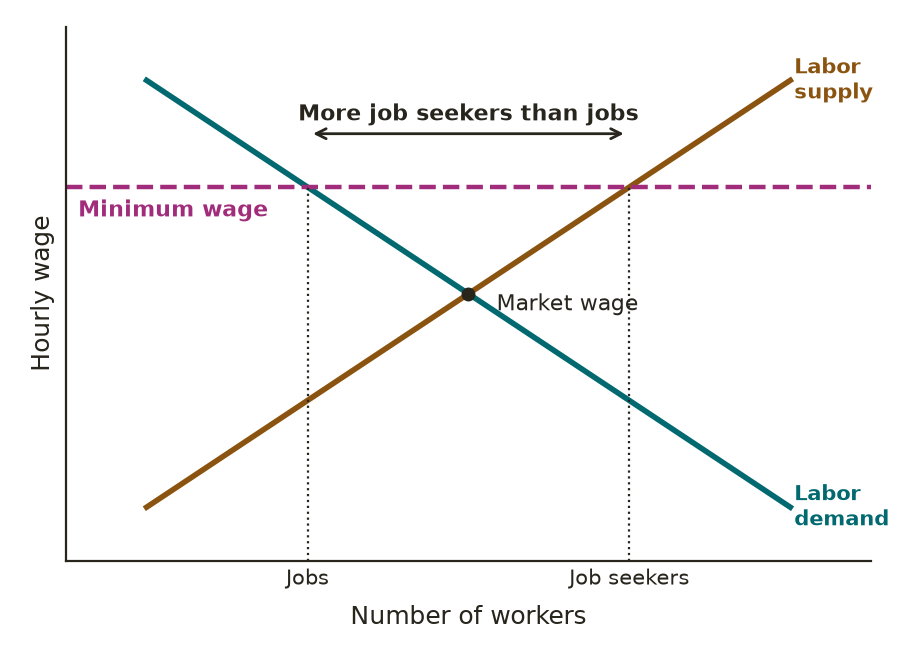
At the market wage, the number of people who want to work equals the number of workers employers want to hire. At the higher minimum, more people want those jobs and employers want fewer workers. In this simple model, workers who keep their jobs earn more, and some workers lose jobs or never find one. How big that gap gets depends on how much the minimum rises above the market wage, and on how easily employers can get by with fewer workers or fewer hours.
The simple model assumes that each employer must pay the going wage or lose its workers to someone else. That is not always true. Economists use the word monopsony for a market where one employer, or a few, can set pay because workers have few other options, or because changing jobs is costly. An employer with that kind of power can pay less than a worker adds to the business and still keep most of its staff. In that case, a minimum wage set in the right range can raise both pay and the number of jobs, because the employer no longer gains by holding wages down. Set the floor too high, though, and jobs fall again, just as in the simple model. Much of the modern debate is about how common this kind of employer power is, and how high a minimum can go before the simple model takes over.
WATCH Price Floors: The Minimum Wage (Marginal Revolution University)
Not all minimum wages work the same way. The United States uses four main kinds:
| Type | How it works | Examples |
|---|---|---|
| Federal floor | Congress sets one rate for the whole country. It changes only when Congress passes a new law. | $7.25 since 2009, under the Fair Labor Standards Act of 1938 |
| State floors | States set rates above the federal floor. Many raise them each year with inflation, so no new vote is needed. | Washington, $17.73 in 2027; California, $17.40; Virginia, $13.75 in 2027 and $15.00 in 2028 |
| Local floors | Cities and counties set their own rates, where state law allows it. | Seattle, $22.14 in 2027. South Carolina does not allow local minimums. |
| Industry floors | A board sets a minimum for one industry. | California’s Fast Food Council; $20 an hour for workers at large fast-food chains since April 2024 |
More Than Lost Jobs
The graph shows only one response: fewer jobs than job seekers. But a minimum wage changes every decision tied to the cost of low-wage work, not just how many people an employer hires. Employers, workers, and customers all adjust. Economists call these other dimensions margins. Each response makes sense for the person making it, and each one changes who gains and who pays.
The studies show people adjusting on each of these margins:
| Margin | How people respond | What studies found |
|---|---|---|
| Hours | Keep workers but schedule fewer shifts. | In Seattle, after the minimum rose to as much as $13, low-wage workers were no less likely to keep working, but their hours fell, especially for workers with less experience. |
| Hiring newcomers | Hire fewer people who have never held a job. | After Seattle’s 2016 increase, the number of new low-wage workers entering the workforce was about 10 percent below the comparison group. |
| Who gets hired | Ask more of applicants. | After recent state increases, workers in low-wage jobs were older and more likely to have a high school diploma, and more job postings required one. |
| Prices | Pass the higher cost on to customers. | In grocery stores, a 10 percent increase in the minimum wage raised prices about 0.36 percent, which is the full cost increase. In California fast food, prices rose about 1.5 percent, or about 6 cents on a $4 item. |
| Quitting | Workers stay longer, so employers spend less on hiring and training. | Seattle’s increases cut job turnover about 8 percent. In California fast food, the share of workers leaving their jobs fell sharply. |
| Which businesses survive | Weaker businesses close, and fewer new ones open. | A $1 increase raised the odds that a median-rated restaurant on Yelp, with 3.5 stars, would close by about 14 percent, with no clear effect on 5-star restaurants. In California, smaller fast-food chains opened 17 to 20 percent fewer outlets and closed more. |
| Climbing the ladder | Fewer entry-level jobs means less work experience, which leads to higher pay later. | One study of the 2007 to 2009 federal increases found slower job and income growth for the low-skilled workers they targeted. Other economists dispute the method, and the authors note that their estimates are large compared with earlier research. |
When economists report “small job losses,” they usually mean the number of people employed. But hours, hiring, prices, and which businesses open and close are where much of the adjustment happens. The people who lose on those margins are hard to see. They are the worker whose shift was cut, the teenager who never got a first job, and the restaurant that was never built. This is the wage version of a lesson from Does Rent Control Make Housing Affordable? When a price is fixed, people adjust on the parts of the deal the rule does not fix.
Who Really Pays?
Some effects of the minimum wage are settled. Workers who keep their jobs get raises, and the raises spill a little above the minimum. Customers pay part of the cost through higher prices. Turnover falls. And the effects depend on how high the floor is compared with local wages: a minimum that is high relative to typical pay in Rock Hill could be low relative to typical pay in Seattle.
The effect on jobs is settled in direction but disputed in size. Most estimates for moderate increases are negative and modest. Economists disagree about whether modest means close to zero or clearly below zero. Arindrajit Dube and Ben Zipperer collected the estimates from 72 published studies. The middle estimate, they write, “suggests that only around 13 percent of the potential earnings gains from minimum wage increases are offset due to associated job losses,” and studies published since 2010 tend to be closer to zero. David Neumark and Peter Shirley reviewed the same body of U.S. research and found “a clear preponderance of negative estimates,” stronger “for teens and young adults and the less educated” and in “studies of directly affected workers.” The Congressional Budget Office, Congress’s nonpartisan scorekeeper, sits between them. After reviewing recent studies in 2023, it made its estimate of job losses somewhat smaller than in 2019, writing that new research “suggests employment is less responsive to changes in the minimum wage than previously estimated.”
Not every study counts equally. The strongest studies follow individual workers in government payroll records, or compare many state increases with careful comparison groups. Studies of a single city based on phone surveys carry less weight, and press releases about one business carry almost none. The best evidence fits together better than the headlines suggest. Moderate increases have small effects on the number of people employed. The losses that do show up fall mostly on hours, on hiring newcomers, and on the least experienced workers, rather than on layoffs of current workers. Large increases compared with local wages carry more risk, and there is less evidence about them.
1 Who earns the minimum
In 2025, about 844,000 workers paid by the hour earned $7.25 or less, about 1.0 percent of hourly workers. Only about 79,000 earned exactly $7.25. Many of the rest were workers, such as restaurant servers, whose base pay can legally be lower because they earn tips, which the survey does not count. About 40 percent of those at or below $7.25 were 16 to 24 years old, and more than half worked part time. Many more workers earn state minimums above $7.25, and any federal increase would reach far beyond the workers at $7.25 today. The Congressional Budget Office estimated that a $17 federal minimum would directly raise the pay of 8.9 million workers, and that many of the 9.7 million earning slightly more would also get raises.
2 Workers who keep their jobs gain
Studies on both sides of the debate agree on this part. A higher minimum raises pay for workers who keep their jobs and their hours, and it nudges up pay for workers just above it. Lower turnover also helps workers. A worker who stays in a job builds experience and avoids the gaps between jobs.
3 Two leading studies: Seattle and 138 states
Two of the most careful studies of the minimum wage seem to point in different directions. Read side by side, they agree more than the headlines about them suggest.
| Seattle, 2015 and 2016 | 138 state increases, 1979 to 2016 | |
|---|---|---|
| Who did it | Economists at the University of Washington, including Jacob Vigdor | Doruk Cengiz, Arindrajit Dube, Attila Lindner, and Ben Zipperer |
| What they measured | Hours and pay for individual workers, from Washington State payroll records, which record hours as well as pay | The number of jobs just below the new minimum that disappeared and the number of jobs just above it that appeared |
| What they found | Workers were no less likely to keep working, but their hours fell. On net, pay rose $8 to $12 a week, all of it going to experienced workers. Workers with less experience “saw no significant change to weekly pay.” Fewer newcomers were hired. | “The overall number of low-wage jobs remained essentially unchanged over the five years following the increase.” Pay also rose a little for workers just above the minimum. The authors found “some evidence of reduced employment” in industries that compete with goods from other places. |
| Limits | One city, during a large increase | Counts jobs, not hours. Covers increases through 2016, before the largest recent ones. |
Neither study finds mass layoffs. The Seattle study, which could see hours, finds that the cost showed up in fewer hours for less experienced workers and fewer jobs for newcomers. The 138-state study, which counts jobs, finds that the number of low-wage jobs held steady after moderate increases. Both can be true: an employer can keep the same number of workers, give them fewer hours, and hire fewer beginners.
4 Customers pay through prices
Some of the cost of a higher minimum reaches customers. A study of grocery store prices across many state increases found that a 10 percent increase in the minimum wage raised grocery prices about 0.36 percent, “consistent with a full pass-through of cost increases into consumer prices.” The price increases are small because labor at the minimum is only part of what it costs to run a store. But every customer pays them, including low-income customers who do not earn the minimum wage themselves.
5 Owners pay, especially at the margin
Some of the cost comes out of profits, and the businesses with the thinnest margins feel it most. Dara Lee Luca and Michael Luca found that a $1 increase in the minimum wage raises the odds that a 3.5-star restaurant on Yelp will close by about 14 percent, but “has no discernible impact for a 5-star restaurant.” Restaurants already close to the edge are the ones pushed over it. As Why Do Profits and Losses Matter? showed, losses move resources to other uses. Here they move resources away from the weakest businesses.
6 California’s $20 fast-food wage
California’s $20 minimum for large fast-food chains, which took effect in April 2024, is the biggest test so far. Dube calculates that it was “roughly 77 percent of the state’s median hourly wage,” a much higher bite than most earlier increases. The studies disagree, and weighing them shows why:
- Jeffrey Clemens and coauthors found that fast-food employment was about 3.5 percent lower after two years than it would otherwise have been. In a separate paper, they built 1,440 versions of one common method. Over 96 percent showed job losses, but they warn that “the range is vast.”
- Dube found estimates ranging from slightly negative to slightly positive, and a sharp drop in the share of workers leaving their jobs, which is what the monopsony model predicts.
- Economists at the University of California, Berkeley, found that weekly pay rose about 11 percent, the policy “did not reduce employment,” and prices rose about 1.5 percent.
- Vitor Melo, David Neumark, Liam Sigaud, and Gary Wagner used data on individual restaurants. Statewide effects were negative but small. The losses were “concentrated among small chains,” which opened fewer restaurants and closed more. The largest chains were unchanged.
Taken together, the effect on statewide fast-food jobs was small, somewhere between zero and a few percent. The cost fell most heavily on smaller chains and on restaurants that never opened. The policy shifted California’s fast-food market toward the largest chains.
7 A blunt tool against poverty
The minimum wage raises pay per hour, but poverty depends on family income: how many hours people work, how many earners and children a family has, and what other income it receives. Many minimum-wage workers are teenagers, and many live in families that are not poor. The Congressional Budget Office estimated that a $17 federal minimum by 2029 would lift about 0.4 million people out of poverty. Its middle estimate was also that 0.5 million fewer people would have jobs, with a one-in-three chance of a loss between 0.5 million and 1.4 million. Low-income families with workers who kept their jobs would gain, low-income families with workers who lost jobs would lose, and higher-income families would pay more for goods and services. A 2014 lesson from the Federal Reserve Bank of St. Louis reported that only 19 percent of the higher earnings from a proposed federal increase would go to families below the poverty line. Targeted programs such as the Earned Income Tax Credit, which adds to the pay of low-income working families through the tax system, put the cost on taxpayers instead of employers, customers, and the workers who lose hours.
The Seen and the Unseen
George Stigler, who later won the Nobel Prize in economics, wrote the best-known case against the minimum wage in 1946. He began from a goal he thought everyone shared, ending extreme poverty, and asked whether a minimum wage would reach it. His answer was no. The likely result, he wrote, was the discharge of “workers whose services are worth less than the minimum wage.” He granted that when employers have power to set wages, “a skillfully set minimum wage” could raise both pay and jobs, but he doubted that lawmakers had any “tolerably accurate method” of finding the right level for each job and place. He called the minimum wage “an inept device for combatting poverty,” because the link between an hourly wage and a family’s income is “remote and fuzzy,” and he favored aid paid through the tax system to low-income families instead.
The evidence shows both sides:
| Case | The seen | The unseen |
|---|---|---|
| Seattle, 2015 and 2016 | Experienced workers earned $8 to $12 more a week. | Less experienced workers got fewer hours, and about 10 percent fewer newcomers were hired. |
| California fast food, 2024 | Pay at large chains rose, and fewer workers quit. | Smaller chains opened fewer restaurants and closed more. |
| Federal increases, 2007 to 2009 | The federal minimum rose from $5.15 to $7.25. | One study finds slower job and income growth for low-skilled workers in states the increases affected most. Its method is disputed. |
| Grocery prices | Higher pay for store workers. | Slightly higher prices for every shopper. |
The unseen runs in both directions. Unseen on one side are the shift that was never scheduled, the newcomer who was never hired, the restaurant that never opened, and the higher price paid by every customer. Unseen on the other side are the worker who no longer quits, and the employer that had been paying less than a worker added to the business because the worker had few other places to go. The best evidence finds both.
The Case for the Minimum Wage
The minimum wage has serious defenders, and their best arguments deserve a hearing, along with what the evidence says about them.
8 Sidney Webb: Ending sweated labor
The first minimum wage laws, in Australia, New Zealand, and Britain, and in Massachusetts in 1912, aimed to end “sweated” labor: hard work for very low pay in poor conditions. The British economist Sidney Webb, who wrote with his wife and coauthor Beatrice Webb, argued in 1912 that low-wage firms in the sweated trades were “parasitic.” They competed by driving wages down, and a minimum wage would force them to compete instead with better machines and better organization. Webb’s argument explains why minimum wages began. It is also a reminder that a floor can push businesses to raise productivity, not only to cut jobs.
9 Joan Robinson and the modern evidence on employer power
In 1933, the British economist Joan Robinson gave the name monopsony to a market where an employer has power to set wages. For decades, it was usually treated as a special case, such as a single mill in a small town. The modern case is that it is more common than that. Workers often stay with an employer even when pay elsewhere is a little higher, because searching takes time, commutes matter, and changing jobs is costly. Each of these gives employers some power over pay. In 2021, David Card shared the Nobel Prize in economics, in part for a study with Alan Krueger comparing fast-food restaurants in New Jersey, which raised its minimum in 1992, with restaurants just across the border in Pennsylvania, which did not. They found no loss of jobs. The Nobel committee summed up the research that followed: “the negative effects of increasing the minimum wage are small, and significantly smaller than was believed 30 years ago.” The New Jersey study was later challenged by economists who used payroll records and found job losses. Card and Krueger answered with government payroll data that showed no loss. Today it matters more for reopening the question than for settling it. California’s sharp drop in quits after the $20 wage is the kind of evidence the monopsony view predicts.
10 Frances Perkins: A floor under work
Frances Perkins, the secretary of labor, wrote the original bill that became the Fair Labor Standards Act of 1938. Supporters saw a minimum wage as a matter of decency: a person who works full time should not live in poverty. In 1937, the Supreme Court upheld a state minimum wage law for women, noting that they were “especially liable to be overreached and exploited by unscrupulous employers.” This argument rests on values, not on a claim about jobs, and many supporters hold it even if a minimum wage costs some jobs.
11 Higher pay and spending
Some supporters argue that higher pay for low-wage workers boosts spending and so creates jobs. The evidence for this is thin. Higher pay for some workers comes with higher prices and lower profits for others, so this is best treated as an argument rather than a finding.
Who Gets to Set the Minimum Wage?
The minimum wage is set at every level of government, and the rules decide who can try what:
| Who | Role |
|---|---|
| Congress | Sets the federal floor under the Fair Labor Standards Act. It has not changed the rate since 2009. |
| States | Set higher floors through their legislatures, as Virginia did in 2026, or through ballot measures, like the one Oklahoma voters rejected in 2026. Many states raise their minimums each year with inflation. |
| Cities and counties | Set their own minimums only where state law allows it, as Washington allows Seattle. South Carolina forbids local minimum wages. |
| Industry boards | Set minimums for one industry where a state creates one, as California did with its Fast Food Council. |
Fair Challenges
- “Raising the minimum wage kills jobs.” For moderate increases, the best evidence finds small effects on the number of people employed, though most estimates are below zero. The costs show up more in hours, in fewer jobs for newcomers, and in closures of marginal businesses. Large increases compared with local wages carry more risk. How many lost hours or first jobs are an acceptable price for higher pay for many workers is a question of values.
- “No one can live on $7.25.” A full-time job at $7.25 pays about $15,000 a year. Few workers earn exactly $7.25, though, and many low-wage workers live in families with other earners or receive tax credits and other aid. Whether a full-time job by itself should support a family, and whether employers or taxpayers should make up the difference, are questions of values.
- “Businesses can just pay it out of profits.” Some of the cost does come out of profits. But much of it reaches customers through higher prices, and the businesses with the thinnest profits, such as lower-rated restaurants and small chains, are the ones that close. Who should bear the cost is a question of values. Where the cost actually lands is a question the evidence answers.
- “It helps the poor.” It helps some poor families, but it is poorly targeted. Many minimum-wage workers are not poor, and some poor families lose hours or jobs. The Congressional Budget Office estimated that a $17 federal minimum would lift 0.4 million people out of poverty while reducing jobs by a middle estimate of 0.5 million. Whether that trade is worth making is a question of values.
- “Let each state or city decide.” Local floors can match local wages and living costs, which reduces the risk of a floor set too high for a place. But some people care about a national standard of fairness, and some worry that businesses will move to lower-wage places. Who should decide is partly a question of values.
- “The Earned Income Tax Credit does it better.” The tax credit targets low-income working families more closely and does not make labor more expensive to hire. But it is paid by taxpayers, it depends on Congress, and it reaches workers mainly once a year, at tax time. Whether employers and customers or taxpayers should carry the cost is a question of values.
Notice what evidence can settle and what it can’t. Who earns the minimum, how employers and workers respond, and what happens to jobs, hours, prices, and businesses are empirical questions, and the best evidence answers many of them clearly, though it still disagrees on the exact size of the job effects. How to weigh higher pay for many workers against lost hours or first jobs for some, and who should pay, are questions of values.
What Economics Adds
The simple model predicts job losses, and the monopsony model shows when that prediction can fail. The best evidence says that moderate minimum wages raise pay for most low-wage workers and cost few jobs in total, but shift costs onto hours, newcomers, customers, and marginal businesses. High minimums compared with local wages are less tested, and the early evidence from California suggests that small chains and new restaurants bear much of the cost. Economists disagree more about the size of the job effects here than about the effects of rent control or farm price supports, and that disagreement is honest: it comes from careful studies using different data and methods.
READ Would Increasing the Minimum Wage Reduce Poverty? and Automation and the Minimum Wage (Page One Economics, Federal Reserve Bank of St. Louis)
READ How Binding Is the Federal Minimum Wage? (FRED Blog, Federal Reserve Bank of St. Louis, January 2024)
LISTEN Jacob Vigdor on the Seattle Minimum Wage on EconTalk, March 4, 2019, with transcript. One of the University of Washington researchers explains how the Seattle study measured hours and pay, and what it found.
LISTEN The Real Cause of Wage Stagnation, featuring Arin Dube on Capitalisn’t, from the University of Chicago. Economist Arin Dube argues that employers have more power over pay than the simple model assumes.
LISTEN Out to Lunch: California’s $20 Fast-Food Wage on the Cato Daily Podcast, May 21, 2026. Economist Jeffrey Clemens of the University of California, San Diego, talks with Ryan Bourne of the libertarian Cato Institute about the job losses he finds in California.
The Normative Question
Economics can show who earns the minimum wage, how employers, workers, and customers respond, and where the costs land. It can’t decide how to weigh higher pay for millions of workers against fewer hours or first jobs for some, or whether employers, customers, or taxpayers should carry the cost. Who should bear the cost of raising the pay of low-wage workers: employers, customers, taxpayers, or the workers who might lose hours or a first job? And should one national floor fit every place, from Rock Hill to Seattle? Your answer depends on how you weigh those gains and losses, and on how much you trust the people who set the number.
Key Terms in Plain Words
- Minimum wage
- The lowest hourly pay an employer may legally offer.
- Price floor
- A legal minimum price; a minimum wage is a price floor on labor.
- Binding
- Set above the price the market would reach, so it changes what happens.
- Bite
- How high a minimum wage is compared with typical local pay, often measured against the median wage.
- Monopsony
- A market where one employer, or a few, has power to set wages.
- Spillover
- A raise for workers earning just above a new minimum.
- Pass-through
- The share of a cost increase that a business passes on to customers as higher prices.
- Turnover
- How often workers leave jobs and must be replaced.
- New entrant
- A worker taking a first job, or returning after years away.
- Earned Income Tax Credit
- A tax credit that adds to the earnings of low-income working families.
- Preemption
- A higher level of government barring a lower one from setting its own rule.
- Indexing
- Raising a minimum wage automatically each year with inflation.
Sources
- Quotations, figures, examples, video, and podcasts in this sheet come from the sources below, current as of November 8, 2026.
- Minimum Wages In 2026 And 2027
- South Carolina Code of Laws, Title 6, Chapter 1, Section 6-1-130 (local minimum wages barred) scstatehouse.gov
- U.S. Department of Labor, Wage and Hour Division, “State Minimum Wage Laws,” updated November 5, 2026 dol.gov
- Washington State Department of Labor & Industries, “Washington’s minimum wage rises to $17.73 an hour in 2027,” September 30, 2026 lni.wa.gov
- City of Seattle Office of Labor Standards, “Minimum Wage.” seattle.gov
- California Department of Industrial Relations, “California’s minimum wage set to increase to $17.40 per hour on January 1, 2027,” August 13, 2026 dir.ca.gov
- Virginia Legislative Information System, SB1, 2026 Regular Session (Acts of Assembly Chapter 351) lis.virginia.gov
- Oklahoma State Election Board, “State Question 832.” oklahoma.gov
- KOCO News 5, “Oklahoma election results: State Question 832 minimum wage vote,” June 2026 (vote totals) koco.com
- What The Minimum Wage Is
- Congressional Research Service, IF11282, Federal Minimum Wage Law, August 5, 2019 (history and tipped minimum) congress.gov
- California Department of Industrial Relations, Fast Food Council dir.ca.gov
- Alan Manning, “Monopsony in Labor Markets: A Review,” ILR Review 74, no. 1 (2021): 3–26 ideas.repec.org
- More Than Lost Jobs
- Ekaterina Jardim and others, “Minimum-Wage Increases and Low-Wage Employment: Evidence from Seattle,” American Economic Journal: Economic Policy 14, no. 2 (2022): 263–314 aeaweb.org
- Ekaterina Jardim and others, “Minimum Wage Increases and Individual Employment Trajectories,” NBER Working Paper 25182, October 2018 nber.org
- American Economic Association, “Higher pay, fewer hours,” May 9, 2022 (Seattle new entrants) aeaweb.org
- Jeffrey Clemens, Lisa B. Kahn, and Jonathan Meer, “Dropouts Need Not Apply? The Minimum Wage and Skill Upgrading,” September 2020 econweb.ucsd.edu
- Tobias Renkin, Claire Montialoux, and Michael Siegenthaler, “The Pass-Through of Minimum Wages into U.S. Retail Prices: Evidence from Supermarket Scanner Data,” Review of Economics and Statistics 104, no. 5 (2022): 890–908 econpapers.repec.org
- Dara Lee Luca and Michael Luca, “Survival of the Fittest: The Impact of the Minimum Wage on Firm Exit,” Harvard Business School, 2018 hbs.edu
- Jeffrey Clemens and Michael Wither, “The Minimum Wage and the Great Recession: Evidence of Effects on the Employment and Income Trajectories of Low-Skilled Workers,” Journal of Public Economics, 2019 econweb.ucsd.edu
- Ben Zipperer, comments on Clemens and Wither, Washington Center for Equitable Growth, December 2016 (a critique of the method) equitablegrowth.org
- Who Really Pays
- Arindrajit Dube and Ben Zipperer, “Quantifying the Impact of Minimum Wages on Employment,” NBER Working Paper 32925, September 2024 nber.org
- Own-Wage Elasticity (OWE) repository of minimum wage studies economic.github.io
- David Neumark and Peter Shirley, “Myth or Measurement: What Does the New Minimum Wage Research Say about Minimum Wages and Job Loss in the United States?” Industrial Relations 61 (2022) onlinelibrary.wiley.com
- Congressional Budget Office, The Budgetary and Economic Effects of S. 2488, the Raise the Wage Act of 2023, December 2023 cbo.gov
- Congressional Budget Office, The Effects on Employment and Family Income of Increasing the Federal Minimum Wage, July 2019 cbo.gov
- U.S. Bureau of Labor Statistics, Current Population Survey, Table 44, wage and salary workers paid hourly rates with earnings at or below the federal minimum wage, 2025 annual averages bls.gov
- Doruk Cengiz, Arindrajit Dube, Attila Lindner, and Ben Zipperer, “The Effect of Minimum Wages on Low-Wage Jobs,” Quarterly Journal of Economics 134, no. 3 (2019): 1405–1454 academic.oup.com
- Jeffrey Clemens, Olivia Edwards, Jonathan Meer, and Joshua D. Nguyen, “Employment Effects of California’s Fast Food Minimum Wage: Evidence from the QCEW and QWI,” NBER Working Paper 34033, revised October 2026 nber.org
- Jeffrey Clemens, Olivia Edwards, Jonathan Meer, and Joshua D. Nguyen, “We Just Created More Than 1,000 Synthetic Controls to Study California’s $20 Fast Food Minimum Wage,” NBER Working Paper 35931, October 2026 nber.org
- Arindrajit Dube, “Labor Market Effects of California’s $20 Fast-Food Minimum Wage,” NBER Working Paper 35171, May 2026 nber.org
- Michael Reich and Denis Sosinskiy, “Effects of a $20 Minimum Wage: Evidence from Granular Data on Wages, Employment, and Prices,” Institute for Research on Labor and Employment, University of California, Berkeley, March 31, 2026 irle.berkeley.edu
- Vitor C. Melo, David Neumark, Liam Sigaud, and Gary A. Wagner, “We’ve Got You Covered: Establishment-Level Evidence on California’s Fast-Food Minimum Wage,” NBER Working Paper 35749, September 2026 nber.org
- Vitor Melo and others, “Establishment-level evidence on California’s fast-food minimum wage,” VoxEU, Centre for Economic Policy Research, October 22, 2026 cepr.org
- Scott A. Wolla, “Would Increasing the Minimum Wage Reduce Poverty?” Page One Economics, Federal Reserve Bank of St. Louis, March 2014 stlouisfed.org
- The Seen And The Unseen; The Case For The Minimum Wage
- Price V. Fishback and Andrew Seltzer, “The Rise of American Minimum Wages, 1912–1968,” NBER Working Paper 26937, April 2020 (on Stigler, Webb, Perkins, and the 1937 Supreme Court decision) nber.org
- George J. Stigler, “The Economics of Minimum Wage Legislation,” American Economic Review 36, no. 3 (1946): 358–365, as quoted in Richard V. Burkhauser and T. Aldrich Finegan, “The Economics of Minimum Wage Legislation Revisited,” Cato Journal 13, no. 1 (1993) cato.org
- NobelPrize.org, “The Prize in Economic Sciences 2021: Popular Information.” nobelprize.org
- David Neumark and William Wascher, “Minimum Wages and Employment: A Case Study of the Fast-Food Industry in New Jersey and Pennsylvania: Comment,” American Economic Review 90, no. 5 (2000): 1362–1396 aeaweb.org
- David Card and Alan B. Krueger, “Minimum Wages and Employment: A Case Study of the Fast-Food Industry in New Jersey and Pennsylvania: Reply,” American Economic Review 90, no. 5 (2000): 1397–1420 aeaweb.org
- Further Reading
- Scott A. Wolla and F. Mindy Burton, “Automation and the Minimum Wage,” Page One Economics, Federal Reserve Bank of St. Louis, November 2021 stlouisfed.org
- FRED Blog, “How Binding Is the Federal Minimum Wage?” Federal Reserve Bank of St. Louis, January 22, 2024 fred.stlouisfed.org
- Video (YouTube)
- Marginal Revolution University, “Price Floors: The Minimum Wage.” youtube.com
- Podcasts
- EconTalk, “Jacob Vigdor on the Seattle Minimum Wage,” March 4, 2019 econtalk.org
- Capitalisn’t, “The Real Cause of Wage Stagnation, ft. Arin Dube,” University of Chicago capitalisnt.com
- Cato Daily Podcast, “Out to Lunch: California’s $20 Fast-Food Wage,” May 21, 2026 (argument) cato.org